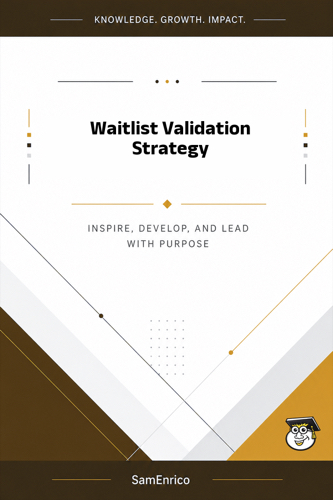
Waitlist Validation Strategy eBook
Builds email list to gauge interest before launch.
by Chalmers Ila
Builds email list to gauge interest before launch.
Formats
Free sample
Chapter 1: The $100,000 Mistake--–- The author opens with a visceral story of launching a $15,000 course to zero buyers, then reveals the "Build It and They Will Come" fallacy that traps most creators. She introduces the Waitlist First flywheel, the Idea Debt concept (risk paid down per sign-up), and the true value of 500 engaged subscribers over 10,000 passive followers. The chapter ends with a self-assessment quiz and a foreshadowing of the 1,000 True Fans math to come in Chapter 12.The Funeral That Changed Everything The conference room smelled like stale coffee and regret.I had just spent twelve months of my life—twelve months of 4:00 a.m. wake-ups, twelve months of skipping birthdays and anniversaries, twelve months of telling my children "Mommy is almost done"—building a $15,000 online course. I had hired a professional videographer.
I had commissioned custom animations. I had written forty-seven modules, each one more detailed than the last. I had poured $8,000 of my own savings into editing, hosting, and marketing materials.And on launch day, exactly three people bought it.One was my mother. One was my best friend, who texted me "I don't even understand what this course is about, but I love you." The third was a stranger who refunded within forty-eight hours.I sat in that conference room, alone, staring at my analytics dashboard. The number on the screen—$197 in revenue, $147 of which came from people who knew my shoe size—felt like a tombstone.
I had buried a year of my life. I had buried my savings. And worst of all, I had buried the quiet confidence I once had that I knew what I was doing.That was eight years ago. Since then, I have launched seven books, four courses, and a membership community. Every single one of those launches has been profitable.
Three of them hit #1 in their category on Amazon. Two of them generated over six figures in pre-orders alone.What changed? I stopped building before I had permission.This book is the manual I wish I had on that terrible Tuesday morning. It is not a theory. It is not a collection of inspirational quotes.
It is a step-by-step, system-by-system, email-by-email framework for doing the opposite of what I did: building your audience before you build your product.Let me show you how.The Graveyard of Great Ideas Every week, I receive emails from creators who made the same mistake I did. The details change, but the shape of the story is always the same:"I spent eighteen months writing a book. I hired an editor. I paid for a cover designer. I formatted the interior.
I uploaded it to Amazon. And then… nothing. I sold forty-seven copies. Most of them to my family. What did I do wrong?"Here is what you did wrong.
And I say this with love, because I did it too.You committed the "Build It and They Will Come" fallacy. You assumed that because your idea was brilliant, because you worked hard, because you poured your heart into it, the universe owed you an audience. You treated production as the first step instead of the last step. You built in secret, launched in silence, and then blamed the algorithm, the market, or your own inadequacy.But the algorithm was never the problem. The market was never the enemy.
The problem was that you never asked anyone if they wanted what you were building before you built it.Let me be brutally clear: Your mother's opinion does not count. Your best friend's encouragement does not count. Your own certainty—no matter how passionate—does not count.The only opinion that matters is the opinion of strangers who give you their email address and say, "Yes, I want what you are creating. I will wait for it."This is the central truth of the Waitlist Validation Strategy: Interest precedes inventory. Always.The "Build It and They Will Come" Lie Where did this lie come from?
We can trace it to three cultural myths that have poisoned the creative class for decades.Myth #1: The Overnight Success Story We love stories about creators who toiled in obscurity and then, magically, their work "found" an audience. The problem is that these stories almost always leave out the crucial detail: the creator was building an audience the entire time. They were sending newsletters. They were building waitlists. They were validating before they produced.
The "overnight" part was the product launch. The "ten years" part was the audience-building.Myth #2: "If You Build It, They Will Come" (The Field of Dreams Fallacy)A movie quote from 1989 has cost creators billions of dollars. In the film, a magical voice tells an Iowa farmer to build a baseball field in his cornfield, and ghosts of dead baseball players appear. This is not a business plan. In the real world, you can build the most beautiful field in existence, and if no one knows about it, the only thing that will appear is weeds.Myth #3: The "Real Creators Don't Do Marketing" Trap There is a seductive belief that if your work is good enough, it will "go viral" on its own.
This is magical thinking. Marketing is not a tax you pay for having a mediocre product. Marketing is how you find the people who need what you have. A waitlist is not spam. It is a service.
You are saying to a stranger, "I have something that might solve a problem you have. If you agree, I will keep you updated." That is not manipulation. That is respect.These three myths have created a generation of creators who build first and ask for permission later. They are not lazy. They are not untalented.
They are simply following a script that was written for a world that no longer exists.In the world that does exist, attention is scarce, trust is expensive, and the cost of building something nobody wants has never been higher. The average self-published author sells fewer than 250 copies. The average online course creator makes less than $3,000 in total revenue. The average crowdfunding campaign fails to reach its goal.Why? Because they built in silence.The Waitlist First Flywheel The antidote to the "Build It and They Will Come" trap is a simple, four-stage framework that reverses the traditional order of creation.
I call it the Waitlist First Flywheel.Here is the traditional order (the one that leads to funerals in conference rooms):Idea → Production → Launch → (Silence) → Despair Here is the Waitlist First order:Interest → Validation → Production → Launch Let me break down each stage:Stage 1: Interest Before you write a single word of your book, before you record a single video for your course, you build a landing page. This page does one thing: it invites strangers to join a waitlist. That is it. No sales. No complicated funnels.
Just a headline, a sub-headline, three bullet points, an email field, and a button that says "Join the Waitlist."You then drive traffic to this page using the strategies in Chapter 5: social media, partnerships, list swaps, and (eventually) paid ads. Every person who joins is not just an email address. They are a vote. They are saying, "I am interested enough in your idea…
This is the end of the free sample. Get the eBook to keep going. Buy now
About this book
Details
- Author
- Chalmers Ila
- Publisher
- SamEnrico
- Language
- English
- Genre
- Non-Fiction, Business Brief, List Building
- Released
- 2026-06-09
- Pages (approx.)
- 150
- Available as
- eBook, Audiobook

Read better in the ZLOADR app
Your eBooks on your phone or tablet. Sign in with your SamEnrico account and start reading.
More by Chalmers Ila
 Offensive Innovation PlaybookChalmers Ila$11.99
 Student Perfectionist RecoveryChalmers Ila$11.99
 Thunberg Family InfluenceChalmers Ila$11.99
 Habit Podcasts GuideChalmers Ila$11.99
 Affirmations for Relationship SecurityChalmers Ila$11.99
 Group Creative Warm Up DeckChalmers Ila$11.99
 Robert La FolletteChalmers Ila$11.99
 Freelancer Feast Famine CycleChalmers Ila$11.99
 Echoes of the Iron Curtain: The Secret Life of Radio LibertyChalmers Ila$11.99
 The Last Guardian: The Secret Rituals of the Vatican’s ExorcistsChalmers Ila$11.99
 The Pearl Divers of Bahrain: Pioneers of the Deep (1600s-1700s)Chalmers Ila$11.99
 The Dancer's Guide to Para ParaChalmers Ila$11.99