
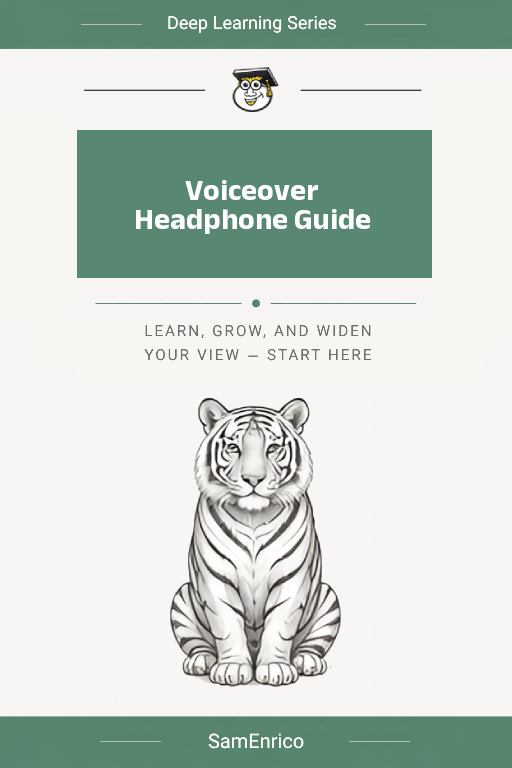
Non-FictionSide Hustle ArchitectHeadphonesMonitoring
Voiceover Headphone Guide
Choose closed back headphones for explainer voiceo
by Hardin Rocio
Choose closed back headphones for explainer voiceover monitoring and recording.
Formats
About this book
Free sample
Chapter 1: The Bleed Test...–- Every voice actor remembers the moment they first heard it: the quiet, insidious warbling of a click track bleeding into a pristine vocal take. You’ve delivered a perfect narration—crisp consonants, natural pacing, the ideal explainer tone—only to play back the recording and discover a ghostly, time-shifted version of your headphone mix haunting the background. That watery, phasey artifact is bleed, and it is the single most common reason otherwise usable voiceover takes are discarded in post-production. For the explainer voiceover artist working in e-learning, medical narration, or corporate training, bleed is not merely an annoyance; it is a career-limiting flaw that signals amateurism to discerning clients. This chapter introduces the Bleed Test, a diagnostic framework that will fundamentally change how you think about headphone selection.
More importantly, it establishes why closed-back headphones are not just a preference but a technical necessity for anyone serious about delivering broadcast-quality explainer audio.Before we can understand why closed-back headphones dominate professional voiceover booths, we must first understand the acoustic physics that make bleed inevitable with open-back designs. The human voice, when recorded through a sensitive condenser microphone, typically registers between -18d B and -6d B at the preamp stage, depending on the talent’s projection and microphone placement. Your headphone monitoring level, conversely, sits somewhere between 75d B and 85d B SPL at the earcup, loud enough to hear yourself clearly over any ambient room tone but quiet enough to avoid hearing damage over long sessions. That difference in absolute loudness is not what matters. What matters is proximity: the microphone capsule sits six to twelve inches from your mouth, while your headphones rest directly against your ears.
That physical closeness means even modest headphone output can couple directly into the microphone’s diaphragm, especially when the headphones lack an acoustic seal.Open-back headphones, beloved by music producers for their wide, airy soundstage and natural timbre, are by design perforated. The grille on the back of each earcup allows air to move freely, preventing pressure buildup and reducing driver resonance. That same perforation, however, means…
This is the end of the free sample. Get the eBook to keep going. Buy now
Contents
- Chapter 1
- Chapter 2
- Chapter 3
- Chapter 4
- Chapter 5
- Chapter 6
- Chapter 7
- Chapter 8
- Chapter 9
- Chapter 10
- Chapter 11
- Chapter 12
Details
- Author
- Hardin Rocio
- Publisher
- SamEnrico
- Language
- English
- Genre
- Non-Fiction, Side Hustle Architect, Headphones, Monitoring
- Released
- 2026-06-01
- Pages (approx.)
- 124
- Available as
- eBook, Audiobook

Read better in the ZLOADR app
Your eBooks on your phone or tablet. Sign in with your SamEnrico account and start reading.
More by Hardin Rocio
 Relationship Building by EmailHardin Rocio$11.99
 Med Student Stress ManagementHardin Rocio$11.99
 Binge Eating Shame Resilience WorkbookHardin Rocio$11.99
 Caregiver Time ManagementHardin Rocio$11.99
 TENS Unit for Menstrual PainHardin Rocio$11.99
 The Golden Key: Ahmed Zewail and the Birth of FemtochemistryHardin Rocio$11.99
 The Last Dance of the FirewalkersHardin Rocio$11.99
 Director of Customer ExperienceHardin Rocio$11.99
 Breach Notification ChecklistHardin Rocio$12.99
 How to Become a Automobile UpholstererHardin Rocio$11.99
 Understanding Ectodermic Dysplasia Anhidrotic Cleft LipHardin Rocio$17.99
You may also like
 Hong Kong Handover 1997Dunn Johnnie$11.99
 Zumba For Postnatal Recovery CourseNeal Christian$11.99
 Zumba for BeginnersLadner Nikia$11.99
 YouTube Comment Mining GuideHumes Pandora$12.99
 Worry Box MeditationCarlin Rudy$11.99
 Workplace Stress MeditationNguyen Lynn$11.99
 Workplace Stress and Sleep RepairHawley Ivory$11.99
 Workplace Perfectionism CureDelaney Jeffry$11.99
 Workplace Injustice Anger GuideWallen Isabelle$11.99
 Work Addiction and Burnout LinkGreenwood Ester$11.99
 Women in Yoga and WellnessBeattie Galina$11.99
 Women in Stand Up ComedyChun Evangeline$11.99