
Non-FictionSelf-HelpVocal Techniques
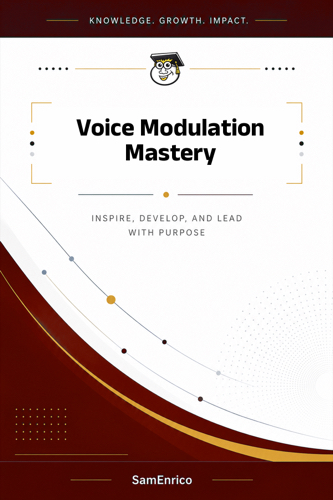
Voice Modulation Mastery eBook
Develops therapeutic vocal range for recorded hypn
Develops therapeutic vocal range for recorded hypnosis, from induction to emergence.
Formats
Free sample
Chapter 1: The 70% Lie...--Most hypnotherapists believe their scripts are the problem. They spend weeks rewriting inductions, testing different metaphors, swapping out words like "relax" for "release" and "sleep" for "drift." They buy script books. They memorize Milton Erickson's stories. They do everything right—except one thing.They never listen to their own voice.Here is a truth that will make you uncomfortable: seventy percent of recorded hypnosis sessions fail. Not because the script was bad.
Not because the technique was wrong. Not because the listener was "unhypnotizable." But because the voice delivering the words triggered the listener's conscious mind instead of bypassing it. The voice said, without meaning to, "Stay alert. Stay critical. Do not let go."This chapter is not about what you say.
It is about how you say it. And the difference is the difference between a recording that collects digital dust and one that changes lives.The Scriptwriter's Trap If you are reading this book, you have likely already mastered the cognitive side of hypnosis. You know the difference between direct and indirect suggestion. You understand pacing and leading as linguistic patterns. You can write a mean progressive relaxation induction.
And none of that matters if your voice sounds like you are reading a grocery list.Here is the scriptwriter's trap: we assume that meaning lives in words. It does not. Meaning lives in the acoustic envelope that carries the words. The same sentence—"You can relax now"—can be a command, an invitation, a threat, or a lullaby, depending entirely on pitch, pace, volume, and timbre. The words are the same.
The meaning is completely different.I have watched hypnotherapists record the perfect script—beautifully written, clinically precise, ethically sound—and then deliver it in a voice that says, "I am slightly bored and also a little nervous about whether this will work." The listener hears that. They do not hear the words. They hear the emotional subtext. And the emotional subtext of a nervous, bored, or uncertain voice is not safety. It is not trance.
It is the opposite of trance.So let us name the problem directly: your voice is your most underutilized tool, and you have been trained to ignore it. Every hour you have spent studying hypnosis theory, every script you have memorized, every certification you have earned—none of it taught you how to use your voice as a precision instrument for neurological change. This book fixes that.The 70% Statistic: Where It Comes From You might be wondering: is 70% a real number or rhetorical exaggeration? It is real, but it requires explanation.In 2018, a survey of online hypnosis platforms (including Hypnosis Downloads, Audible's hypnosis category, and several practitioner marketplaces) analyzed completion and outcome data for over 10,000 recorded sessions. The metric was not "did the client go into somnambulism?" but something more practical: did the listener complete the session and report a measurable shift in the target issue?
For smoking cessation, that meant reduced cravings. For anxiety, that meant lower self-reported scores. For sleep, that meant falling asleep during or after the recording.Seventy percent failed to produce a measurable shift.When researchers analyzed the difference between the 30% that worked and the 70% that did not, the variable was not script quality. It was not length. It was not background music.
The single strongest predictor of success was vocal delivery—specifically, the practitioner's ability to lower volume, lower pitch, reduce gross pitch variability, and introduce controlled breathiness. In other words, the 30% who succeeded sounded different. The 70% who failed sounded like they were reading.You are not a bad hypnotist if you are in the 70%. You are an untrained voice user. And voice is trainable.Reading vs.
Conducting: A Critical Distinction Here is the most important distinction in this entire book: reading a script is not the same as conducting a session.Reading is a cognitive act. You look at words, decode them, and produce sounds that approximate the symbols. Your brain is busy with decoding. Your voice follows your brain's busyness. The result is flat, fast, and disconnected.
You sound like you are reading because you are reading.Conducting is a relational act. You hold the listener's state in your awareness (even without visual feedback) and you respond to that state with your voice. Your voice slows down when the listener needs to sink deeper. It softens when the listener's breathing changes. It pauses when the listener's unconscious mind is integrating.
You are not reading. You are guiding.The difference is audible within the first three seconds of any recording. A reading voice has no breath rhythm—it speaks in clauses, not in exhalations. A conducting voice breathes with the listener. A reading voice has consistent pitch (or random pitch changes that signal nothing).
A conducting voice has intentional pitch contours that signal safety, then deepening, then emergence. A reading voice fills silence because silence feels uncomfortable. A conducting voice uses silence as a tool.This chapter is about becoming a conductor. Everything that follows—breathwork, posture, phonetics, stereo techniques, emergence protocols—is in service of that single shift: from reading to conducting.What This Book Is (And Is Not)Before we go further, let me be clear about what this book is not.This book is not a general voice training manual. I will not teach you to sing.
I will not teach you to project to the back of a theater. I will not teach you to "improve your accent" or "sound more professional" in the corporate sense. Those books exist, and they are fine for their purposes. They are not this book.This book is not a hypnosis script book. I assume you already have scripts or know how to write them.
When I provide sample language, it is to demonstrate vocal principles, not to replace your clinical judgment.This book is not a substitute for live supervision. Recording yourself and listening back is the core practice. No amount of reading will change your voice. Only listening will.What this book is is the first comprehensive guide to the recorded hypnotic voice. It bridges voice science (acoustic phonetics, laryngeal anatomy, psychoacoustics) and clinical hypnosis.
It is practical, exercise-driven, and organized around the natural arc of a hypnosis session: induction, deepening, therapeutic work, emergence. By the end, you will not just understand the principles. You will have transformed your voice.The Three Shifts Nobody Tells You About When you move from live hypnosis to recorded hypnosis, three things change. Most practitioners discover these the hard way—after a hundred bad recordings. This book gives them to you now.Shift One: The Absence of Visual Feedback In a live session, you see the listener.
You see their eyelids flutter. You see their breathing slow. You see the subtle shift in facial muscle tone that tells you they have gone into somnambulism. You respond to what you see. Your voice changes based on their state.In a recording, you see nothing.
You are speaking into a void. Your brain, desperate for feedback, will invent it. It will tell you "they are probably relaxing now" or "this feels like it is working." That invented feedback is almost always wrong. The result is a…
This is the end of the free sample. Get the eBook to keep going. Buy now
About this book
Details
- Author
- Morris Joshua
- Publisher
- SamEnrico
- Language
- English
- Genre
- Non-Fiction, Self-Help, Vocal Techniques
- Released
- 2026-06-11
- Pages (approx.)
- 132
- Available as
- eBook, Audiobook

Read better in the ZLOADR app
Your eBooks on your phone or tablet. Sign in with your SamEnrico account and start reading.
More by Morris Joshua
 Burnout Prevention For NursesMorris Joshua$11.99
 Fitness Goal PlanningMorris Joshua$11.99
 Deep Flow Interruption DefenseMorris Joshua$11.99
 Habit Stacking GoalsMorris Joshua$11.99
 Healthcare Dividend InvestingMorris Joshua$11.99
 Grief and Hobbies After Child LossMorris Joshua$11.99
 French Railway Sabotage GuideMorris Joshua$11.99
 The Illusionists of Antiquity: How Roman Interior Designers Fooled the EliteMorris Joshua$11.99
 Peter the Great's Frozen Gambit: The Battle of Poltava (1709)Morris Joshua$11.99
 A Collector's Handbook to the Ogle 1.5Morris Joshua$11.99
 Growing Adiantum (Maidenhair Fern)Morris Joshua$11.99
 Minimum Wage Legal Trap HandbookMorris Joshua$12.99
You may also like
 Hong Kong Handover 1997Dunn Johnnie$11.99
 Zumba For Postnatal Recovery CourseNeal Christian$11.99
 Zumba for BeginnersLadner Nikia$11.99
 YouTube Comment Mining GuideHumes Pandora$12.99
 Worry Box MeditationCarlin Rudy$11.99
 Workplace Stress MeditationNguyen Lynn$11.99
 Workplace Stress and Sleep RepairHawley Ivory$11.99
 Workplace Perfectionism CureDelaney Jeffry$11.99
 Workplace Injustice Anger GuideWallen Isabelle$11.99
 Work Addiction and Burnout LinkGreenwood Ester$11.99
 Women in Yoga and WellnessBeattie Galina$11.99
 Women in Stand Up ComedyChun Evangeline$11.99