
Non-FictionSelf-HelpVisualization
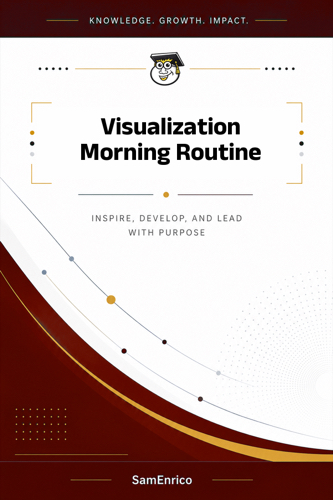
Visualization Morning Routine eBook
See your success like Olympic athletes with this p
See your success like Olympic athletes with this practical mental rehearsal workbook.
Formats
Free sample
Chapter 1: The Goggles That Never Leaked...--–- The swimmer couldn’t see. Fifty meters into the 2008 Olympic 200-meter butterfly final, Michael Phelps’s goggles had filled with water. Not a drop—completely flooded. Every practiced breath, every turn, every finish depended on visual cues he no longer had. Most swimmers, even elite ones, would have panicked.
They would have slowed, blinked furiously, maybe even stopped to clear the lenses. Phelps didn’t. He swam blind, counting strokes, feeling the wall approach, and touched first—not just winning the gold but breaking the world record. Later, when reporters asked how he managed, he gave an answer that should have been strange but wasn’t: “I’ve done that race in my mind a thousand times. Goggles filling up, suit ripping, lane ropes breaking.
I’ve rehearsed every disaster.”That single sentence separates Olympic-level performers from everyone else. Phelps didn’t hope to succeed. He didn’t just work hard. He mentally rehearsed his success—and every possible obstacle—before his body ever touched the water. And he did it not once, not occasionally, but nightly, for years, as systematically as his physical training.This book is about doing exactly that for your life, but with one crucial difference: you will do it in the morning, when your brain is most receptive, and you will do it using a four-layer method distilled from sports psychology, neuroscience, and the daily routines of the world’s highest achievers.
This is not positive thinking. It is not vision boards or wishful daydreaming. It is mental rehearsal: deliberate, structured, and evidence-based.Before we dive into how to do it, we need to understand why it works. Why does imagining something make it more likely to happen? Why does the brain treat a vividly rehearsed event almost identically to a real one?
And why have Olympic athletes, concert pianists, fighter pilots, and brain surgeons quietly used this technique for decades while the rest of us stumbled through our days on autopilot?The Night That Changed Sports Psychology Bob Bowman, Michael Phelps’s coach, didn’t invent visualization. But he perfected its application. Every night before sleep, Phelps would lie in bed and run a mental video of the perfect race. He didn’t just see himself swimming. He heard the starting beep, felt the water temperature, tasted the chlorine, sensed the lactic acid building in his shoulders, and saw the lane lines blurring past.
Bowman called it “the videotape.” And he made Phelps create not just the perfect version but a library of disaster versions: goggles filling, suit tearing, a competitor pulling ahead, a false start, a cramp in the final meters.When the goggles actually failed in Beijing, Phelps didn’t need to think. His nervous system had already rehearsed the response thousands of times. He counted strokes—seventeen to the wall, he had decided years earlier—and executed.This is not a story about exceptional talent. It is a story about preparation that most people never consider. Physical training prepares your muscles.
Mental rehearsal prepares your nervous system, your decision-making, and your emotional responses. Without the latter, the former is incomplete.But here’s what most books get wrong. They tell you to visualize your success—see the promotion, feel the trophy, imagine the applause. That’s outcome visualization, and it’s only one third of the picture. Olympic athletes use three distinct types of mental rehearsal, and skipping any two makes the third almost useless.The Three Types of Visualization (And Why Most People Only Use One)Let’s define terms clearly.
Visualization, in the context of performance science, means deliberately generating sensory-rich mental experiences of a future event with the intention of improving real-world execution. It is not daydreaming. It is not wishful thinking. It is practice—just without the physical movement.Researchers and elite coaches distinguish three forms:Outcome visualization is seeing the result. The gold medal around your neck.
The signed contract on the table. The audience standing. This is what most self-help books teach, and it’s the least useful on its own. Outcome alone gives you a destination but no map.Process visualization is seeing the actions. The stroke, the breath, the turn.
The words you will say in the meeting. The way you will hold your fork during a difficult conversation. Process visualization is where 80% of an Olympian’s mental rehearsal time goes.Emotional visualization is feeling the internal state you want to inhabit. The calm before the start. The focus during the critical moment.
The relief and quiet satisfaction after success—not the giddy celebration, but the earned rest.Here is the critical insight that changed how I practice visualization and will change how you use this book: Outcome visualization without process creates entitlement. Process visualization without outcome creates directionless effort. Emotional visualization without the other two creates a pleasant feeling with no performance improvement.All three must work together. In this book, you will learn a four-layer method that integrates these three types into a single 12-minute morning routine. But before we get to the how, we need to understand the why—specifically, what happens inside your brain when you visualize.Mirror Neurons: The Brain’s Rehearsal Hall In the 1990s, a team of Italian neuroscientists led by Giacomo Rizzolatti made a discovery that would revolutionize our understanding of learning and imitation.
They were studying macaque monkeys, recording individual neurons in the premotor cortex—the part of the brain that plans movements. They noticed something strange. A particular neuron would fire when a monkey reached for a peanut. That made sense. But the same neuron also fired when the monkey watched another monkey—or a human—reach for a peanut.
The neuron didn’t care who was moving. It cared about the action.They called these mirror neurons.Later research using f MRI on humans showed that mirror neurons fire not only when we perform an action or watch someone else perform it but also when we vividly imagine performing it. The brain does not distinguish perfectly between seeing, doing, and imagining. It treats a well-rehearsed mental image as a low-grade version of actual experience.This has profound implications. If you vividly imagine yourself giving a calm, confident presentation, your brain strengthens the same neural pathways that would activate during the real presentation.
When you later stand in front of the room, those pathways are already primed. You are not starting from zero. You have rehearsed.But mirror neurons alone don’t explain why visualization changes what we notice in the world. For that, we need to talk about your brain’s gatekeeper.The Reticular Activating System: Your Brain’s Bouncer Every second, your senses are bombarded with roughly eleven million bits of information. Your conscious mind can process only about forty to fifty bits per second.
Something has to filter out the 99.999 percent of reality that you don’t need to notice right now. That something is the reticular activating system (RAS).The RAS is a bundle of neurons at the base of your brainstem. Its job is simple: decide what matters. It pays attention to three categories of information:Threats (anything that might harm you)Rewards…
This is the end of the free sample. Get the eBook to keep going. Buy now
About this book
Details
- Author
- Esquivel Samella
- Publisher
- SamEnrico
- Language
- English
- Genre
- Non-Fiction, Self-Help, Visualization
- Released
- 2026-06-09
- Pages (approx.)
- 140
- Available as
- eBook, Audiobook

Read better in the ZLOADR app
Your eBooks on your phone or tablet. Sign in with your SamEnrico account and start reading.
More by Esquivel Samella
 Hungryroot AI NutritionEsquivel Samella$11.99
 Digital Freight Growth ProjectionEsquivel Samella$11.99
 The Arthritis Car Modification GuideEsquivel Samella$11.99
 The Loot Box and Gacha AddictionEsquivel Samella$11.99
 The Phantom Composer: How a Forgotten Maestro Scored the Soul of Latin American CinemaEsquivel Samella$11.99
 How to Become a Levers-lace Machine OperatorEsquivel Samella$11.99
 Global Rate Impact on SMBsEsquivel Samella$12.99
 B2B Sales Oman Market GuideEsquivel Samella$12.99
 Understanding Sialuria, French TypeEsquivel Samella$17.99
 Spectropolarimetry TechnicianEsquivel Samella$11.99
You may also like
 Hong Kong Handover 1997Dunn Johnnie$11.99
 Zumba For Postnatal Recovery CourseNeal Christian$11.99
 Zumba for BeginnersLadner Nikia$11.99
 YouTube Comment Mining GuideHumes Pandora$12.99
 Worry Box MeditationCarlin Rudy$11.99
 Workplace Stress MeditationNguyen Lynn$11.99
 Workplace Stress and Sleep RepairHawley Ivory$11.99
 Workplace Perfectionism CureDelaney Jeffry$11.99
 Workplace Injustice Anger GuideWallen Isabelle$11.99
 Work Addiction and Burnout LinkGreenwood Ester$11.99
 Women in Yoga and WellnessBeattie Galina$11.99
 Women in Stand Up ComedyChun Evangeline$11.99