
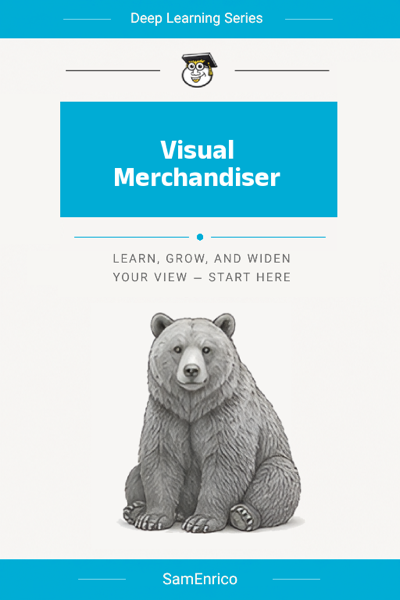
Non-FictionInformativeEducational
Visual Merchandiser eBook
A Coursebook on Visual Merchandiser
A Coursebook on Visual Merchandiser
Formats
Free sample
Chapter 1: The Silent Sell--–- The man in the charcoal gray overcoat had walked past the same storefront every Tuesday for three years. He never went in. He barely looked. But on the fourth Tuesday of December, something changed. The window display had been completely transformed overnight—a single mannequin in a crimson coat, backlit by a warm amber glow, surrounded by nothing but falling artificial snow and one handwritten sign that read: “Some gifts are worth stopping for.” He stopped.
He stepped closer. He entered the store. He bought the coat for his wife. That man was not a statistical anomaly; he was a predictable outcome of a discipline most retailers misunderstand. Visual merchandising is not decoration.
It is a silent sales force.This chapter establishes the fundamental reason for visual merchandising’s existence in an age where more than half of all retail transactions begin online. If a customer can buy anything from a phone, why should a physical store matter? The answer lies not in convenience—online wins that battle—but in emotion, memory, and the irreducible power of a moment. The physical store is the only channel where a brand can control every variable: light, texture, sound, smell, temperature, and the silent narrative of objects arranged with intention. This chapter traces the evolution of retail displays from ancient open-air markets to the Instagram-driven “window-shopping” of today.
It introduces the core psychological models that explain why some displays stop traffic while others become invisible. And it resolves the first major question any visual merchandiser faces: should your displays be digital, analog, or a hybrid of both? By the end of this chapter, you will understand not just what visual merchandising is, but why it works—and you will have a framework to decide which type of display is right for your brand, your customer, and your budget.The Evolution of Retail Displays: From Pile to Performance Before the nineteenth century, “visual merchandising” did not exist as a conscious discipline. Merchants piled goods as high as possible—more product meant more choice, which meant more sales. The window was a storage unit, not a stage.
That changed in 1909 when Harry Gordon Selfridge opened his department store on London’s Oxford Street. Selfridge did something revolutionary: he removed the storage from the windows and replaced it with theater. His windows told stories. One window featured a mannequin reading a book in a library setting, selling not just the dress but the fantasy of a sophisticated life. Another window showed a complete dining table set for twelve, selling not just china but the aspiration of hospitality.
Selfridge understood something his competitors missed: customers do not buy products; they buy better versions of themselves.The twentieth century refined Selfridge’s insight. Department stores in New York, Paris, and Tokyo hired full-time window dressers who became celebrities in their own right. The 1950s introduced the concept of “lifestyle merchandising”—grouping products not by category (shirts with shirts, pants with pants) but by how a real person would use them (an outfit for a picnic, an outfit for a job interview). The 1980s brought the mall, which demanded displays visible from fifty feet away, designed for the “walk-by glance.” The 1990s introduced the first digital displays—video screens embedded in windows, playing loops of runway shows or product demonstrations.The twenty-first century has been defined by a paradox. Online shopping decimated physical retail foot traffic, yet the stores that survived—and thrived—invested more in visual merchandising than ever before.
Why? Because the physical store is no longer primarily a distribution center. It is a brand embassy. A customer visiting a Nike flagship store is not there to buy sneakers; they could do that online. They are there to experience Nike—to walk through a space that smells like new rubber, sounds like a stadium, and shows them what it feels like to be an athlete.
Visual merchandising has shifted from “showing the product” to “selling the feeling.” This chapter will teach you how to sell feelings, not just sweaters.The Psychology of Stopping Power: S.R.P. and AIDAEvery display has approximately three seconds to capture attention. In a shopping mall, the average pedestrian walks at three miles per hour, which means they cover four feet per second. A ten-foot window gives them less than three seconds of viewing time before they have passed. In that time, their brain must decide: look away or lean in.
The difference between those two outcomes is determined by psychological triggers that have been studied for more than a century.The most practical model for visual merchandising is the S.R.P. Theory, developed from consumer behavior research and refined by practitioners including Pegler and Kong. S.R.P. stands for Sight, Retention, and Purchase. Sight is the initial capture of attention—the moment when the pedestrian’s peripheral vision registers something unusual, unexpected, or emotionally salient.
Retention is the cognitive and emotional engagement that follows—the moment when the pedestrian stops walking, tilts their head, and begins to process details. Purchase is the final transaction—not necessarily immediate, but the planting of a memory that will activate when the customer crosses the threshold.A complementary model is AIDA: Attention, Interest, Desire, Action. AIDA originated in advertising but applies perfectly to VM. The display must first grab Attention (Sight, in S.R.P.). Then it must sustain Interest by providing details that reward closer inspection (Retention).
Then it must create Desire by showing the product in a context that implies a better life (the fantasy). Finally, it must prompt Action—walking into the store, picking up the product, trying it on, or ultimately buying.The case study that best illustrates both models is the contrast between Selfridges’ theatrical windows and Apple’s minimalistic product windows. Selfridges uses high spectacle—multiple mannequins, complex narratives, elaborate props, theatrical lighting. This approach maximizes Attention and Interest but risks overwhelming the product. Apple uses the opposite approach: a single product on a white table, under perfect light, with no props, no narrative, no distraction.
This approach works because the product itself is the digital experience. An i Phone or Mac Book is already a portal to infinite content; adding props would be redundant. For most retailers—who do not sell devices that contain universes—theatrical windows are more effective. But the decision requires the framework introduced below.Silent Selling vs. Invisible Tools: A Critical Distinction Before proceeding, we must clarify two terms that are often confused.
Silent Selling, drawn from the foundational work of Bell and Ternus, refers to the idea that a well-designed display replaces the need for a pushy salesperson. The display persuades without words. It answers the customer’s unspoken questions: “Will this look good on me?” (the mannequin shows me). “Is this worth the price?” (the lighting and materials signal value). “Does this fit my lifestyle?” (the props show me using it).
Silent Selling is the display acting as a salesperson.Invisible tools are different. They are environmental factors that the customer does not consciously notice but that affect their mood, comfort, and purchase likelihood. These include ambient lighting, background music, store temperature, flooring texture, ceiling height…
This is the end of the free sample. Get the eBook to keep going. Buy now
About this book
Details
- Author
- Hooks Lashawn
- Publisher
- SamEnrico
- Language
- English
- Genre
- Non-Fiction, Informative, Educational
- Released
- 2026-06-02
- Pages (approx.)
- 157
- Available as
- eBook, Audiobook

Read better in the ZLOADR app
Your eBooks on your phone or tablet. Sign in with your SamEnrico account and start reading.
More by Hooks Lashawn
 Mindful Driving MBSR CourseHooks Lashawn$11.99
 Teens and Self WorthHooks Lashawn$11.99
 Ayurvedic Fasting GuideHooks Lashawn$11.99
 The Russian Tech Brain Drain ReportHooks Lashawn$11.99
 Teen Self Esteem and Sexual HealthHooks Lashawn$11.99
 The Clockmaker’s Secret: How a 19th-Century Watchmaker Outsmarted Time ItselfHooks Lashawn$11.99
 Escalation Management GuideHooks Lashawn$12.99
 Brazil Dropshipping Google ShoppingHooks Lashawn$12.99
 Understanding Microcephaly AHooks Lashawn$17.99
 How to Start a Hobby in Piano / KeyboardHooks Lashawn$11.99
You may also like
 Hong Kong Handover 1997Dunn Johnnie$11.99
 Zumba For Postnatal Recovery CourseNeal Christian$11.99
 Zumba for BeginnersLadner Nikia$11.99
 YouTube Comment Mining GuideHumes Pandora$12.99
 Worry Box MeditationCarlin Rudy$11.99
 Workplace Stress MeditationNguyen Lynn$11.99
 Workplace Stress and Sleep RepairHawley Ivory$11.99
 Workplace Perfectionism CureDelaney Jeffry$11.99
 Workplace Injustice Anger GuideWallen Isabelle$11.99
 Work Addiction and Burnout LinkGreenwood Ester$11.99
 Women in Yoga and WellnessBeattie Galina$11.99
 Women in Stand Up ComedyChun Evangeline$11.99