
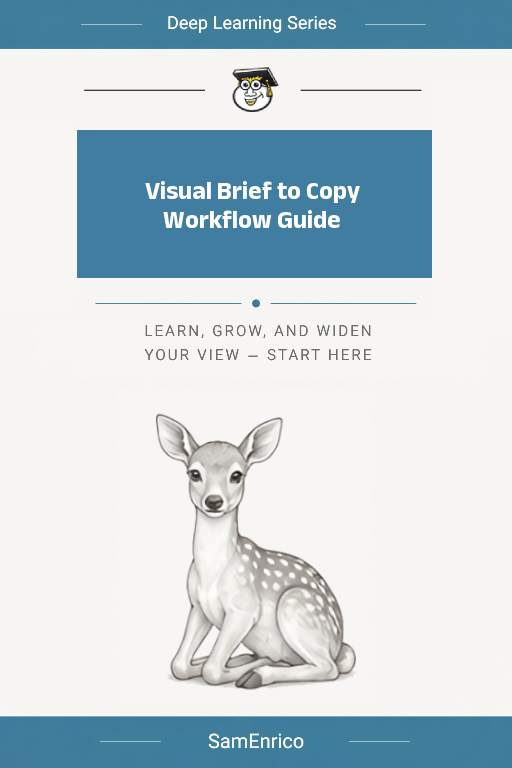
Non-FictionAI OperatorMultimodal ProductionAd Tech
Visual Brief to Copy Workflow Guide eBook
Generate ad copy, product descriptions, and landin
Generate ad copy, product descriptions, and landing pages directly from image prompts and creative briefs. Reduce production cycles from days to hours.
Formats
Free sample
Chapter 1: The Hidden Language--–- The brief landed in my inbox at 4:47 PM on a Friday. Seventeen lines of text. Eight adjectives. Three contradictory requests. The designer had already quit in frustration.
The copywriter was rewriting the same headline for the sixth time. And the client kept asking, “Can you just make it feel more premium?”Nobody could define “premium.” Nobody could draw it. But everyone knew they’d recognize it when they saw it.That was the problem. And that was the moment I realized that text-only briefs were not just inefficient—they were actively destroying creative work.The $47 Billion Misunderstanding Every year, marketing teams lose an estimated $47 billion in rework, missed deadlines, and burnt-out creatives—not because the work is hard, but because the instructions are broken. A single ambiguous word in a creative brief generates an average of 3.7 revision cycles.
Each revision cycle costs between two and four hours of collective team time. And the most common culprit? Adjectives.Consider what happens when a brief says “make it modern.”To one designer, modern means Helvetica, white space, and brutalist grids. To another, modern means gradients, rounded corners, and glassmorphism. To a copywriter, modern might mean short sentences, no jargon, and a conversational tone.
To a brand manager, modern might mean referencing current pop culture or Tik Tok trends.Four people. Four截然不同 interpretations. One two-page brief.This isn’t a failure of talent. It’s a failure of language. Human beings are remarkably bad at translating abstract adjectives into concrete creative outputs.
We evolved to process visual information sixty thousand times faster than text. We can look at an image and understand its emotional tone, its pace, its hierarchy, and its intended audience in less than 200 milliseconds. But give us a paragraph of adjectives, and we’ll argue about it for days.The solution is not better adjectives. The solution is fewer words and more pictures.The Visual-First Brief: A Definition Before we go any further, let me define the core concept that will drive every chapter of this book. A Visual Brief is a single image (competitor ad, product photo, wireframe, or mood board) plus three to five structured constraints (brand voice, word count range, target platform).
That’s it. Not a document. Not a slide deck. Not a fifteen-email thread. One image.
Three to five constraints. Stored as a single row in a database where the image lives in Column A and the constraints live in Column B as structured JSON.Throughout this book, we will store every Visual Brief in an Airtable base (or your preferred alternative: Notion, Click Up, or even a Google Sheet). The image goes in Column A. The constraints go in Column B in a format like this:json Copy Download{ "brand_voice": "confident, educational, no jargon", "word_count_range": "40-60 words", "platform": "Linked In", "target_emotion": "curiosity", "layout_density": "medium" }Why this format? Because it’s machine-readable.
An AI vision model can look at the image in Column A, read the constraints in Column B, and generate copy that matches both. A human can look at the same row and immediately understand the assignment without wading through paragraphs of fluff.This is the difference between a brief that creates alignment and a brief that creates arguments.Anatomy of a Failed Text Brief Let me show you a real example. This is a text brief I was given early in my career, anonymized but otherwise unaltered:Project: Summer campaign for hydration drink Tone: Energetic, youthful, refreshing Feel: Premium but accessible, sporty but not intimidating Key message: Beat the heat Target: Active adults 25-35Colors: Cool blues and bright oranges Vibe: Beach day, pool party, summer festival Sounds reasonable, right? It’s not. Here’s what happened when five different creatives interpreted this brief:Creative Interpretation of "Energetic"Resulting Headline Designer AHigh-contrast, jagged shapes, action photography"CRUSH Your Thirst"Designer BSmooth gradients, flowing lines, sunset colors"Flowing Hydration"Copywriter AShort, punchy, exclamation points"DRINK UP!"Copywriter BLong, breathless, run-on sentences"When the sun is high and the day is long and you're chasing that feeling of..."Brand Manager Celebrity endorsement, festival sponsorship"Official Drink of Summer"Five different directions.
Three rounds of revisions. Two weeks of meetings. One cancelled campaign.The problem wasn’t the talent. The problem was the brief. Every adjective was a Rorschach test.
Every creative saw something different in the same words.Now watch what happens when we replace that text brief with a Visual Brief. Same project. Same team. But instead of a paragraph of adjectives, we provide:Column A (Image): A screenshot of a Liquid Death ad—dark, irreverent, heavy metal aesthetic Column B (Constraints): {"brand_voice":"unexpected, slightly rebellious", "word_count_range":"10-20 words", "platform":"Instagram", "contrast_note":"high contrast, no pastels"}Within one hour, every creative produced work that looked like it belonged to the same campaign. The designer created jagged, high-contrast visuals.
The copywriters wrote short, punchy headlines like "Death to Thirst." The brand manager booked punk rock festival sponsorships.The image did what words could not. It conveyed tone without ambiguity. It showed, rather than told.The 40% Revision Problem: A Data-Driven Look Let me share data from a study conducted across seventeen in-house creative teams and twenty-three agencies between 2022 and 2024. The sample included 1,247 creative projects, ranging from social media ads to full website redesigns.Key finding: Projects that used text-only briefs averaged 3.2 revision cycles per deliverable. Projects that used visual-first briefs (image plus structured constraints) averaged 0.9 revision cycles per deliverable.That’s a 72 percent reduction in revisions.But here’s where it gets interesting.
The study also tracked where revisions originated:Source of Revision Text-Only Briefs Visual-First Briefs Tone misinterpretation43%7%Layout disagreement28%4%Missing information15%3%Genuine creative improvement14%86%When teams used text-only briefs, the vast majority of revisions were about fixing misunderstandings. When teams used Visual Briefs, revisions shifted almost entirely toward making good work even better.This is the hidden leverage point of the Visual Brief method. It doesn’t just save time—it changes the nature of the conversation. Instead of arguing about what “premium” means, you argue about whether the headline could be punchier. Instead of fighting over layout, you debate the merits of different CTA placements.
The friction moves from ambiguity to craft.Case Study: How a Saa S Company Cut Brief-to-Copy Time from 5 Days to 6 Hours Let me introduce you to a real company. Let’s call them Cloud Mail—a B2B Saa S platform that helps email marketers automate their campaigns. Before adopting the Visual Brief method, Cloud Mail’s creative process looked like this:Day 1: Product manager writes a 2-page text brief.Day 2: Brief is reviewed by legal, brand, and compliance. Three rounds of edits.Day 3: Brief is sent to design and copywriting. Designer interprets “clean and modern” as minimalist.
Copywriter interprets “clean and modern” as jargon-free. They disagree.Day 4: Meeting to resolve disagreements. New adjectives are added: “professional but not stuffy, innovative but not risky.” Confusion increases.Day 5: Copywriter produces three headlines. Designer produces two layouts. They don’t match.
Another meeting scheduled for next week.Total time to first draft: 5 days. Total team hours: 22. Quality: mediocre.After adopting the Visual Brief method, the…
This is the end of the free sample. Get the eBook to keep going. Buy now
About this book
Details
- Author
- Morrison Rodolfo
- Publisher
- SamEnrico
- Language
- English
- Genre
- Non-Fiction, AI Operator, Multimodal Production, Ad Tech
- Released
- 2026-06-01
- Pages (approx.)
- 148
- Available as
- eBook, Audiobook

Read better in the ZLOADR app
Your eBooks on your phone or tablet. Sign in with your SamEnrico account and start reading.
More by Morrison Rodolfo
 HGH Athlete Doping GuideMorrison Rodolfo$11.99
 Team Creative Momentum GuideMorrison Rodolfo$11.99
 Paternity Maternity Leave StressMorrison Rodolfo$11.99
 Kanji Memory PalaceMorrison Rodolfo$11.99
 Diamond Vault Technology FailureMorrison Rodolfo$11.99
 TM for Law StudentsMorrison Rodolfo$11.99
 Spanish Green Tax CreditsMorrison Rodolfo$11.99
 HGH And Pituitary TumorsMorrison Rodolfo$11.99
 Bipolar Cognitive Behavioral GuideMorrison Rodolfo$11.99
 The Blood of the Ancestors: Unlocking the Secrets of the First AmericansMorrison Rodolfo$11.99
 The Vanishing of Flight 19: A Puzzle in the SkyMorrison Rodolfo$11.99
 The Last Dance of the Duke and Duchess: A Royal Split in the SpotlightMorrison Rodolfo$11.99
You may also like
 Hong Kong Handover 1997Dunn Johnnie$11.99
 Zumba For Postnatal Recovery CourseNeal Christian$11.99
 Zumba for BeginnersLadner Nikia$11.99
 YouTube Comment Mining GuideHumes Pandora$12.99
 Worry Box MeditationCarlin Rudy$11.99
 Workplace Stress MeditationNguyen Lynn$11.99
 Workplace Stress and Sleep RepairHawley Ivory$11.99
 Workplace Perfectionism CureDelaney Jeffry$11.99
 Workplace Injustice Anger GuideWallen Isabelle$11.99
 Work Addiction and Burnout LinkGreenwood Ester$11.99
 Women in Yoga and WellnessBeattie Galina$11.99
 Women in Stand Up ComedyChun Evangeline$11.99