
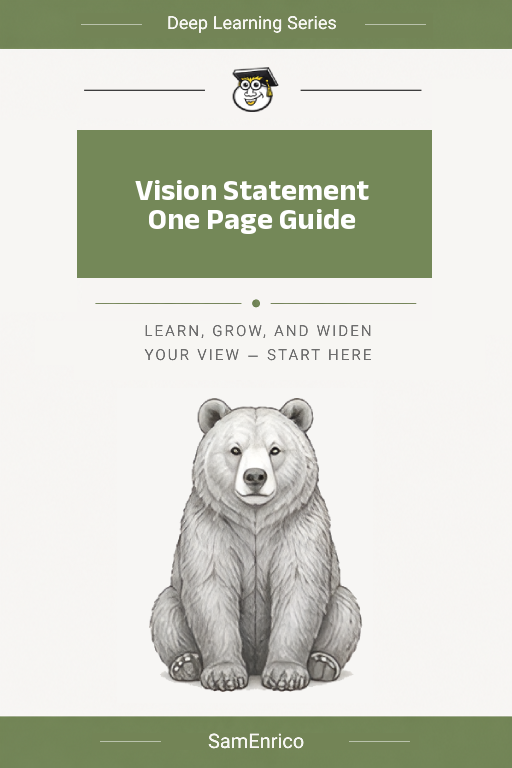
Vision Statement One Page Guide eBook
Describe where your company will be in 5 years usi
Describe where your company will be in 5 years using specific measurable and ambitious language.
Formats
Free sample
Chapter 1: The Five-Year Lie...--Most leaders believe they have a five-year plan. They do not. What they have is a twelve-month budget dressed up in strategic clothing, repeated twelve times with slightly different font sizes. I have sat in over two hundred strategy offsites across four continents, and I have watched otherwise intelligent executives present fifty-seven slide decks titled "Vision 2028" or "Strategic Horizon" or "The Future Starts Now." And I have watched those same executives, six months later, fail to recite a single sentence from those decks without glancing at their notes.This chapter exposes the foundational problem that makes every other chapter necessary: leaders confuse the map for the territory, the document for the direction, and the plan for the purpose. Before you can write a single measurable metric or declare an ambitious goal, you must understand what a vision actually is, what it is not, and why almost every company gets this wrong.
The five-year lie is not that you cannot predict the future. The five-year lie is that you have already done the work of distinguishing where you are going from how you will get there.Let me tell you about Sarah. She was the newly promoted CEO of a mid-sized logistics software company called Relay. When she inherited the role, she also inherited a forty-seven-page document called "Relay 2028: Dominating the Last Mile." The document had been written eighteen months earlier by her predecessor and a consulting firm that charged two hundred thousand dollars for the privilege. It contained mission statements, value propositions, market analyses, competitor grids, and twelve appendices.
It was beautiful. It was also completely useless.Sarah asked her leadership team a simple question at her first all-hands: "Without looking at the document, what is our five-year vision?" She got eight different answers. The head of sales said, "We want to be the number one logistics platform." The head of product said, "We want to build the most innovative tracking solution." The head of customer success said, "We want to have the happiest customers in the industry." The CFO said, "We want to reach fifty million in revenue." None of these answers contradicted each other. But none of them aligned, either. The sales team was pursuing enterprise deals that required custom features the product team had no intention of building.
The product team was building innovative features that customers had not asked for. The customer success team was measuring happiness with a survey that eighty percent of customers ignored. And the CFO was tracking revenue that came from one-time consulting fees the CEO had explicitly said they would phase out.This is not a failure of effort. This is a failure of distinction. Sarah's company had a mission, a strategy, and a set of goals.
What it did not have was a vision. And without a vision, a mission becomes a slogan, a strategy becomes a wishlist, and goals become busywork.The Great Confusion: Vision, Mission, Strategy Let me define three terms with surgical precision. If you remember nothing else from this chapter, remember these definitions. Write them on a sticky note. Tape it to your monitor.Vision is the destination in five years.
It answers the question: Where will we be? It is specific, measurable, ambitious, and time-bound. It describes a future state that is recognizably different from today. A vision is not inspirational wallpaper. It is a contract with the future.Mission is your ongoing purpose.
It answers the question: Why do we exist? It does not change every five years. It is the reason you showed up to work yesterday, today, and five years from now. Your mission is your North Star; your vision is the specific port you are sailing toward.Strategy is the path. It answers the question: How will we get there?
Strategy changes. It adapts to competition, market conditions, new technology, and lessons learned. A good strategy is flexible. A good vision is not.Here is where most companies go wrong. They write a mission statement that tries to do the job of a vision ("We will be the world's leading provider of customer-centric solutions by 2028").
They write a vision statement that is actually a strategy ("We will expand into three new markets, launch two new products, and increase our sales headcount by fifty percent"). Or they write something that is none of the above—a vague paragraph of aspirational nonsense that sounds good at a company retreat and means nothing on a Tuesday morning.Let me give you concrete examples of each, drawn from real companies (anonymized to protect the embarrassed).Bad Vision Statement (actually a mission): "Our vision is to make the world a better place through innovative technology that empowers people and connects communities."This is not a vision. This is a mission dressed up in corporate drag. It answers why the company exists (to make the world better) but says nothing about where the company will be in five years. You cannot measure it, you cannot test it, and you cannot hold anyone accountable to it.Bad Vision Statement (actually a strategy): "Our vision is to launch our mobile app in twelve countries, achieve SOC2 compliance, and grow our partner network to five hundred resellers."This is not a vision.
This is a strategy document summarized badly. These are tactics and milestones. They belong in your quarterly rocks (Chapter 6) or your annual operating plan. They are not a destination.Good Vision Statement (specific, measurable, ambitious, five-year): "By December 31, 2028, we will serve 25,000 paying customers in the construction industry, achieve $50 million in annual recurring revenue, maintain a 95% gross retention rate, and be recognized as the #1 project management software for mid-sized contractors according to G2's annual ranking."This is a vision. It has a deadline.
It has numbers. It has a specific market. It has a third-party validation mechanism (G2 ranking). You could debate whether it is achievable. You could not debate what it means.Why Five Years?
The Goldilocks Horizon I am often asked why this book insists on a five-year horizon. Why not three years? Why not ten? The answer comes from observing hundreds of companies across two decades, and it is brutally simple.Three years is too short. A three-year horizon is essentially your current trajectory extended slightly.
It does not force you to think differently. It does not require a leap. It is the strategic equivalent of saying, "We will probably do what we are already doing, but a bit more of it." Three-year plans become twelve-month plans with two years of wishful thinking attached. I have never seen a three-year vision that made anyone uncomfortable. If your vision does not make you at least a little uncomfortable, it is not a vision—it is a forecast.Ten years is too long.
A ten-year horizon is so distant that it invites abstraction and procrastination. When someone says, "In ten years, we will be the market leader," what they are really saying is, "I have no idea how we will get there, and I am counting on being someone else's problem by year seven." Ten-year visions are rarely revisited with any seriousness. They are filed away in a drawer marked "someday." They lack…
This is the end of the free sample. Get the eBook to keep going. Buy now
About this book
Details
- Author
- Harlan Arcelia
- Publisher
- SamEnrico
- Language
- English
- Genre
- Non-Fiction, First 30 Days
- Released
- 2026-05-30
- Pages (approx.)
- 160
- Available as
- eBook, Audiobook

Read better in the ZLOADR app
Your eBooks on your phone or tablet. Sign in with your SamEnrico account and start reading.
More by Harlan Arcelia
 Meditation For Panic DisorderHarlan Arcelia$11.99
 Evening Reflection for StudentsHarlan Arcelia$11.99
 Water Phobia Swim SafeHarlan Arcelia$11.99
 The Senior Comparison Trap GuideHarlan Arcelia$11.99
 Adolescent Pornography ExposureHarlan Arcelia$11.99
 Gambling and Identity TheftHarlan Arcelia$11.99
 The Concert HostageHarlan Arcelia$11.99
 Legacy Beyond Work GuideHarlan Arcelia$11.99
 The Silk Serpent: How a 17th-Century Female Pirate Queen Outsmarted EmpiresHarlan Arcelia$11.99
 The Architect of the Cosmos: Imhotep and the Birth of Egyptian GeniusHarlan Arcelia$11.99
 Growing DaphneHarlan Arcelia$11.99
 University of Toronto GuideHarlan Arcelia$12.99
You may also like
 Website Launch For New LLCStrunk Tracee$12.99
 Shopify Market Expansion GuideGaffney Jude$12.99
 Power Backup Solutions for Philippine VAsPearce Eldon$12.99
 Feedback License Clause TemplateCrum Ashli$12.99Feedback License Clause TemplateCrum Ashli$12.99Feedback License Clause TemplateCrum Ashli$12.99Feedback License Clause TemplateCrum Ashli$12.99Feedback License Clause TemplateCrum Ashli$12.99Feedback License Clause TemplateCrum Ashli$12.99Feedback License Clause TemplateCrum Ashli$12.99Feedback License Clause TemplateCrum Ashli$12.99
 Channel Distribution On One PagePetersen Narcisa$12.99