
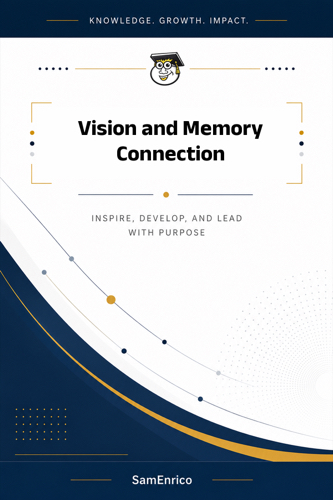
Non-FictionSelf-HelpVision Health
Vision and Memory Connection eBook
Correct eyesight to reduce cognitive load using th
Correct eyesight to reduce cognitive load using this practical guide.
Formats
Free sample
Chapter 1: The Cognitive Tax--I want you to try something. Right now, without moving your head, shift your gaze to the top right corner of this page. Now the bottom left. Now back to the first word of this sentence.What you just did—those rapid, jerky movements of your eyes—took energy. Not just muscular energy, but cognitive energy.
Every time your eyes jump from one point to another, your brain performs a silent calculation: Where am I looking now? What was there a moment ago? How do these two images connect?You didn't feel that calculation. You never do. But it happened, just as your heart beat without your permission and your lungs expanded without your command.Here is the question this entire book will answer: What if those silent calculations are consuming the very same mental fuel you need to remember, to think, and to create?And here is the more disturbing question: What if your eyes are wasting that fuel right now, while you read this sentence, and you have no idea?The Day I Stopped Believing in "Bad Memory"My grandmother used to say she had a "leaky memory." She would walk into a room and forget why.
She would lose her glasses while they were still on her face. She would meet someone at a party and forget their name before the handshake ended.She laughed about it. "Old age," she said.But here is what I noticed: on the days when she wore her reading glasses—the thick ones with the anti-glare coating—she forgot less. On the days when the light in her kitchen was bright and even, she could find her keys. On the days when her eyes were rested, she could tell you the plot of the movie she watched last night.I was twenty-two when I first asked the question that would become this book.
What if Grandma's memory wasn't failing? What if her eyes were just working too hard?That question sat in the back of my mind for years, dormant, until I stumbled across a study that made my breath catch. Researchers had found that people who closed their eyes for just ten seconds before trying to recall something remembered forty percent more than people who kept their eyes open. Forty percent. That is not a tiny improvement.
That is the difference between an A and a C. That is the difference between remembering where you parked and wandering a parking lot for twenty minutes.But here is what the study didn't say—what almost no one talks about—because it was hidden in the data, buried under the headline.The eye-closure effect worked even for people with perfect vision.That meant the problem wasn't just blurriness. The problem was visual noise. The problem was that your brain, right now, is processing thousands of pieces of visual information that have nothing to do with what you are trying to remember. The glare on your screen.
The movement of your own hands. The bookshelf in your peripheral vision. The shadow on the wall. The text message notification that popped up two minutes ago and is still glowing in the corner of your eye.Your brain processes all of that. Automatically.
Unstoppably. And every piece of visual noise it processes is a tiny withdrawal from an account with a very limited balance.The Two-Channel Lie To understand why your eyes are draining your memory, you first have to understand a mistake that most people make—and that most self-help books repeat without question.The mistake is this: believing that "seeing" and "thinking" are separate things.They are not separate. They are the same biological process, running on the same fuel, competing for the same limited resources.Here is the science. In the 1970s, a psychologist named Allan Paivio proposed something called Dual-Coding Theory. His idea was simple but radical: the brain processes information through two separate but interconnected channels.
One channel handles verbal information—words, sounds, language. The other channel handles visual information—images, spatial relationships, faces, scenes.These two channels are like two workers in a factory. They have different tools and different specialties, but they share the same power supply. When one channel is working hard, the other channel has less power available. When one channel is struggling, the other channel has to pick up the slack.Here is what that means for you, right now, reading this sentence.Your verbal channel is processing these words.
It is decoding the letters, assembling the sounds, constructing meaning from the squiggles on the page. That is hard work. Reading is not natural; it is a cultural invention that your brain learned to do by repurposing ancient visual circuits. Every word you read is a minor miracle of neural adaptation.But while your verbal channel is working, your visual channel is also working. It is processing the shape of this page, the texture of the paper or the glow of the screen, the movement of your eyes across the line, the ambient light in the room, the flicker of the overhead lamp, the reflection of your own face in the dark glass of the monitor.All of that visual processing—most of which you never consciously notice—is stealing power from your verbal processing.
Every time your eyes struggle to focus on a letter, every time they hunt for the start of the next line, every time they are distracted by a glare spot, your brain diverts a little bit of glucose from "understanding" to "seeing."That is the hidden tax. And it is always there.Clinical Sight vs. Cognitive Sight Here is another mistake that almost everyone makes, including many eye doctors.We measure vision using a tool called the Snellen chart—that's the wall of letters you read at the eye doctor's office. 20/20 means you can see at twenty feet what a "normal" person can see at twenty feet. 20/40 means you have to be twenty feet away to see what a normal person can see at forty feet.This measurement is useful for one thing: diagnosing whether you need glasses to pass a driving test.
It is almost useless for measuring whether your vision is efficient for thinking.Let me explain the difference with a story.A few years ago, a friend of mine—a brilliant software engineer named Priya—started complaining about brain fog. She said she could code for about two hours in the morning, and then her brain would "turn to oatmeal." She couldn't remember variable names. She would write a line of code, look away, and forget what she had just written. She started using sticky notes everywhere, covering her monitor with reminders. She was thirty-one years old and terrified she had early-onset dementia.Priya had 20/20 vision.
She had been tested six months earlier. Her eye doctor told her she had "perfect eyes."But here is what the eye doctor did not test. He did not test how quickly her eyes could switch from near to far focus. He did not test how accurately her eyes could track a moving object. He did not test how long she could maintain clear focus on a screen before…
This is the end of the free sample. Get the eBook to keep going. Buy now
About this book
Details
- Author
- Cathey Winnifred
- Publisher
- SamEnrico
- Language
- English
- Genre
- Non-Fiction, Self-Help, Vision Health
- Released
- 2026-06-09
- Pages (approx.)
- 151
- Available as
- eBook, Audiobook

Read better in the ZLOADR app
Your eBooks on your phone or tablet. Sign in with your SamEnrico account and start reading.
More by Cathey Winnifred
 Corporate Procurement to Nonprofit SourcingCathey Winnifred$11.99
 Twelve Step Programs For LGBTQ Individuals GuideCathey Winnifred$11.99
 Forgiveness for Lost TimeCathey Winnifred$11.99
 Business Card ExchangeCathey Winnifred$11.99
 Skin Loot Box AddictionCathey Winnifred$11.99
 Suicide Loss and NatureCathey Winnifred$11.99
 Merger Salary ProtectionCathey Winnifred$11.99
 The Lost Tapes of the Apollo 11 Backup CrewCathey Winnifred$11.99
 The Ghosts of Prohibition: Europe's First Identity Theft RingCathey Winnifred$11.99
 How to Produce Zero-voc ProductsCathey Winnifred$11.99
 How to Start a Entrance Telephones Business (Beginners Guide)Cathey Winnifred$11.99
 Growing AnthemisCathey Winnifred$11.99
You may also like
 Hong Kong Handover 1997Dunn Johnnie$11.99
 Zumba For Postnatal Recovery CourseNeal Christian$11.99
 Zumba for BeginnersLadner Nikia$11.99
 YouTube Comment Mining GuideHumes Pandora$12.99
 Worry Box MeditationCarlin Rudy$11.99
 Workplace Stress MeditationNguyen Lynn$11.99
 Workplace Stress and Sleep RepairHawley Ivory$11.99
 Workplace Perfectionism CureDelaney Jeffry$11.99
 Workplace Injustice Anger GuideWallen Isabelle$11.99
 Work Addiction and Burnout LinkGreenwood Ester$11.99
 Women in Yoga and WellnessBeattie Galina$11.99
 Women in Stand Up ComedyChun Evangeline$11.99