
Non-FictionStudent's ShortcutSTEM
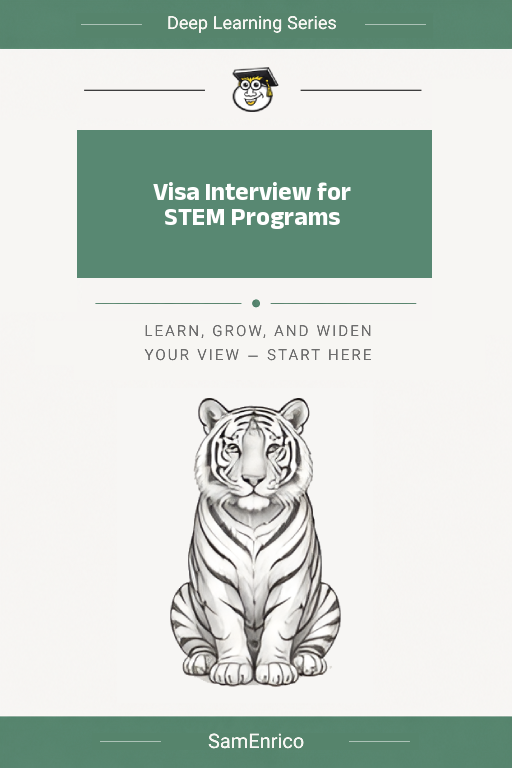
Visa Interview for STEM Programs eBook
Address possible additional scrutiny for sensitive
Address possible additional scrutiny for sensitive technologies in US STEM programs.
Formats
Free sample
Chapter 1: The Invisible Checklist--–- The first time Arjun opened his DS-160 confirmation page, he felt a quiet pride. He had been admitted to a top-tier Ph D program in robotics at a well-known American university. His advisor was a rising star. His research proposal was crisp, ambitious, and technically sound. He had done everything right.
Three weeks later, standing outside the US consulate in Hyderabad, he watched a consular officer slide a small yellow slip back across the counter. No stamp. No smile. Just three words: “Administrative processing required.” Arjun had never heard the term before. Within hours, he learned that his application had been flagged under something called the Technology Alert List – a document he had never seen, a list he did not know existed, a set of criteria that would now control the next eight months of his life.This book begins with Arjun not because his story is unusual, but because it has become the new normal.
Every year, thousands of highly qualified STEM students from around the world receive the same yellow slip, the same vague explanation, the same gut-wrenching uncertainty. They are not denied. They are not approved. They are simply... paused.
And during that pause, most of them have no idea what is happening behind the consulate walls. They do not know that their fate is being decided by a patchwork of laws, lists, and executive orders that most visa officers themselves struggle to explain in full. They do not know that their application has entered a parallel universe – one governed not by the student visa regulations they studied, but by export control laws, national security directives, and a shifting set of informal guidelines that change with each new administration.The purpose of this chapter is to pull back the curtain on that hidden universe. Before you can prepare for your visa interview, before you can sanitize your CV or rehearse your answers, you must understand the actual legal and procedural framework that will be used to judge you. This is not a theoretical exercise.
Consular officers do not wake up each morning and decide arbitrarily who to approve. They follow a set of rules – some public, some classified, some written, some passed down through training and institutional memory. Your job is not to guess what those rules are. Your job is to learn them systematically.This chapter will give you that system. We will dissect the Technology Alert List (TAL), the Export Administration Regulations (EAR), the International Traffic in Arms Regulations (ITAR), and the Bureau of Industry and Security (BIS) Entity List.
We will explain why funding sources often matter more than your research topic. We will bust the myth of a simple “public blacklist” and show you how officers actually build a case for suspicion using indirect evidence – your past internships, your publication co-authors, even the physical location of your lab. By the end of this chapter, you will not only know what the invisible checklist contains; you will know exactly where you stand on it.Understanding the Technology Alert List (TAL)The Technology Alert List is the single most important document that almost no STEM applicant has ever heard of. Created in the aftermath of the Cold War and continuously updated by the US Department of State, the TAL is a formal catalog of sensitive technologies that, if transferred to foreign nationals, could harm US national security or economic competitiveness. Unlike a simple blacklist of countries or institutions, the TAL focuses on technical domains.
It does not say “Chinese students are suspicious.” It says “students working on hypersonic vehicle propulsion systems are suspicious” – regardless of nationality, though in practice nationals of certain countries receive far more scrutiny.The current version of the TAL contains fourteen categories. Each category is broad, deliberately vague, and subject to interpretation by individual consular officers. The categories include:Nuclear technology, including reactors, enrichment, and reprocessing Missile and rocket technology, including guidance systems and propulsion Chemical and biological weapons, including toxins and delivery mechanisms Advanced materials, including composites, ceramics, and specialized alloys Sensor and laser technology, including LIDAR, infrared, and hyperspectral imaging Navigation and avionics, including GPS, inertial systems, and radar Marine technology, including submarines, underwater vehicles, and sonar Robotics and artificial intelligence, including autonomous systems and machine learning Advanced computing, including supercomputers, quantum computing, and specialized chips Cryptography and information security, including encryption and network defense Biotechnology, including genetic engineering, synthetic biology, and pathogen research Munitions and explosives, including guidance, fusing, and detection Space technology, including satellites, launch vehicles, and ground control Emerging technologies not yet formally listed (a catch-all category)At first glance, this list seems impossibly broad. A student working on medical imaging AI might see “machine learning” on the list and panic. A student researching agricultural robotics might see “autonomous systems” and assume the worst.
But the presence of a keyword alone does not trigger TAL scrutiny. The officer must determine that the student’s specific work involves a “dual-use” technology – a technology with both civilian and military applications – and that the student’s access to that technology could reasonably lead to transfer to a foreign military or intelligence service.This is where the art of the interview meets the science of the law. Two students working on autonomous navigation can have radically different outcomes. The first, working on drone swarms for military reconnaissance, will almost certainly be flagged. The second, working on self-driving cars for civilian transportation, may sail through – provided they frame their work correctly.
The TAL does not ban civilian autonomous navigation. It bans autonomous navigation technologies that are “specifically designed or modified for military use.” The difference lies in the details, and the details are what you will learn to control in later chapters.The Export Administration Regulations (EAR) and ITARThe Technology Alert List does not exist in a vacuum. It is closely tied to two massive regulatory frameworks: the Export Administration Regulations (EAR) and the International Traffic in Arms Regulations (ITAR). Understanding these frameworks is essential because consular officers often use TAL as a screening tool to identify applicants who may be subject to EAR or ITAR restrictions.The EAR, administered by the Bureau of Industry and Security (BIS), controls the export of “dual-use” items – goods, software, and technologies that have both commercial and military applications. The key concept here is “deemed export.” Under US law, sharing sensitive technology with a foreign national on US soil is legally considered an export to that person’s home country.
This means that a Chinese Ph D student learning about semiconductor manufacturing techniques in a California lab is, in the eyes of the law, exporting those techniques to China. The student does not need to smuggle anything out of the country. The export happens the moment the knowledge transfers.This is why your research matters so much to a visa officer. They are not just deciding whether to admit you to the United States. They are deciding whether to allow a foreign national to access technology that, under the EAR, might require an export license.
If your research falls under a category that typically requires a license, and if your home country is subject to licensing restrictions, the officer faces…
This is the end of the free sample. Get the eBook to keep going. Buy now
About this book
Details
- Author
- Grisham Maranda
- Publisher
- SamEnrico
- Language
- English
- Genre
- Non-Fiction, Student's Shortcut, STEM
- Released
- 2026-06-01
- Pages (approx.)
- 138
- Available as
- eBook, Audiobook

Read better in the ZLOADR app
Your eBooks on your phone or tablet. Sign in with your SamEnrico account and start reading.
More by Grisham Maranda
 Self Esteem for Mid Career PlateauGrisham Maranda$11.99
 Road Rage and Anger RuminationGrisham Maranda$11.99
 Rejection Recovery WorkbookGrisham Maranda$11.99
 Growth Mindset for HealthcareGrisham Maranda$11.99
 Business Credit for Marketing AgenciesGrisham Maranda$11.99
 Letting Go of Pet Loss GuiltGrisham Maranda$11.99
 Legal Presentation SkillsGrisham Maranda$11.99
 Leaving the Human GardenGrisham Maranda$11.99
 The Silk Road's Digital Phoenix: How a 2,000-Year-Old Trade Route Rebooted as a 21st-Century E-Commerce EmpireGrisham Maranda$11.99
 The Jade Emperor's Celestial Bureaucracy: How Heaven Runs Like a DynastyGrisham Maranda$11.99
 How to Produce Ironing BoardsGrisham Maranda$11.99
 How to Produce a Trommel ScreenGrisham Maranda$11.99
You may also like
 Hong Kong Handover 1997Dunn Johnnie$11.99
 Zumba For Postnatal Recovery CourseNeal Christian$11.99
 Zumba for BeginnersLadner Nikia$11.99
 YouTube Comment Mining GuideHumes Pandora$12.99
 Worry Box MeditationCarlin Rudy$11.99
 Workplace Stress MeditationNguyen Lynn$11.99
 Workplace Stress and Sleep RepairHawley Ivory$11.99
 Workplace Perfectionism CureDelaney Jeffry$11.99
 Workplace Injustice Anger GuideWallen Isabelle$11.99
 Work Addiction and Burnout LinkGreenwood Ester$11.99
 Women in Yoga and WellnessBeattie Galina$11.99
 Women in Stand Up ComedyChun Evangeline$11.99