
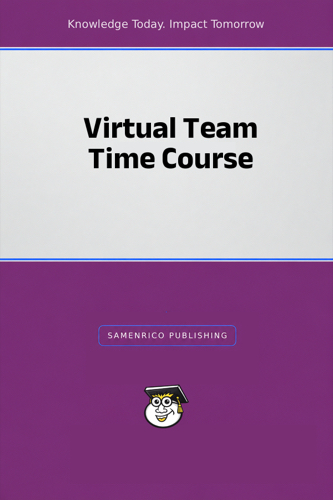
Non-FictionSelf-Help / Teamwork
Virtual Team Time Course eBook
undefined
by New Kathrine
undefined
Formats
Free sample
Chapter 1: The Meeting Industrial Complex--–- Maria stared at her calendar for the thirty-seventh time that day. Forty-two hours of meetings across five time zones. Her team in Manila had already logged off. Her boss in New York was just starting his day. And somewhere in the void between 2:00 AM and 3:00 AM, she had promised herself she would sleep.
She didn't. The Slack notifications hadn't stopped. The @here messages had come in waves—first from London, then from Chicago, then from Singapore. Each ping felt like a small emergency. Each reply spawned three more replies.
By Thursday afternoon, she had answered 147 messages, attended eleven hours of video calls, and completed exactly zero hours of the strategic work that her bonus depended on. Her team was burning out. Her marriage was fraying. And somewhere in the executive dashboard, her "green light" availability status had been green for seventy-two consecutive hours—proof, the algorithm suggested, that she was a model employee.This book is for Maria. And for every leader, manager, and team member who has been quietly suffocating under the weight of a well-intentioned but deeply broken assumption: that real-time communication is the gold standard of collaboration.
This chapter dismantles that assumption. It names the enemy. It quantifies the cost. And it introduces the first of many tools that will, over the next eleven chapters, transform how you think about time, trust, and teamwork in a distributed world.The Myth We All Believed In the era of co-located offices, real-time communication made sense. You walked to someone's desk.
You asked a question. They answered. The transaction took thirty seconds, and both parties returned to work. The cost of interruption was low because the cost of coordination was high. Face-to-face was efficient.Then we went remote.And we did what humans always do when confronted with uncertainty: we replicated the familiar.
We took the meeting culture of the physical office and poured it into Zoom. We took the open-office interruption culture and translated it into Slack. We took the manager's ability to "walk the floor" and turned it into a relentless stream of check-in meetings. We didn't design for distributed work. We emulated co-located work with worse technology.The result is a system that nobody designed, nobody wants, and nobody knows how to escape.
Call it the Meeting Industrial Complex—the invisible machinery of meeting-culture inertia, calendar-filler habits, and the reflexive "let's jump on a quick call" that has come to define virtual work. The Meeting Industrial Complex has three core components.First, the default meeting assumption: when faced with any question, decision, or update, the default response is "let's schedule time to discuss it." This assumption is so deeply embedded that most teams never notice they are making it. Second, the anxiety loop: managers fear that without visible activity, their teams aren't working. So they schedule more meetings to "check in." The meetings consume time that could have been used for actual work, which increases anxiety, which leads to more meetings. Third, the responsiveness trap: because distributed teams lack the casual visibility of an office, they substitute speed of reply for quality of work.
The fastest responder is assumed to be the most productive, even if their actual output has collapsed under the weight of constant interruption.These three components reinforce each other. The default meeting assumption creates the calendar bloat. The anxiety loop prevents anyone from canceling meetings. The responsiveness trap ensures that even when people aren't in meetings, they are monitoring Slack for the next ping. The result is a system that produces the appearance of productivity while systematically destroying actual productivity.Flow Lag: The Hidden Tax on Your Time To understand what the Meeting Industrial Complex is costing you, we need a new unit of measurement.
Meet Flow Lag.Flow Lag is the cumulative productivity cost incurred when a team member waits for a response that could have been delivered asynchronously. Every time you send a message that says "thoughts?" without context, you create Flow Lag. Every time you schedule a thirty-minute meeting to answer a question that could have been answered in a two-sentence email, you create Flow Lag. Every time you demand an instant response to a non-emergency, you create Flow Lag.Here is the math. A typical knowledge worker experiences approximately sixty interruptions per day.
Each interruption costs an average of twenty-three minutes to fully recover focus. That is twenty-three minutes of cognitive drag—time spent remembering where you were, what you were doing, and what you were about to think next. Twenty-three minutes multiplied by sixty interruptions is 1,380 minutes, or twenty-three hours. That's three full work days of recovery time per week, on top of the actual time spent on the interruptions themselves.Most of these interruptions are unnecessary. In a study of 1,200 remote workers, researchers found that 73% of synchronous touchpoints (meetings, phone calls, instant messages expecting immediate replies) could have been replaced with asynchronous communication without any loss of quality or speed.
The remaining 27% were legitimate—complex negotiations, crisis resolution, creative brainstorming. But 73% were waste. That is nearly three-quarters of all meeting time, gone.Flow Lag is the name for that waste at the individual level. When you multiply it across a team of ten people, each losing twenty-three hours per week to unnecessary interruptions, you get 230 hours of lost productivity per week. That is nearly six full-time employees worth of work, vanished into the gap between a ping and a reply.But Flow Lag is not just an economic cost.
It is a cognitive and emotional cost. The human brain is not designed for constant task-switching. When you interrupt a knowledge worker mid-flow, you are not asking them to pause. You are asking them to completely unload their working memory, switch contexts, process your request, formulate a response, and then reload their original context—assuming they can remember what it was. Most cannot.
That is why the twenty-three minute recovery number exists. That is why deep work is so rare in virtual teams. That is why Maria, our opening example, spent seventy-two hours "available" while accomplishing nothing of strategic value.The Trust Paradox Here is where the Meeting Industrial Complex becomes truly insidious. Managers do not schedule meetings because they enjoy wasting time. They schedule meetings because they are afraid.The fear has a name: the Trust Paradox of virtual work.
In a physical office, trust is built through passive observation. You see your colleague arrive on time. You see them engaged in conversation. You see them at their desk, working. You don't need to ask "are you working?" because the evidence is visible.
This is called passive trust—trust earned through ambient awareness.In a virtual environment, passive trust disappears. You cannot see your team members. You cannot observe their effort. You cannot tell the difference between someone who is deeply focused and someone who is watching Netflix. In the absence of passive trust, managers default to active verification—meetings, check-ins, status updates, and the constant demand for responsiveness.Active verification feels productive.
It gives managers a sense of control. But it destroys the very trust it seeks to build. When you demand constant updates, you signal that you do not…
This is the end of the free sample. Get the eBook to keep going. Buy now
About this book
Details
- Author
- New Kathrine
- Publisher
- SamEnrico
- Language
- English
- Genre
- Non-Fiction, Self-Help / Teamwork
- Released
- 2026-06-07
- Pages (approx.)
- 143
- Available as
- eBook, Audiobook

Read better in the ZLOADR app
Your eBooks on your phone or tablet. Sign in with your SamEnrico account and start reading.
More by New Kathrine
 Burnout Prevention For Customer ServiceNew Kathrine$11.99
 Hoffa Case Solved By Amateur Sleuths GuideNew Kathrine$11.99
 The Guilt Time MachineNew Kathrine$11.99
 Commission Income AnxietyNew Kathrine$11.99
 Letterboxd Film Snobbery TrapNew Kathrine$11.99
 Home Gym SetupNew Kathrine$11.99
 Sundown Serenade: The Last Blues of Robert JohnsonNew Kathrine$11.99
 Vanished Masterpiece: The Phantom of the LouvreNew Kathrine$11.99
 How to Produce Multipurpose LubricantNew Kathrine$11.99
 A Collector's Handbook to the Rover 2000tcNew Kathrine$11.99
 Nigeria VAT on Imported ServicesNew Kathrine$12.99
 Paraphrasing Citation Rules GuideNew Kathrine$12.99
You may also like
 Hong Kong Handover 1997Dunn Johnnie$11.99
 Zumba For Postnatal Recovery CourseNeal Christian$11.99
 Zumba for BeginnersLadner Nikia$11.99
 YouTube Comment Mining GuideHumes Pandora$12.99
 Worry Box MeditationCarlin Rudy$11.99
 Workplace Stress MeditationNguyen Lynn$11.99
 Workplace Stress and Sleep RepairHawley Ivory$11.99
 Workplace Perfectionism CureDelaney Jeffry$11.99
 Workplace Injustice Anger GuideWallen Isabelle$11.99
 Work Addiction and Burnout LinkGreenwood Ester$11.99
 Women in Yoga and WellnessBeattie Galina$11.99
 Women in Stand Up ComedyChun Evangeline$11.99