
Non-FictionSelf-HelpRemote Work
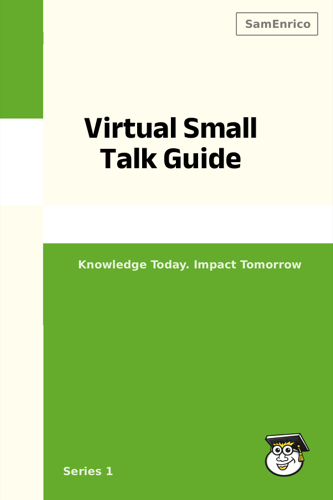
Virtual Small Talk Guide eBook
Starts conversations on Zoom and Teams before meet
Starts conversations on Zoom and Teams before meetings begin.
Formats
Free sample
Chapter 1: The $37 Billion Pause--–- The three minutes before a virtual meeting officially begins are the most expensive silence in modern business. Most people treat them as dead air—a technical waiting room where nothing of value happens. They could not be more wrong.Every day, an estimated 200 million people join virtual meetings on Zoom, Microsoft Teams, and Google Meet. Before each meeting, there is a window—typically three to five minutes—where participants trickle in, adjust their cameras, mute and unmute, and sit in awkward digital stillness. Multiply those minutes by 200 million people.
Then multiply by 250 working days per year. The total is approximately 250 billion minutes of pre-meeting silence annually. At the average professional hourly rate, that silence costs organizations an estimated $37 billion in lost relationship capital, delayed decisions, and eroded trust.This is not an exaggeration. It is an accounting of the most overlooked asset in remote work: the pause before the agenda.The problem is that most people do not know what to do in that pause. They sit frozen, staring at their own camera thumbnail, waiting for someone else to speak.
They check email on a second monitor. They pretend to review notes. They arrive exactly at the start time to avoid the discomfort altogether. And in doing so, they abdicate the single most valuable opportunity in virtual communication: the chance to build trust before the work begins.This chapter is about why that silence is so expensive, why your brain reacts to it with actual physiological stress, and how reframing those three minutes as "fast trust" rather than "small talk" can transform your remote work relationships—and your career.The Physical Room vs. The Digital Void To understand why virtual silence feels so much worse than physical silence, you have to understand what your brain expects from a room full of people.In a physical conference room, silence is rarely absolute.
Even when no one is speaking, there are ambient cues: the hum of the HVAC system, the shuffle of papers, the squeak of a chair, the distant sound of traffic or office chatter. These low-level noises reassure your brain that the world is still operating normally. More importantly, they provide social proof—a psychological term for the information we gather from observing others. In a physical room, you can see people looking at agendas, adjusting their glasses, sipping coffee, or nodding to themselves. Those tiny movements tell you: They are here.
They are present. They are just quiet right now.In a virtual room, all of that disappears.When you join a Zoom or Teams call and everyone is muted and video-off, you enter a digital void. There is no ambient noise. There are no peripheral movements. There is only a grid of frozen names or dark rectangles.
Your brain, which evolved to read social cues from physical spaces, suddenly has nothing to read. So it invents threats.This is the root of what we call "Zoom fatigue," a term popularized by Stanford researcher Jeremy Bailenson. One of Bailenson's key findings is that video calls require intense, unnatural cognitive load because your brain is trying to decode micro-expressions on a two-dimensional grid. In person, you process body language, spatial distance, and facial expressions simultaneously and subconsciously. On video, you have to actively work to interpret a pixelated smile or a half-second delay in reaction time.
When you add silence to that equation, your brain goes into overdrive: Are they muted? Are they ignoring me? Did they leave the call? Did I do something wrong?That internal monologue is not a personality flaw. It is a neurological response to a sensory vacuum.The Research: What Two Minutes of Rapport Actually Does Andrew Brodsky, a management professor at the University of Texas and author of Ping: The Secret to Getting More From Your Technology, has conducted some of the most rigorous research on pre-meeting virtual interaction.
In one study, his team analyzed thousands of workplace meetings across multiple industries. They measured two variables: whether teams engaged in at least two minutes of off-agenda conversation before the formal meeting began, and how quickly those teams reached consensus on contentious decisions later in the meeting.The results were striking. Teams that used the pre-meeting window for casual rapport made final decisions 34 percent faster than teams that sat in silence and went straight to the agenda.Why? Because the silent teams had to conduct their "social warming up" during the meeting. They spent the first five to seven minutes tentatively testing each other's moods, avoiding direct disagreement, and dancing around conflict.
The teams that had already chatted about their weekends, their pets, or their coffee orders arrived at the formal agenda already calibrated. They knew who was in a good mood, who was distracted, who was likely to push back, and who needed encouragement. They had already built enough trust to say, "I actually disagree with that approach," without fear of social punishment.Brodsky calls this social glue—the invisible bonding agent that allows teams to move quickly from proposal to decision. Without it, every meeting starts in a defensive crouch. With it, teams can afford to be direct because they have already established that they like and respect one another.Silence as a Signal: What You Are Accidentally Saying Here is the uncomfortable truth that most professionals refuse to acknowledge: silence in a virtual room is never neutral.
It always signals something. And that something is usually negative.When you join a call, see a colleague already there, and say nothing, you are not being "quiet." You are being interpreted as distant, annoyed, or socially anxious. When you stare at your own camera thumbnail while someone else sits in silence, you are communicating, I would rather look at myself than engage with you. When you type "Sorry, just reviewing my notes" in the chat instead of unmuting, you are saying, My notes are more important than our relationship.None of this is intentional. But intention does not matter.
Perception does.In the absence of verbal or visual warmth, the human brain defaults to threat detection. This is an evolutionary holdover: in prehistoric times, a silent member of the tribe was either sick, hostile, or planning something. Your brain has not updated its software for video conferencing. So when you encounter digital silence, your amygdala—the brain's fear center—lights up. You start scanning for danger.
Did I say something wrong last meeting? Does that person have a grudge against me? Is this call going to be awkward?This is not just uncomfortable. It is expensive. Teams that perceive each other as threatening or untrustworthy withhold information, avoid constructive conflict, and make slower, more conservative decisions.
A study from Google's Project Aristotle—a massive internal research effort to understand what makes teams effective—found that psychological safety was the single most important predictor of team performance. And psychological safety is built drop by drop, minute by minute, in exactly the kind of low-stakes interactions that happen before meetings.The $37 Billion Pause, Revisited Let us return to that $37 billion figure. How was it calculated?First, we estimate that 200 million people participate in virtual meetings daily. This is conservative; Zoom alone reported…
This is the end of the free sample. Get the eBook to keep going. Buy now
About this book
Details
- Author
- Quick Kendrick
- Publisher
- SamEnrico
- Language
- English
- Genre
- Non-Fiction, Self-Help, Remote Work
- Released
- 2026-06-06
- Pages (approx.)
- 133
- Available as
- eBook, Audiobook

Read better in the ZLOADR app
Your eBooks on your phone or tablet. Sign in with your SamEnrico account and start reading.
More by Quick Kendrick
 The Tech Features PriorityQuick Kendrick$11.99
 Pattern Recognition In DiagnosisQuick Kendrick$11.99
 Sabbatical Program ComplianceQuick Kendrick$11.99
 Listening Skills for Lawyers and AdvocatesQuick Kendrick$11.99
 Networking for Physical TherapistsQuick Kendrick$11.99
 Morning Routine for IntrovertsQuick Kendrick$11.99
 Remote Work Life Balance PlanQuick Kendrick$11.99
 The Maestro of the Andes: Manuel Rodríguez and the Birth of the CharangoQuick Kendrick$11.99
 The Great Vinyl Revival That Never Was: How a Tech Giant Bet on Records and Lost MillionsQuick Kendrick$11.99
 How to Produce Leotards and UnitardsQuick Kendrick$11.99
 How to Produce Wallcover SizingQuick Kendrick$11.99
 How to Become a Grooving-machine OperatorQuick Kendrick$11.99
You may also like
 Hong Kong Handover 1997Dunn Johnnie$11.99
 Zumba For Postnatal Recovery CourseNeal Christian$11.99
 Zumba for BeginnersLadner Nikia$11.99
 YouTube Comment Mining GuideHumes Pandora$12.99
 Worry Box MeditationCarlin Rudy$11.99
 Workplace Stress MeditationNguyen Lynn$11.99
 Workplace Stress and Sleep RepairHawley Ivory$11.99
 Workplace Perfectionism CureDelaney Jeffry$11.99
 Workplace Injustice Anger GuideWallen Isabelle$11.99
 Work Addiction and Burnout LinkGreenwood Ester$11.99
 Women in Yoga and WellnessBeattie Galina$11.99
 Women in Stand Up ComedyChun Evangeline$11.99