
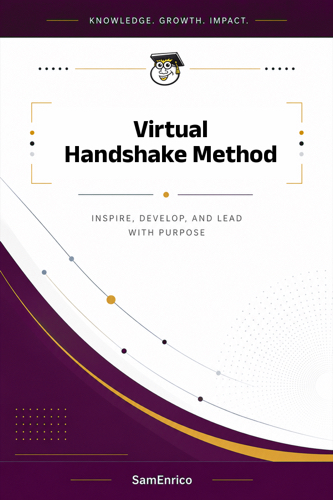
Virtual Handshake Method eBook
Build trust and rapport in purely digital professi
Build trust and rapport in purely digital professional relationships.
Formats
Free sample
Chapter 1: The Broken Circuit...--–- The first time I watched a senior vice president fumble a virtual handshake, I didn’t even recognize what I was seeing. It was early 2020, and like millions of others, she had been forced into a video call with a major client. She was polished, experienced, and had closed seven-figure deals in person for two decades. But on that screen, she looked frantic. She talked over the client three times because of lag.
She stared at her own face instead of the camera. She asked, “How are you?” and then immediately answered the question herself because the silence felt unbearable. The client went silent. The deal went cold. And she had no idea what she had done wrong.–- This is the broken circuit of digital trust.
Every day, millions of professionals walk into virtual rooms carrying the invisible weight of a physical world that no longer exists. They use the same words, the same smiles, the same questions that built empires in conference rooms and coffee shops. But on screen, those same behaviors don’t translate. They misfire. They signal anxiety, disinterest, or incompetence.
And the worst part is that nobody tells you. The client doesn’t say, “I don’t trust you because you looked at your own face instead of into the lens.” The colleague doesn’t say, “I think you’re unreliable because you took eighteen hours to reply to a Slack message.” They just drift away. They choose someone else. They say, “It’s not a fit.”–- This book is the repair manual for that broken circuit. The method inside these pages is called the Virtual Handshake Method, and it is not a collection of tips about better lighting or faster Wi-Fi.
It is a complete, research-driven, battle-tested protocol for building trust and rapport in purely digital professional relationships. It draws from the foundational insights of the original The Virtual Handshake (2005), synthesizes the best practices from subsequent bestsellers like Leading at a Distance and Trust at a Distance, and updates everything for the hybrid, asynchronous, camera-weary reality of 2025 and beyond.–- This chapter, the first of twelve, has a single mission: to convince you that the old rules are not just outdated but actively dangerous, and to give you the first new tool you need to replace them. We will deconstruct the physical handshake until it reveals its hidden assumptions. We will introduce the concept of Signal-to-Noise Ratio, the single most important lens for understanding why digital trust fails. And we will conclude with the foundational framework of this entire book: Intentional Trust Architecture.
By the time you finish this chapter, you will never look at a video call or a Slack message the same way again.The Myth of the Transferable Handshake–- Let us name the assumption that is quietly sabotaging your career. It is the belief that the skills, instincts, and behaviors that build trust in person transfer automatically to digital spaces. Call it the Transferability Myth. It feels true because the words are the same. You say “hello.” You ask “how are you?” You make a promise.
You deliver. But the medium is not a neutral pipeline. The medium is the message, as Marshall Mc Luhan said half a century ago. And when the medium changes from the physical, three-dimensional, real-time, body-language-rich world to a flat, laggy, two-dimensional, notification-saturated screen, the meaning of every single behavior changes.–- Consider the physical handshake itself. What does it actually do?
It achieves five things simultaneously. First, it establishes physical proximity, which the brain subconsciously reads as safety and connection. Second, it provides tactile feedback—the firmness, the dryness, the duration—that signals confidence, health, and sincerity. Third, it synchronizes two bodies in time and space, creating a shared rhythm that neuroscientists call interpersonal synchrony, a powerful trust-builder. Fourth, it forces mutual eye contact.
Fifth, it marks the official beginning of a social interaction, a ritual that reduces anxiety by providing a predictable script.–- Now try to replicate that on a screen. You cannot. Physical proximity becomes a pixelated face in a grid. Tactile feedback becomes nothing. Synchrony becomes a casualty of lag.
Eye contact becomes a confusing choice between looking at a face (which makes you appear to look down) or looking at a lens (which feels unnatural). And the ritual becomes a jarring “Can you hear me? You’re on mute.”–- The Transferability Myth tells you to compensate by trying harder. Smile bigger. Speak louder.
Ask more enthusiastic questions. This is precisely the wrong response. It signals anxiety. It reads as performance. And it drains the very trust you are trying to build.–- Let me give you a concrete example from the research.
In a landmark study on virtual negotiations, researchers found that pairs who met face-to-face reached agreement 82% of the time. Pairs who met via video with cameras on reached agreement only 62% of the time. Pairs who met via audio only: 45%. And pairs who met via text chat: 31%. The same people.
The same negotiation task. The only variable was the medium. The Transferability Myth would say, “Just be more charming.” The data says the medium itself imposes a trust deficit that no amount of charm can overcome unless you change your behavior at the structural level.–- This is not a character flaw. It is not a generational gap. It is not a lack of digital native intuition.
It is a design problem. And design problems require design solutions.The Signal-to-Noise Ratio: A New Lens for Digital Trust–- To build trust in any environment, you must understand what the relevant signals are and how to protect them from noise. In person, the signals are overwhelmingly non-verbal. Albert Mehrabian’s famous 7-38-55 rule (7% words, 38% tone, 55% body language) is often oversimplified, but its core insight remains valid: in face-to-face communication, the majority of emotional and relational meaning comes from what you don’t say with words. Your posture, your gestures, your facial expressions, your proximity, your touch—these are the primary signals.
Words are secondary. They provide the content, but the body provides the trust.–- This means that in person, the Signal-to-Noise Ratio (SNR) is heavily weighted toward non-verbal channels. The signal is your body. The noise is your words. That is why you can sit in a meeting, say almost nothing, and still be trusted if your posture is open, your nods are timely, and your eye contact is steady.–- Online, everything inverts.
Your body disappears or is reduced to a floating head in a small rectangle. Your gestures are cropped out. Your posture is hidden. Your touch is gone. What remains?
Your words. Your tone (if audio is on). And a handful of new, purely digital artifacts: your response time, your typing indicator, your emoji choices, your framing, your background, your lighting, your lag.–- Therefore, in digital spaces, the Signal-to-Noise Ratio flips completely. Your words become the primary signal. Your body becomes secondary, reduced to a few noisy cues (facial tension, framing, lighting).
And everything else—the blurry background, the echo, the delay, the notification that pops up, the child who runs through the frame—becomes noise that…
This is the end of the free sample. Get the eBook to keep going. Buy now
About this book
Details
- Author
- Keyes Charise
- Publisher
- SamEnrico
- Language
- English
- Genre
- Non-Fiction, Self-Help, Digital Communication
- Released
- 2026-06-07
- Pages (approx.)
- 146
- Available as
- eBook, Audiobook

Read better in the ZLOADR app
Your eBooks on your phone or tablet. Sign in with your SamEnrico account and start reading.
More by Keyes Charise
 Digital Declutter Priority GuideKeyes Charise$11.99
 Embracing Wrinkles and Gray Hair GuideKeyes Charise$11.99
 Rust Base Protection FixKeyes Charise$11.99
 Almodovar Color Palette GuideKeyes Charise$11.99
 The Silent Witness: Canada's First Whistleblower in a Murder TrialKeyes Charise$11.99
 Comparison To Job Description GuideKeyes Charise$12.99
 UN General Assembly Conference CareersKeyes Charise$12.99
 Understanding Mental Retardation EpilepsyKeyes Charise$17.99
 School PrincipalKeyes Charise$11.99
 How to Start a Hobby in PuzzlesKeyes Charise$11.99
You may also like
 Assertiveness in Text and EmailMaloney Lura$11.99
 Social Media Anger GuideLaird Robbie$11.99
 Assertiveness In Online Communication GuideCowan Chrystal$11.99
 Email and Chat Distraction CureCarnes Shaun$11.99
 Assertiveness Online GuideTaylor Joey$11.99
 Active Listening Through TextingVitale Margaretta$11.99
 Social Media AssertiveKnudson Minh$11.99
 Slack and Teams Distraction GuideRichie Rochell$11.99
 Digital Anger in RelationshipsHearn Virgil$11.99
 Remote Work Communication OverloadWiese Aron$11.99
 Texting Listening EquivalentsPatrick Grant$11.99
 Text Conversation StartersBeattie Alvina$11.99