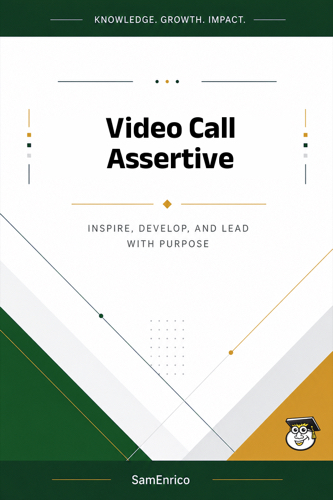
Video Call Assertive eBook
Speak up in virtual meetings without interrupting.
Speak up in virtual meetings without interrupting.
Formats
Free sample
Chapter 1: The Invisible Tax...-- The first time Maria lost her voice in a virtual meeting, she didn’t even notice it happening.She was seven minutes into a Thursday morning product review. Twelve faces stared back from her screen, arranged in the familiar grid of Gallery View. Her boss, Derek, was walking through the Q3 metrics. Maria had prepared a crucial point about a customer retention anomaly she had spotted the night before—a 12 percent drop in renewals that correlated perfectly with the previous quarter’s feature launch. If the team didn’t address it now, they would lose another three months to the wrong roadmap.She waited for a pause.Derek finished a sentence.
Maria leaned toward her microphone, her finger hovering over the unmute button. But before she could speak, James—director of product, always the first to fill silence—jumped in. “And building on that, I think we should also consider the Southeast Asia rollout...”Maria exhaled. She muted again. She would wait for him to finish.James talked for ninety seconds.
When he stopped, Maria lifted her finger again. But Derek had already moved on. “Great points, James. Let’s table that for now and look at the engineering timeline.”Maria typed her thought into the chat. No one responded.
The meeting moved to the next agenda item. She never spoke.Later that day, she saw her insight—slightly reworded—in James’s follow-up email. He had called it “a data point worth flagging.” He got the credit. She got the meeting minutes in her inbox, a reminder of the fifteen minutes she had spent waiting for a turn that never came.Maria is not shy. She is not incompetent.
She is not invisible in person. In fact, in the office, she was known as someone who spoke her mind—direct, thoughtful, respected. But that was before the pandemic. Before the 0.5-second audio lag. Before the mute button became a psychological barrier she could not seem to cross.Maria is you.
Or someone you work with. Or someone you manage. And the story of her lost voice is not a story about personality. It is a story about physics, psychology, and the hidden structure of virtual meetings—a structure that is quietly punishing the very people organizations need to hear from most.This chapter is about that structure. It is about the Invisible Tax—the cumulative penalty that polite, thoughtful, and well-prepared people pay every time they join a video call.
By the end of this chapter, you will understand why silence is not golden on Zoom. You will know why your best ideas are getting stolen, repeated, or ignored. And you will have the first tool you need to stop the bleeding.But first, we have to name the enemy.The Physics of the 0.5-Second Lag In a physical room, human conversation operates on a timing system refined over hundreds of thousands of years. When two people speak at the same time in person, their brains process the overlap in milliseconds. They make micro-adjustments—a slight pause, a nod, a raised eyebrow—that signal “you go first” or “I’m not done.” This is called turn-taking prosody, and humans are extraordinarily good at it.In fact, research from the University of California, Santa Cruz, found that in-person conversational overlaps are typically less than 200 milliseconds—shorter than the blink of an eye.
These tiny overlaps are not interruptions. They are engagement cues. They say, “I’m listening, I’m with you, and I have something to add when you’re ready.”Now consider the virtual meeting.Video conferencing platforms introduce an unavoidable delay: the round-trip audio latency. On a good day, with excellent internet, that delay is approximately 150 to 200 milliseconds each way. Add processing time, network jitter, and the user’s own hardware, and the total latency often reaches 500 milliseconds—half a second—or more.Half a second does not sound like much.
But in the architecture of conversation, it is an eternity.Here is what happens in that half-second gap: your brain registers that someone has stopped speaking. You decide to respond. You move your finger to the unmute button. The platform processes your request. You begin to speak.
But in that same half-second, someone else—someone with faster reflexes, lower latency, or less inhibition—has already started. Their audio reaches your ears. The platform’s echo cancellation algorithm detects two signals and suppresses one. Usually, it suppresses the second speaker.That second speaker is often you.The result is not an interruption in the traditional sense. It is a collision.
And unlike in person, where collisions resolve gracefully with a quick “sorry, you go,” virtual collisions resolve with one person simply disappearing from the audio stream. No one hears them. No one acknowledges them. They are not interrupted; they are erased.This is the first layer of the Invisible Tax. It is not personal.
It is not political. It is physics. But the consequences are deeply personal.Why “Waiting for a Pause” Is a Losing Strategy Most people who struggle to speak in virtual meetings believe they have a confidence problem. They tell themselves: I just need to be more assertive. I need to just go for it.
I need to stop being so polite.This is wrong.The problem is not that you are too polite. The problem is that you are using the wrong model of conversation. You are using the in-person model—where polite people wait for a pause, then speak. But virtual meetings do not have pauses. They have gaps—and those gaps are not invitations.
They are illusions.Let me prove this to you.Record your next team meeting. Use the platform’s native recording feature or a simple audio recorder on your phone. After the meeting, open the recording in any audio editing software (Audacity is free). Look at the waveform. What you will see is almost no flat line—no true silence—between speakers.
Instead, you will see overlapping waveforms, clipped beginnings, and abrupt cutoffs.Now listen to those overlaps. Notice what happens when two people start speaking at the same time. In almost every case, one voice simply drops out. That person is not being rude. They are not being ignored.
They are simply late by 150 milliseconds.The polite conversational model—wait for a pause, then speak—assumes that pauses exist. In virtual meetings, they do not. The only true pauses occur when everyone is so uncertain that no one speaks. Those pauses are rare, and when they happen, they are usually filled by the person with the highest status or the loudest voice—not the person with the best idea.So what is the alternative?You cannot wait for a pause that never comes. You cannot rely on the politeness of others to create space for you.
You must create that space yourself—not by interrupting, but by reserving it. And the way you reserve it is with a technique called Flagging.We will spend most of this book teaching you how to Flag effectively. But for now, understand this: Flagging is the opposite of waiting. Flagging is announcing your intent to speak before you need…
This is the end of the free sample. Get the eBook to keep going. Buy now
About this book
Details
- Author
- Compton Ashlea
- Publisher
- SamEnrico
- Language
- English
- Genre
- Non-Fiction, Self-Help, Virtual Communication
- Released
- 2026-06-07
- Pages (approx.)
- 147
- Available as
- eBook, Audiobook

Read better in the ZLOADR app
Your eBooks on your phone or tablet. Sign in with your SamEnrico account and start reading.
More by Compton Ashlea
 Senior Travel Medical InsuranceCompton Ashlea$11.99
 Selenium For Hashimoto's GuideCompton Ashlea$11.99
 Senior Yoga Self EsteemCompton Ashlea$11.99
 Birth Control And Fertility ReturnCompton Ashlea$11.99
 Gen Z Low AlcoholCompton Ashlea$11.99
 Navigating End of Life TalksCompton Ashlea$11.99
 Self Hypnosis for Habit ChangeCompton Ashlea$11.99
 The Quantum Gambit: How a Cold War Bet Changed the Future of ComputingCompton Ashlea$11.99
 The Opal Conspiracy: A Thief’s Gambit in the Court of the Sun KingCompton Ashlea$11.99
 How to Produce Craft Pipe CleanersCompton Ashlea$11.99
 A Collector's Handbook to the Vauxhall Big Six ByCompton Ashlea$11.99
 Family Money SecretsCompton Ashlea$12.99