
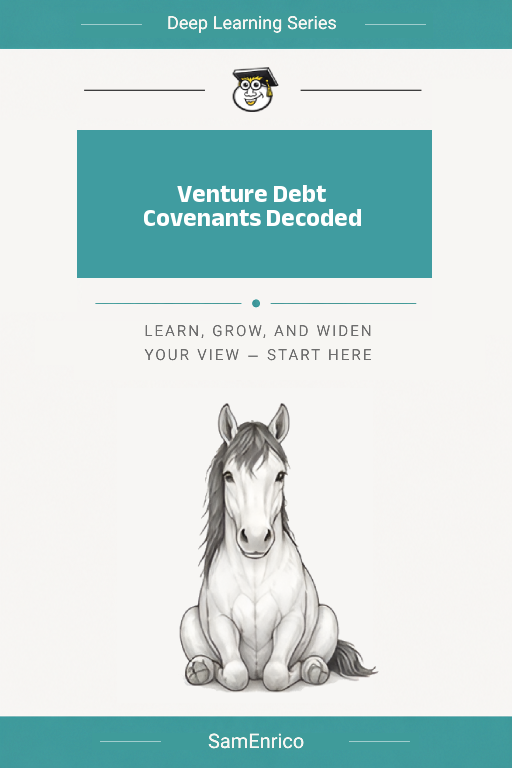
Venture Debt Covenants Decoded
Understand financial covenants (liquidity, revenue
Understand financial covenants (liquidity, revenue minimums) that trigger default, and negotiate covenant-lite terms for early-stage startups.
Formats
About this book
Free sample
Chapter 1: The $5 Million Mistake--It was 11:47 PM on a Tuesday when Sarah Chen, founder of a high-growth Saa S startup, realized she had signed away control of her company. The notification wasn't a dramatic phone call from a lawyer or an angry email from a lender. It was a routine dashboard alert from her bank: available balance, 1,847,322.Theminimumcashcovenantinherventuredebtagreementrequired1,847,322. The minimum cash covenant in her venture debt agreement required 1,847,322.Theminimumcashcovenantinherventuredebtagreementrequired2 million at all times. She was $152,678 short—and she didn't even know what a covenant was when she signed the term sheet eighteen months earlier.The delayed customer payment that caused the shortfall arrived three days later, bringing her balance back to 3.2million.Itdidn′tmatter.Thetechnicaldefaulthadalreadytriggered.Herlender′sautomatedcompliancesystemflaggedthebreach.Withinaweek,shereceivedanoticeofdefault.Withinamonth,herentire3.2 million.
It didn't matter. The technical default had already triggered. Her lender's automated compliance system flagged the breach. Within a week, she received a notice of default. Within a month, her entire 3.2million.Itdidn′tmatter.Thetechnicaldefaulthadalreadytriggered.Herlender′sautomatedcompliancesystemflaggedthebreach.Withinaweek,shereceivedanoticeofdefault.Withinamonth,herentire5 million loan was accelerated—due immediately.
Her board forced a fire sale to repay the debt. Sarah walked away from a company she had built for seven years with less than $500,000.The interest rate on her loan was 11%. She thought she was being smart, using "cheap debt" instead of dilutive equity. The true cost of that decision was not the interest she paid—it was the control she lost. And it all came down to a single paragraph of fine print she never fully read.This is the Venture Debt Illusion.
And this chapter will dismantle it completely.The Most Expensive Myth in Startup Finance Venture debt has become an essential tool in the startup financing toolkit. Over 80% of venture-backed startups now use some form of debt financing between equity rounds, according to industry data from the post-SVB lending environment. The pitch is seductive: borrow money at 10-14% interest instead of giving away 20-30% of your company in an equity round. On paper, the math looks compelling. In reality, that math is dangerously incomplete.The myth sounds like this: "Venture debt is almost as good as equity, but cheaper."Here…
This is the end of the free sample. Get the eBook to keep going. Buy now
Contents
- Chapter 1
- Chapter 2
- Chapter 3
- Chapter 4
- Chapter 5
- Chapter 6
- Chapter 7
- Chapter 8
- Chapter 9
- Chapter 10
- Chapter 11
- Chapter 12
Details
- Author
- Squires Milagros
- Publisher
- SamEnrico
- Language
- English
- Genre
- Non-Fiction, Startup Guide
- Released
- 2026-05-30
- Pages (approx.)
- 150
- Available as
- eBook, Audiobook

Read better in the ZLOADR app
Your eBooks on your phone or tablet. Sign in with your SamEnrico account and start reading.
More by Squires Milagros
 Senior Funeral PlanningSquires Milagros$11.99
 CPR for Cardiac ArrestSquires Milagros$11.99
 Broadcast News Director StressSquires Milagros$11.99
 Anger Management Essential OilsSquires Milagros$11.99
 Sleep Learning For ExamsSquires Milagros$11.99
 The Father's Hidden FortuneSquires Milagros$11.99
 Boxer Self Hypnosis GuideSquires Milagros$11.99
 Action Planning for Real EstateSquires Milagros$11.99
 The Silk Road Gambit: Han China's Forgotten Conquest of the WestSquires Milagros$11.99
 The Cambridge Five: Britain's Betrayal in the Shadows of WarSquires Milagros$11.99
 The Essential Guide to New WaveSquires Milagros$11.99
 How to Start a Crane Lorries Rental (without Operator) Business (Beginners Guide)Squires Milagros$11.99
You may also like
 Hong Kong Handover 1997Dunn Johnnie$11.99
 Zumba For Postnatal Recovery CourseNeal Christian$11.99
 Zumba for BeginnersLadner Nikia$11.99
 YouTube Comment Mining GuideHumes Pandora$12.99
 Worry Box MeditationCarlin Rudy$11.99
 Workplace Stress MeditationNguyen Lynn$11.99
 Workplace Stress and Sleep RepairHawley Ivory$11.99
 Workplace Perfectionism CureDelaney Jeffry$11.99
 Workplace Injustice Anger GuideWallen Isabelle$11.99
 Work Addiction and Burnout LinkGreenwood Ester$11.99
 Women in Yoga and WellnessBeattie Galina$11.99
 Women in Stand Up ComedyChun Evangeline$11.99