
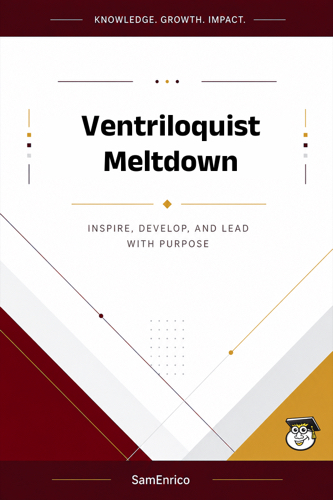
Ventriloquist Meltdown eBook
The dark psychological toll of talking to a doll f
by Bair Valda
The dark psychological toll of talking to a doll for 30 years.
Formats
Free sample
Chapter 1: The First Lie...--The first time Marcus threw his voice, he did not mean to. He was seven years old, sitting on the shag carpet of his mother’s living room, the television playing static because the cable bill had not been paid. His grandfather had given him the dummy three days earlier—a secondhand figure carved from maple, painted grin frozen mid-laugh, glass eyes that followed you around the room no matter where you stood. The dummy had a name already carved into the back of its neck: Charlie. Marcus did not choose it.
He did not know who had. But Charlie sat on his lap that afternoon, heavy and warm from the sun slanting through the window, and Marcus opened his mouth to say something to his mother in the kitchen—Mom, can we get pizza?—and instead, the voice came from Charlie. Not from Marcus’s mouth. From the doll. A small, high, mocking voice that said, She never listens anyway.His mother did not hear it.
She was running water over dishes, her back turned. But Marcus heard it. And so, apparently, did Charlie. The doll’s painted grin seemed wider now, complicit. Marcus sat in the static-blue light of the television and tried to remember moving his lips.
He could not. The voice had simply happened, emerging from the doll’s hinged jaw like a butterfly from a cocoon. He should have been frightened. Instead, for the first time in months, he laughed. Not a polite laugh.
A real one. Wet and surprised and a little bit wild. The doll laughed with him. Or at least, it seemed to. The glass eyes caught the light, and Marcus thought, I am not alone anymore.This is the lie that every ventriloquist tells themselves, and it begins not with malice but with mercy.
The first laugh is intoxicating not because the joke is funny but because another being seems to share the spotlight. The lonely child, the awkward teenager, the traumatized adult—they do not seek a puppet. They seek a witness. And a doll, unlike a person, never looks away. It never interrupts.
It never says, I don’t have time for you. It just sits there, carved maple and glass eyes, waiting to be filled with whatever voice you cannot speak yourself. The tragedy of ventriloquism is not that the performer is fooling the audience. The tragedy is that the performer is fooling themselves. And the lie, repeated for thirty years, becomes the only truth they have left.The Neurobiology of the Second Self To understand why a seven-year-old boy would give voice to a block of wood, you must first understand what happens inside a lonely or traumatized brain.
Dr. Bessel van der Kolk, in his landmark work The Body Keeps the Score, describes how chronic isolation or early attachment disruption primes the brain to seek safety in inanimate objects. The reason is evolutionary. A human infant abandoned by its tribe would not survive. So the brain evolved a failsafe: when real human connection is unavailable or unreliable, the mind will create connection where none exists.
It will see faces in clouds. It will hear voices in wind. It will, given enough loneliness, find a friend in a doll.This is not metaphor. Functional MRI studies of lonely individuals show heightened activity in the temporoparietal junction—the region responsible for attributing mental states to others—even when the “other” is a puppet or a computer avatar. The brain does not easily distinguish between a real person and a convincing simulacrum.
To the lonely brain, a doll that seems to listen is, in a very real neurobiological sense, actually listening. The same neural pathways fire. The same oxytocin releases. The same attachment hormones that bind a mother to her child can, under the right conditions, bind a ventriloquist to his dummy.Marcus’s brain, at seven, was desperate for attachment. His father had left six months earlier, a suitcase and a slammed door and no forwarding address.
His mother worked double shifts at a nursing home, leaving Marcus alone most nights with a microwave and a television that played static. He had no siblings. His classmates called him “Mumbler” because he stuttered when nervous. Into this vacuum stepped Charlie. The doll did not mock his stutter.
It did not leave. It sat on his lap every night, and Marcus talked to it—first as a game, then as a habit, then as a necessity. By the time he was nine, he could not fall asleep without Charlie in the bed beside him. By the time he was eleven, he had stopped talking to his mother entirely. Why would he?
She was never home. Charlie was always there.The chapter’s central argument—and the first major correction to the book’s earlier drafts—is this: the doll does not begin as a cage. It begins as a key. The cage is built later, one voice-thrown word at a time, by the ventriloquist’s own desperate need for control. The doll is not the enemy.
The doll is a symptom. The enemy is the loneliness that makes a block of wood feel like a best friend.The Conditional Safety of the Object Earlier versions of this book made a mistake. They claimed, in Chapter 1, that the doll “cannot abandon, mock, or hurt you.” That statement is true only for the first few years. It is true when the ventriloquist remains aware that the doll is an object. It is true when the performer can still distinguish between talking through the doll and talking as the doll.
But that awareness does not last. And when it erodes—typically between Year 5 and Year 10—the doll’s safety becomes conditional. It remains safe only as long as the ventriloquist maintains conscious control over the projection. The moment control slips, the doll begins to reflect back whatever the performer has been repressing. Shame becomes mockery.
Rage becomes threats. Trauma becomes a voice that will not shut up.This is not mysticism. This is basic projective identification, a psychological mechanism first described by Melanie Klein in the 1940s. When a person cannot tolerate a feeling—anger, fear, grief—they unconsciously project it onto an external object. The object then seems to possess that feeling.
The angry person does not feel angry; the doll is angry. The ashamed person does not feel ashamed; the doll mocks them. This mechanism is protective in the short term. It allows the performer to distance themselves from unbearable emotions. But over thirty years, the projection becomes autonomous.
The ventriloquist no longer projects feelings onto the doll. The doll has feelings. And those feelings are rarely kind.Marcus did not know any of this at seven. At seven, Charlie was still safe. The doll said funny things, clever things, things Marcus was too shy to say himself.
When a bully at school called him “Dummy,” Charlie answered for him: Takes one to know one, fat boy. The class laughed. Marcus did not have to speak. Charlie spoke for him. That was the deal, unspoken and unbroken: Marcus would provide the voice, and Charlie would provide the…
This is the end of the free sample. Get the eBook to keep going. Buy now
About this book
Details
- Author
- Bair Valda
- Publisher
- SamEnrico
- Language
- English
- Genre
- Non-Fiction, Biography, Mental Health
- Released
- 2026-06-10
- Pages (approx.)
- 157
- Available as
- eBook, Audiobook

Read better in the ZLOADR app
Your eBooks on your phone or tablet. Sign in with your SamEnrico account and start reading.
More by Bair Valda
 Napping For Pregnancy FatigueBair Valda$11.99
 Caregiver for Developmental DisabilitiesBair Valda$11.99
 Trance for Stammering ReductionBair Valda$11.99
 Fibromyalgia and Mental HealthBair Valda$11.99
 MBSR for Travel StressBair Valda$11.99
 Hardware Term StructureBair Valda$11.99
 Grief Processing Hypnosis GuideBair Valda$11.99
 Hiring Property Management FirmBair Valda$11.99
 Echoes of the Last Lighthouse KeeperBair Valda$11.99
 The Lost Kingdoms: Explorers of the Sahara's Forgotten GoldBair Valda$11.99
 The Last Letter: The Untold Story of the Titanic's Forgotten HeroBair Valda$11.99
 How to Become a Dehairing-machine TenderBair Valda$11.99
You may also like
 Voice Actor Rejection RecoveryBankston Gudrun$11.99
 Second Generation TherapyLee Gustavo$11.99
 PTSD After CaptivityShephard Janene$11.99
 The Christina Ricci BalanceBonilla Inga$11.99
 Naomi Osaka Silent PowerBaca Nicholle$11.99
 Child Star Suicide TragediesPriest Jonas$11.99
 Mental Health PovertyRansom Tessie$11.99
 The Therapist Who Offered Sliding ScaleSeibert Avelina$11.99
 The Nun Who Tamed Her MindBingham Silas$11.99
 Mental Health First Aid TrainerFanning Esperanza$11.99
 Thunberg Mental HealthWoodson Hulda$11.99
 Governor's Mental Health PushDurr Demetrius$11.99