
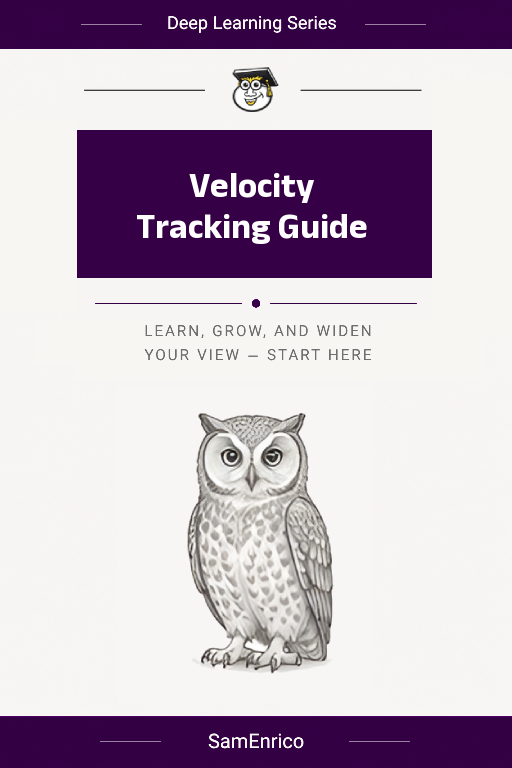
Non-FictionStartup GuideAgile Methods
Velocity Tracking Guide Audiobook
Track team velocity for startup sprints. Historica
Track team velocity for startup sprints. Historical data, capacity planning, and forecasting.
Formats
Free sample
Chapter 1: The 30-Point Lie...--The first time a CEO told me that their team was “crushing it” with a stable velocity of 30 story points per sprint, I asked to see their burndown chart. What I found were eight consecutive sprints where every single task was marked “done” on the last day, zero unplanned work was ever logged, and the product hadn’t shipped a single feature to paying customers in four months. The team was performing “Sprint Theater” — and they had become so good at the performance that even they believed their own numbers.This is the velocity trap. And until you see it, you are already caught.The Day I Stopped Believing in Stable Velocity Let me tell you about a startup called Swift Pay (name changed, story real). They had raised a $12 million Series A, employed 22 engineers across four squads, and proudly displayed their agile metrics on a 65-inch dashboard in the middle of their open office.
Their rolling velocity was 27.3 story points per sprint. For six months, it had never deviated by more than 2 points. The CTO bragged about this at a board meeting: “We are a well-oiled machine.”Three weeks later, they missed their biggest customer commitment. The product simply didn’t work. During the post-mortem, we discovered that the team had been inflating story points, marking tasks complete while leaving critical edge cases untouched, and accumulating technical debt so severe that a simple feature addition required two weeks of refactoring.
The stable velocity was not a sign of health. It was a sign of systemic dishonesty — mostly to themselves.This chapter dismantles the most dangerous misconception in startup agile: that a consistent, predictable velocity is something to celebrate. In a startup environment — where requirements change daily, team members wear multiple hats, and the product itself is an evolving hypothesis — a stable velocity is statistically improbable. When you see it, you are likely seeing fraud, fear, or both.What Velocity Actually Measures (And What It Hides)Before we can diagnose the trap, we must understand the tool. Velocity, in standard agile practice, is the number of story points a team completes in a sprint.
Story points are relative estimates of effort, complexity, and risk. The theory is elegant: by tracking velocity over time, you can predict how much work the team can handle in future sprints.The reality is messier.Velocity measures activity, not outcome. It tells you…
This is the end of the free sample. Get the Audiobook to keep going. Buy now
About this book
Details
- Author
- Fugate Elisabeth
- Publisher
- SamEnrico
- Language
- English
- Genre
- Non-Fiction, Startup Guide, Agile Methods
- Released
- 2026-05-28
- Pages (approx.)
- 124
- Available as
- eBook, Audiobook

Listen in the VoxFlicks app
Audiobooks and audio dramas wherever you go. Sign in with your SamEnrico account and press play.
More by Fugate Elisabeth
 The Goal Decomposition GuideFugate Elisabeth$11.99
 Single Parent Burnout GuideFugate Elisabeth$11.99
 Customer Service AI Tools GuideFugate Elisabeth$11.99
 Sugar Alcohols on KetoFugate Elisabeth$11.99
 Francis of Assisi BiographyFugate Elisabeth$11.99
 Firestorm: The Day the Sky BurnedFugate Elisabeth$11.99
 Learn to Play the RequintoFugate Elisabeth$11.99
 How to Become a Dynamite-packing-machine OperatorFugate Elisabeth$11.99
 Climate Risk Modeling for InsuranceFugate Elisabeth$12.99
 Storeroom AttendantFugate Elisabeth$11.99
You may also like
 Hong Kong Handover 1997Dunn Johnnie$11.99
 Zumba For Postnatal Recovery CourseNeal Christian$11.99
 Zumba for BeginnersLadner Nikia$11.99
 YouTube Comment Mining GuideHumes Pandora$12.99
 Worry Box MeditationCarlin Rudy$11.99
 Workplace Stress MeditationNguyen Lynn$11.99
 Workplace Stress and Sleep RepairHawley Ivory$11.99
 Workplace Perfectionism CureDelaney Jeffry$11.99
 Workplace Injustice Anger GuideWallen Isabelle$11.99
 Work Addiction and Burnout LinkGreenwood Ester$11.99
 Women in Yoga and WellnessBeattie Galina$11.99
 Women in Stand Up ComedyChun Evangeline$11.99