
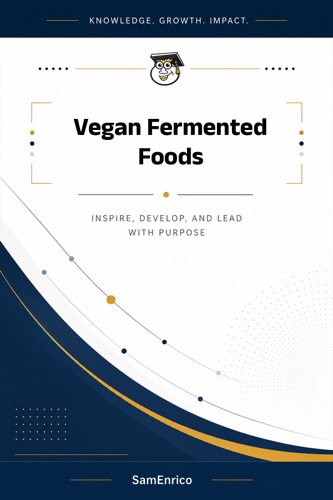
Non-FictionHealth & WellnessGut Health
Vegan Fermented Foods eBook
Boost gut health with kimchi, sauerkraut, and komb
by Romano Berna
Boost gut health with kimchi, sauerkraut, and kombucha.
Formats
Free sample
Chapter 1: The Microbial Bridge--–- The first time I watched a cabbage transform into sauerkraut, I felt like a witness to magic. I had shredded the vegetable, massaged it with salt, and packed it into a jar. Then, for three weeks, I ignored it on my kitchen counter. When I finally opened the lid, the sharp, tangy aroma hit my nose, and I understood—without fully comprehending the science—that something alive had been at work. That something was a world of microbes, invisible architects that had taken my humble cabbage and turned it into a living food, rich with organisms that would go on to colonize my own gut.This chapter is not about recipes.
You will find those in Part 2. Instead, this is the foundation upon which every successful ferment is built: an understanding of why fermentation matters specifically for vegans, how the gut-brain connection works, and what the latest science reveals about fermented foods as medicine. By the end of this chapter, you will see your kitchen counter as a laboratory of transformation—and your digestive tract as a garden waiting to be cultivated.The Vegan Paradox: Why Plants Alone Are Not Enough For decades, the vegan movement has celebrated the power of whole plant foods: fiber, vitamins, antioxidants, and phytochemicals. And rightly so. A well-planned vegan diet reduces the risk of heart disease, type 2 diabetes, and certain cancers.
But there is a paradox that many long-term vegans quietly struggle with: bloating, gas, fatigue, and stubborn nutrient deficiencies despite eating mountains of kale, quinoa, and chickpeas.The culprit is not the plants themselves, but the way we eat them.Most plant foods are encased in cell walls made of cellulose and hemicellulose, structures that human digestive enzymes cannot fully break down. More critically, plants contain anti-nutrients—evolutionary defense compounds that protect the plant from predators but interfere with human nutrient absorption. The two most significant anti-nutrients for vegans are phytic acid (found in grains, nuts, seeds, and legumes) and oxalates (found in spinach, beets, Swiss chard, almonds, and sweet potatoes).Phytic acid binds to minerals—iron, zinc, calcium, and magnesium—forming insoluble complexes that pass through the digestive tract unabsorbed. This is why a vegan eating iron-rich spinach may still become anemic: the oxalates in the spinach bind to the iron, and the phytic acid from the accompanying whole grains binds to whatever iron remains. The result is a nutritional bottleneck.Oxalates present a different danger.
These sharp, crystalline compounds can accumulate in the kidneys, forming stones. For individuals with a genetic predisposition or a gut microbiome lacking oxalate-degrading bacteria, high-oxalate vegan diets can lead to recurrent kidney stones, chronic pain, and even kidney damage.So how do traditional cultures—many of whom ate predominantly plant-based diets—avoid these problems? They fermented.Fermentation as Pre-Digestion Fermentation is not merely a preservation technique. It is a form of pre-digestion. Before you ever take a bite, microbes have already begun breaking down the food for you.Here is what happens inside a fermentation jar.
Lactic acid bacteria—primarily Lactobacillus species—consume the natural sugars in vegetables, grains, or legumes. As they feed, they produce lactic acid, which lowers the p H of the environment. This acidity preserves the food and creates the characteristic sour taste. But more importantly, the bacteria secrete enzymes that break down cell walls, degrade phytic acid, and in some cases, cleave oxalates into harmless byproducts.Consider the difference between raw kale and fermented kale. Raw kale contains oxalates and tough cellulose fibers.
Many people experience digestive distress after eating raw kale because their gut bacteria are not equipped to handle the load. But after a week in a 2% salt brine, that same kale has been partially digested by Lactobacillus. The cell walls have softened. The oxalates have been reduced. The nutrients—vitamin K, calcium, iron—are now more bioavailable because the phytic acid that once bound them has been neutralized.This is the vegan superpower that no supplement can replicate.
You are not just eating food. You are eating food that has been transformed by living collaborators.The Stanford Study: Inflammation and Microbial Diversity In 2021, researchers at Stanford University published a landmark clinical trial that changed how scientists think about fermented foods. The study, led by Justin and Erica Sonnenburg, divided 36 healthy adults into two groups. One group followed a high-fiber diet (45 grams of fiber per day). The other group consumed six servings of fermented foods per day—yogurt, kefir, kombucha, kimchi, sauerkraut, and fermented vegetable brine.After 10 weeks, the results were striking.
The high-fiber group showed no significant change in microbiome diversity or inflammatory markers. The fermented food group, however, demonstrated a dramatic reduction in 19 different inflammatory proteins, including interleukin-6 (IL-6) and interleukin-12 (IL-12), both linked to chronic conditions like rheumatoid arthritis, metabolic syndrome, and even depression.Even more surprising, the fermented food group did not see a massive shift in the composition of their gut microbes. Instead, the existing microbes became more functionally active—expressing genes involved in immune regulation and nutrient metabolism. The researchers concluded that fermented foods exert their benefits not primarily by introducing new bacteria, but by creating an environment in which existing gut microbes thrive.For vegans, this finding is crucial. You do not need to swallow billions of exotic probiotic strains.
You need to feed your native microbes with the metabolites produced during fermentation: lactic acid, short-chain fatty acids, and bioactive peptides. These compounds reduce gut permeability (often called "leaky gut"), calm intestinal inflammation, and signal the immune system to stand down from constant low-grade alert.The Psychobiotic Effect: Fermenting Your Mood The phrase "gut feeling" is not merely metaphorical. The enteric nervous system—a mesh of 500 million neurons lining your digestive tract—is sometimes called the "second brain." This neural network communicates directly with your brain via the vagus nerve, a bidirectional superhighway that runs from your skull down to your colon.What you eat determines what signals travel along that highway.Psychobiotics are a class of probiotics that produce neuroactive compounds capable of influencing mood, anxiety, and cognitive function. Several strains commonly found in vegan ferments—Lactobacillus plantarum, Lactobacillus acidophilus, and Bifidobacterium longum—have been shown in clinical trials to synthesize gamma-aminobutyric acid (GABA), the brain's primary inhibitory neurotransmitter. Low GABA levels are associated with anxiety, insomnia, and panic disorders.Other psychobiotics produce serotonin precursors.
Approximately 90% of the body's serotonin—the "happiness molecule"—is manufactured in the gut, not the brain. But gut-derived serotonin cannot cross the blood-brain barrier. Instead, it acts locally on the enteric nervous system, regulating motility, pain sensitivity, and intestinal permeability. However, the precursors and metabolites produced by gut bacteria can influence central serotonin production indirectly, through the vagus nerve and the immune system.One of the most compelling studies in this field comes from University College Cork, where researchers fed mice a strain of Lactobacillus rhamnosus isolated from a fermented vegetable brine. Compared to control mice, the treated mice showed lower levels of stress hormones, less anxious behavior in maze tests, and higher concentrations of GABA receptors in brain regions associated with emotional regulation.
When the researchers surgically severed the vagus nerve in a second group of mice, the probiotic had no effect. The…
This is the end of the free sample. Get the eBook to keep going. Buy now
About this book
Details
- Author
- Romano Berna
- Publisher
- SamEnrico
- Language
- English
- Genre
- Non-Fiction, Health & Wellness, Gut Health
- Released
- 2026-06-09
- Pages (approx.)
- 139
- Available as
- eBook, Audiobook

Read better in the ZLOADR app
Your eBooks on your phone or tablet. Sign in with your SamEnrico account and start reading.
More by Romano Berna
 Resonant Frequency BreathingRomano Berna$11.99
 SAD And Eating DisordersRomano Berna$11.99
 Virtual Team Asynchronous WorkRomano Berna$11.99
 Anger De escalation in PrisonRomano Berna$11.99
 Nonverbal Cues in Active ListeningRomano Berna$11.99
 The YouTube Car Review ImpactRomano Berna$11.99
 Networking for PilotsRomano Berna$11.99
 The Cosmic Pioneers of Timbuktu: When African Astronomers Charted the StarsRomano Berna$11.99
 The Spice Kings: How Portugal Built a Global EmpireRomano Berna$11.99
 How to Become a Rubber-printing-machine OperatorRomano Berna$11.99
 How to Produce Walk-behind MowersRomano Berna$11.99
 A Collector's Handbook to the Mercedes-benz 250Romano Berna$11.99
You may also like
 Hong Kong Handover 1997Dunn Johnnie$11.99
 Zumba For Postnatal Recovery CourseNeal Christian$11.99
 Zumba for BeginnersLadner Nikia$11.99
 YouTube Comment Mining GuideHumes Pandora$12.99
 Worry Box MeditationCarlin Rudy$11.99
 Workplace Stress MeditationNguyen Lynn$11.99
 Workplace Stress and Sleep RepairHawley Ivory$11.99
 Workplace Perfectionism CureDelaney Jeffry$11.99
 Workplace Injustice Anger GuideWallen Isabelle$11.99
 Work Addiction and Burnout LinkGreenwood Ester$11.99
 Women in Yoga and WellnessBeattie Galina$11.99
 Women in Stand Up ComedyChun Evangeline$11.99