
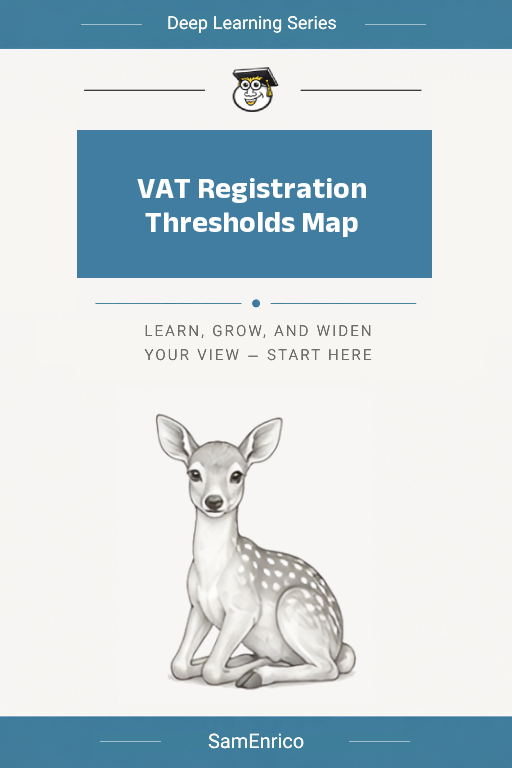
Non-FictionBusiness BriefThresholds
VAT Registration Thresholds Map eBook
Navigate different registration thresholds for dis
Navigate different registration thresholds for distance sales across all 27 EU member states and UK.
Formats
Free sample
Chapter 1: The €10,000 Illusion--The email arrives on a Tuesday morning, usually. Sometimes it comes on a Thursday. But it always comes eventually, and when it does, the seller’s heart stops.“Your Amazon seller account has been suspended due to non-compliance with VAT regulations in one or more European Union member states. Please contact the relevant tax authority immediately.”No warning. No grace period.
No phone number to call for an explanation. Just a frozen account, thousands of euros in pending payouts suddenly inaccessible, and a stack of inventory sitting in warehouses across Europe that you can no longer sell.This scene has played out for more than twelve thousand e-commerce sellers since the EU’s VAT e-commerce package took effect in July 2021. According to data aggregated from VAT compliance firms including Taxually, Marosa, and Pw C, the single most common trigger for these suspensions is not fraud, not misdeclared customs values, not even unpaid VAT. It is a misunderstanding of the €10,000 threshold.Sellers believe, because countless blog posts and You Tube videos have told them so, that they can safely sell up to €10,000 across the entire European Union before needing to worry about VAT registration. They have been told that this is a “small seller exemption,” a “safe harbor,” a “beginner’s allowance.”Every single one of those sellers is wrong.
And every single one of them is at risk.The Most Dangerous Myth in Cross-Border E-Commerce Let me state this as clearly as human language allows: The €10,000 threshold does NOT apply to non-EU sellers.If your business is established outside the European Union—in the United Kingdom, the United States, China, Australia, Canada, or any other non-member country—you have zero threshold. Not €10,000. Not €1,000. Zero. You must register for VAT in an EU member state from the first euro of distance sales you make into that country, or you must use the One-Stop Shop (OSS) scheme to consolidate your obligations.The €10,000 threshold exists in EU law, yes.
But it exists only for businesses that are already established within the European Union. An Italian seller shipping to German customers has a €10,000 threshold before needing to register in Germany via OSS. A French seller shipping to Spanish customers has the same. A British seller shipping to French customers? Zero threshold.
An American seller shipping to any EU country? Zero threshold. A Chinese seller using Amazon FBA in Poland? Zero threshold from the first unit.This distinction is not a technicality. It is not a nuance that only tax lawyers need to understand.
It is the single most important fact in this entire book, and misunderstanding it has cost sellers millions of euros in penalties, back taxes, and lost business.I have spoken with a seller from Manchester who shipped £8,000 worth of children’s toys to Germany over six months. She believed she was safe because her total EU sales were under €10,000. The German tax authority disagreed. They assessed €4,200 in late registration penalties plus €1,800 in VAT on her sales. Her total liability: €6,000 on £8,000 of revenue.
She lost money on every single transaction without knowing it until the penalty letter arrived.I have spoken with a seller from Texas who used Amazon FBA to store 200 units of hiking equipment in a warehouse near Frankfurt. His sales were modest—around €7,000 over nine months. He had no idea that storing inventory in Germany created a “fixed establishment” requiring immediate VAT registration regardless of sales volume. The German tax authority froze his Amazon account, and it took him four months and €9,000 in legal fees to resolve the situation.These stories are not exceptions. They are the rule.What This Chapter Actually Covers Before we go any further, let me be explicit about what this chapter will and will not cover.This chapter will:Define the €10,000 threshold precisely, including who it applies to and how to calculate it Explain the “Cliff Edge” – what happens the moment you exceed €10,001Introduce the concept of “fixed establishment” and why it matters more than sales volume Explain the Opt-Out strategy – why some businesses voluntarily register even when they don’t have to Provide a clear decision framework for EU-established versus non-EU-established sellers This chapter will not:Cover the OSS scheme in detail (that is Chapter 3)Explain country-by-country registration requirements (Chapters 4 through 7)Address Intrastat reporting (Chapter 9)Discuss the Vi DA 2026 reforms (Chapter 11)Think of this chapter as the foundation.
If you do not understand the material here, the rest of this book will confuse rather than clarify. If you do understand it, you will already be ahead of ninety percent of cross-border sellers.The Legal Origin of the €10,000 Threshold The €10,000 threshold comes from Article 54 of the EU VAT Directive (2006/112/EC), as amended by Council Implementing Regulation (EU) 2019/2026. The amendment took effect on July 1, 2021, as part of the broader VAT e-commerce package.Before 2021, the rules were different—and much simpler in some ways, much more complicated in others. Each EU member state had its own distance selling threshold, typically ranging from €35,000 to €100,000. A seller could ship goods across borders without registering for VAT until they exceeded the threshold of each individual destination country.
This created a patchwork of rules that was difficult to navigate but offered genuine safe harbors for small sellers.The 2021 reforms abolished all of those country-specific thresholds for non-resident sellers. In their place, the EU created a single, unified system with two tracks:Track One: EU-established sellers. If your business is legally established in an EU member state, you have a €10,000 EU-wide threshold for B2C distance sales of goods and digital services. Once your total EU-wide sales exceed €10,000 in a calendar year, you must begin charging VAT at the customer’s country rate and reporting via OSS (or via local registrations if you prefer).Track Two: Non-EU-established sellers. If your business is established outside the EU, you have no threshold.
You must register for VAT (or use OSS) from your first sale into the EU.The rationale for this distinction is straightforward. EU-established sellers are already in the EU tax net. They have a VAT number in their home country. They file returns. They are known entities.
The €10,000 threshold is a simplification measure for small businesses that do not want to deal with the complexity of cross-border compliance.Non-EU sellers are not in the EU tax net. They have no EU VAT number. They file no EU returns. They are unknown entities. The EU has no interest in giving them a tax-free allowance when they contribute nothing to the EU tax base.
From the first euro, the EU wants to know who they are, what they are selling, and where their customers are located.This is not unfair. It is not arbitrary. It is a deliberate policy choice, and every non-EU seller needs to understand it.Who Qualifies as “EU-Established”?The definition of “established” is surprisingly complex and has been the subject of dozens of court cases before the Court of Justice of the European Union (CJEU).For VAT purposes, a business is considered “established” in an EU member state if it has either:A seat of economic activity – typically a registered office, branch, or permanent legal presence where key management decisions are made, or A fixed establishment – a physical location with…
This is the end of the free sample. Get the eBook to keep going. Buy now
About this book
Details
- Author
- Mcdowell Amie
- Publisher
- SamEnrico
- Language
- English
- Genre
- Non-Fiction, Business Brief, Thresholds
- Released
- 2026-05-30
- Pages (approx.)
- 153
- Available as
- eBook, Audiobook

Read better in the ZLOADR app
Your eBooks on your phone or tablet. Sign in with your SamEnrico account and start reading.
More by Mcdowell Amie
 Memrise for Language LearningMcdowell Amie$11.99
 Pain as Weather MeditationMcdowell Amie$11.99
 Alcoholism Brain Recovery ScienceMcdowell Amie$11.99
 Bengal Jungle Tiger HunterMcdowell Amie$11.99
 The Financial Stress and HolidaysMcdowell Amie$11.99
 Open Innovation for BusinessMcdowell Amie$11.99
 Daily Planning RitualsMcdowell Amie$11.99
 Meditation for IBS PainMcdowell Amie$11.99
 The Golden Road of the Kingdom of Ghana: Trade, Wealth, and WisdomMcdowell Amie$11.99
 Whispers of the Celestial Weavers: The Lost Art of Star-Mapping NomadsMcdowell Amie$11.99
 How to Produce a Reaper-binderMcdowell Amie$11.99
 Yam: DioscoreaMcdowell Amie$11.99
You may also like
 Hong Kong Handover 1997Dunn Johnnie$11.99
 Zumba For Postnatal Recovery CourseNeal Christian$11.99
 Zumba for BeginnersLadner Nikia$11.99
 YouTube Comment Mining GuideHumes Pandora$12.99
 Worry Box MeditationCarlin Rudy$11.99
 Workplace Stress MeditationNguyen Lynn$11.99
 Workplace Stress and Sleep RepairHawley Ivory$11.99
 Workplace Perfectionism CureDelaney Jeffry$11.99
 Workplace Injustice Anger GuideWallen Isabelle$11.99
 Work Addiction and Burnout LinkGreenwood Ester$11.99
 Women in Yoga and WellnessBeattie Galina$11.99
 Women in Stand Up ComedyChun Evangeline$11.99