
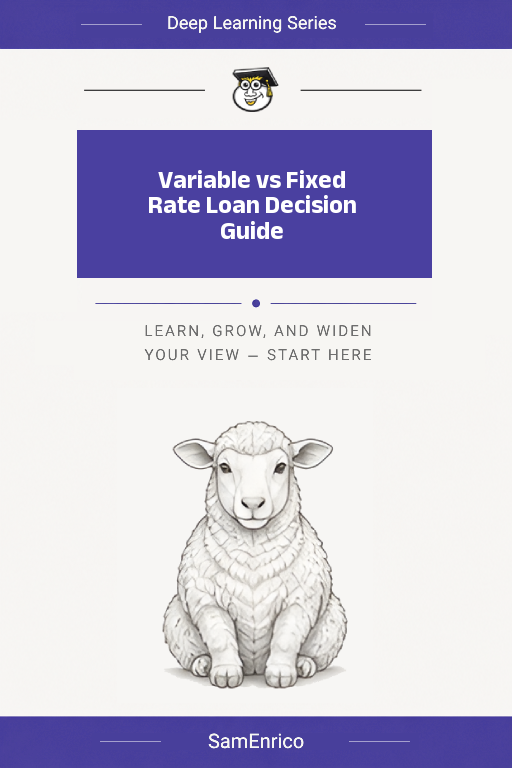
Variable vs Fixed Rate Loan Decision Guide eBook
Choose between loan structures based on your inter
Choose between loan structures based on your interest rate outlook and cash flow stability, protecting small business margins from unexpected hikes.
Formats
Free sample
Chapter 1: The $47,000 Mistake--Maria’s hands trembled as she hung up the phone. Her banker’s voice still echoed in her ears: “Your variable rate has adjusted to 9.25 percent. Your new monthly payment is $4,187.”Just eighteen months earlier, that payment had been $2,800.Maria owned “Sweet Maria’s,” a beloved bakery with two locations in Portland, Oregon. She had taken a $250,000 variable-rate loan to open her second shop. The rate had started at 5.75 percent—almost two full points lower than the fixed-rate offer she had also considered.
Her banker had made it sound so simple: “Rates are stable. Why pay more for certainty you don’t need?”Maria had believed him.Now, standing in her original bakery at 4:30 in the morning, watching flour dust float through the air as her bakers prepared cinnamon rolls for the morning rush, she did the math for the hundredth time. The 4,187paymentwas4,187 payment was 4,187paymentwas1,387 higher than her original payment. That extra 1,387permonthwas1,387 per month was 1,387permonthwas16,644 per year. Her net profit from the second location—the one she had opened with so much hope—was barely $18,000 annually.She was working seventy-hour weeks to pay her banker, not herself.Two months later, Maria closed her second location.
She laid off eleven employees. She sold the ovens, the mixers, the display cases at a steep discount. The “cheap” variable-rate loan had cost her $47,000 in extra interest, uncounted hours of stress, and a dream she had spent five years building.Maria’s story is not unusual. It plays out every single day across the country—in construction companies blindsided by rate hikes, in retail shops that expanded too fast on variable debt, in restaurants that watched their profit margins evaporate one monthly statement at a time.This book exists to ensure that Maria’s story is not your story.The Dangerous Myth That Costs Business Owners Billions Every year, small and medium-sized business owners borrow hundreds of billions of dollars. And every year, a significant percentage of them choose the wrong loan structure.
They are not stupid. They are not reckless. They are simply making decisions based on incomplete information, misleading sales pitches, and a fundamental misunderstanding of how loan structures interact with their specific business reality.The dangerous myth is simple: the interest rate is the most important number on a term sheet.This myth is perpetuated by lenders who benefit from your confusion. It is reinforced by comparison shopping websites that display rates prominently and hide fees in fine print. It is amplified by well-meaning friends who say, “Just find the lowest rate.”But the interest rate is not the most important number.
In many cases, it is not even in the top three.Consider this: a loan with a 7 percent interest rate and a 5 percent upfront fee can have a higher effective cost than a loan with an 8 percent interest rate and no fees. A loan with monthly compounding costs less than a loan with daily compounding—even if the stated rate is identical. A loan with interest that is tax-deductible can be cheaper than a personal loan with a lower stated rate.And most critically: a variable-rate loan that starts at 5 percent but rises to 9 percent over eighteen months can destroy a healthy business, while a fixed-rate loan at 7.5 percent can provide the stability needed to grow.This chapter is the foundation for everything that follows. By the time you finish reading, you will never look at a loan offer the same way again. You will understand exactly what you are actually paying, where the hidden costs lurk, and how to calculate the one number that matters: the true, after-tax, fully-loaded cost of your debt.The Anatomy of a Loan Offer: What They Show You vs.
What They Don’t Before we can calculate true cost, we need to understand what a loan offer actually contains. Most term sheets are designed to highlight favorable numbers and obscure unfavorable ones. Learning to read them correctly is the first step toward protecting your margins.The Interest Rate (What Everyone Looks At)The interest rate is the percentage of your outstanding principal that you pay each year for the privilege of borrowing money. It is expressed as an annual percentage—for example, 6 percent or 8.5 percent.The interest rate is important. It is not, however, the complete picture.
A low interest rate can hide high fees. A low interest rate can be attached to an amortization schedule that front-loads interest payments, creating cash flow problems in the critical early months of a loan. A low interest rate can be undermined by unfavorable compounding frequency.Think of the interest rate as the sticker price on a car. It tells you something, but it does not tell you about the destination fees, the dealer markup, the extended warranty, or the financing charges. You would not buy a car based solely on the sticker price.
You should not borrow money based solely on the interest rate.The Annual Percentage Rate (APR) – Your First Line of Defense The Annual Percentage Rate, or APR, is legally required to include not just the interest rate but also certain mandatory fees. These include origination fees, points, mortgage broker fees, and other closing costs. The APR is expressed as a percentage that is typically higher than the interest rate.Here is the critical insight: the APR allows you to compare loan offers on an apples-to-apples basis.Consider two loans for $100,000:Loan A: 7 percent interest rate, 5 percent origination fee ($5,000). The APR might be 8.2 percent.Loan B: 8 percent interest rate, no origination fee. The APR is 8 percent.Loan B has a higher interest rate but a lower APR.
Loan B is cheaper, even though the headline number looks worse.The chapter worksheets at the end of this book include a True Cost Calculator that will do this math for you. For now, the rule is simple: never compare interest rates alone. Always compare APRs.The Fees That Lenders Don't Shout About Beyond the fees included in APR, there are other costs that may or may not appear in the APR calculation depending on the loan type and lender. These include:Origination fees: A percentage of the loan amount charged for processing the loan. Typically 1 to 5 percent.
A 3 percent origination fee on a 500,000loanis500,000 loan is 500,000loanis15,000—real money that comes directly off your top line.Underwriting fees: Flat fees charged to evaluate your creditworthiness. Typically 500to500 to 500to2,000.Application fees: Sometimes refundable, sometimes not. Often 100to100 to 100to500.Prepayment penalties: Fees charged if you pay off the loan early. These are discussed extensively in later chapters, but for now, understand that they can range from 1 percent of the remaining balance to complex formulas like “yield maintenance” that can cost 5 percent or more.Late payment fees: Often 5 percent of the missed payment amount.Draw fees: For lines of credit or construction loans, fees charged each time you request a draw of funds.The True Cost Calculator in the appendix will help you account for all of these. The key takeaway: read the entire term sheet.
Do not stop at the interest rate. Ask specifically: “What fees are not included in the APR?”The Amortization Trap: Why “Cheap” Loans Can Strangle…
This is the end of the free sample. Get the eBook to keep going. Buy now
About this book
Details
- Author
- Naquin Elidia
- Publisher
- SamEnrico
- Language
- English
- Genre
- Non-Fiction, Annual Checkup
- Released
- 2026-05-30
- Pages (approx.)
- 146
- Available as
- eBook, Audiobook

Read better in the ZLOADR app
Your eBooks on your phone or tablet. Sign in with your SamEnrico account and start reading.
More by Naquin Elidia
 Birth Order Self Esteem IssuesNaquin Elidia$11.99
 E Commerce Persuasion GuideNaquin Elidia$11.99
 The First Five Minutes ManualNaquin Elidia$11.99
 Bereavement Leave GuideNaquin Elidia$11.99
 Nightmare Processing Art TherapyNaquin Elidia$11.99
 Presentation Skills Dubai GuideNaquin Elidia$11.99
 Perfectionism Anger TriggersNaquin Elidia$11.99
 Composite Sketch FallibilityNaquin Elidia$11.99
 The Silk Rebellion: How Shanghai's Fashion Revolution Defied Colonial Rule (1920s)Naquin Elidia$11.99
 Filarete and the Golden Gates of Florence: A Renaissance Vision in BronzeNaquin Elidia$11.99
 A Collector's Handbook to the Daimler Es24Naquin Elidia$11.99
 SMS Based Freemium ExtensionsNaquin Elidia$12.99
You may also like
 Ransomware Evolution ReportWatkins Kara$11.99
 DFIR Response MetricsBolt Eufemia$11.99
 Breach Disclosure TimelinesRudolph Benito$11.99Breach Disclosure TimelinesRudolph Benito$11.99
 SEC Cyber Rules ImpactWorthy Jay$11.99
 Cyber Talent ShortageVanhoose Delta$11.99
 Mobile Malware SurgeCurry Annette$11.99
 Data Breach Cost AnalysisStepp Filiberto$11.99
 Financial Sector BreachesWyman Nicolasa$11.99
 Ransomware EconomicsJacques Keely$11.99
 Cybersecurity Budget BenchmarksBradbury Setsuko$11.99
 Vulnerability Disclosure TrendsMccune Kevin$11.99