
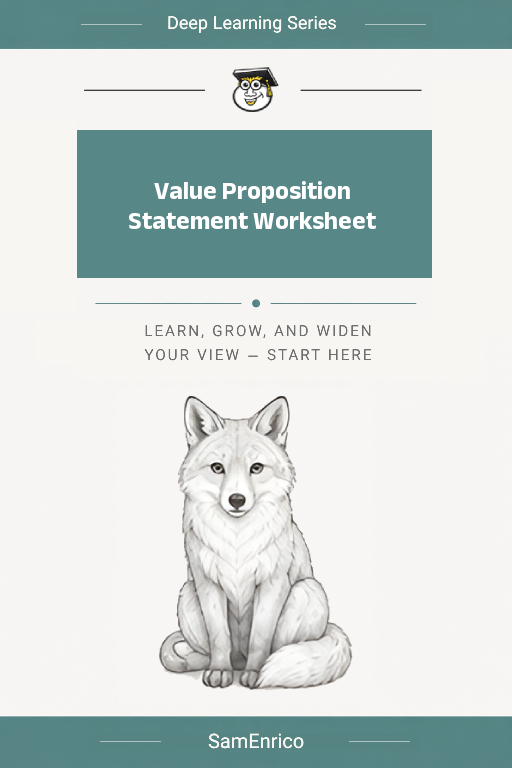
Value Proposition Statement Worksheet eBook
Craft a clear one sentence promise that solves a s
Craft a clear one sentence promise that solves a specific customer problem better than alternatives.
Formats
Free sample
Chapter 1: The Billion-Dollar Blindspot--–- Andy had just raised $12 million. His Saa S platform reduced logistics costs by 18%. His engineering team was top-tier. His advisory board included a former Fortune 500 CIO. Everything about his company said "inevitable success." Everything except one thing: his website.The homepage read: "We provide integrated, synergistic logistics solutions that leverage real-time data to optimize supply chain paradigms and maximize enterprise value."Andy couldn't understand why qualified leads were bouncing in under 30 seconds.
His paid ads were getting clicks. His demo requests? Nearly zero. When I asked him to explain what his company actually did—not what the website said—he replied: "We help warehouse managers stop losing weekends to broken delivery promises."That sentence took him four seconds to say. It had taken his marketing agency six weeks and $47,000 to produce the opposite.This is the billion-dollar blindspot.
And this chapter will prove that you have it too.The Most Expensive Sentence Nobody Reads Let me start with a provocation that will either infuriate you or liberate you: Most businesses do not have a value proposition problem. They have a clarity problem disguised as a strategy problem.Every week, I audit five companies' websites. The pattern is so predictable I could write a script. The founder describes their product brilliantly in conversation—specific, emotional, urgent. Then I scroll to their homepage and find something like:"We are a next-generation, AI-driven, full-stack platform delivering end-to-end solutions for the modern enterprise ecosystem."That sentence contains zero information.
It has been scrubbed of all meaning, all risk, all humanity. It is a corpse dressed in a tuxedo.The billion-dollar mistake is this: We believe that sounding professional is the same as being clear. It is not. Professionalism, in most marketing contexts, is actually performance art for other professionals. Your customer doesn't care if you sound like a Mc Kinsey deck.
They care if you understand why they cried on Tuesday.Let me show you the math.The Seven-Second Tax Here is a number that should terrify you: the average website visitor gives you seven seconds before deciding to stay or leave. Seven seconds. That's roughly eighteen words of reading time at a normal pace.Now let me tell you a second number: the average B2B software homepage contains 1,200 words of copy. Your visitor will read approximately 18 of them. That means you have a 1.5% chance that the word they land on is the word that makes them stay.This is not a traffic problem.
This is not a pricing problem. This is a signal-to-noise problem.Every vague, abstract, or jargon-filled word you write is a tax you charge your customer before they've received any value. Most businesses set that tax at 95% of their copy. Then they wonder why visitors leave without paying.I call this the Seven-Second Tax. It is the silent killer of otherwise excellent businesses.Real-World Exhibit A: The Logistics Company Remember Andy from the opening?
His $12 million logistics platform had one clear, emotional value proposition: "We help warehouse managers stop losing weekends to broken delivery promises."But his website said: "Integrated, synergistic logistics solutions that leverage real-time data to optimize supply chain paradigms and maximize enterprise value."Let me translate the website sentence into plain English: "We do something with logistics and data, and we think that's impressive."Now let me break down why the first sentence works and the second sentence fails. The first sentence names a specific human (warehouse manager). It names a specific pain (lost weekends). It names a specific villain (broken delivery promises). It promises an outcome (stop losing weekends).
The second sentence names no human, no pain, no villain, and no outcome. It names only features dressed up as benefits.Andy's company eventually rewrote their homepage. They put the real sentence front and center. Conversion rates on demo requests increased by 340% in thirty days. The rewrite cost them one hour of focused thinking.
The original cost them $47,000 and six months of missed revenue.That is the billion-dollar blindspot. You are bleeding money not because your product is bad, but because you explain it badly.The Three-Word Confusion That Destroys Most Marketing Before we go any further, we need to perform surgery on a confusion that is responsible for 80% of the bad copy I see. Most business owners, marketers, and even some copywriters cannot distinguish between three fundamentally different things: the Elevator Pitch, the Unique Selling Proposition (USP), and the Value Proposition.These are not the same. Using them interchangeably is like using a hammer to screw in a lightbulb. You might eventually get light, but you'll break a lot of things along the way.The Elevator Pitch: Who You Are The elevator pitch answers the question: "What does your company do?" It is typically delivered verbally, in the time it takes to ride an elevator (hence the name).
It is about identity and category.Examples:"We're a CRM software company.""We're a boutique marketing agency focused on e-commerce.""We make artisanal coffee equipment."Notice something? Elevator pitches are boring. They are supposed to be. They are category labels, not promises. If you lead with your elevator pitch on your website, you have already lost.
The customer doesn't care what category you're in. They care whether you can solve their problem.The Unique Selling Proposition (USP): What You Have The USP answers the question: "What makes you different from other companies in your category?" It is about features, differentiators, and proprietary advantages.Examples:"Our CRM includes AI-powered forecasting.""We offer same-day turnaround on all design requests.""Our espresso machines use dual-boiler technology."USPs are useful for comparison shopping. They belong on product pages, pricing tables, and feature comparison grids. They do not belong in your headline. A USP tells the customer what you have.
A value proposition tells the customer what they get. Those are different conversations.The Value Proposition: What the Customer Gets The value proposition answers the question: "Why should I give you my money instead of keeping it or giving it to someone else?" It is about outcomes, transformations, and the elimination of a specific pain.Examples:"Stop losing weekends to broken delivery promises.""Never embarrass yourself in front of your boss again.""Wake up without back pain for the first time in ten years."Notice the difference? The value proposition makes the customer the hero. The customer's pain is named. The customer's desired outcome is promised.
The company disappears into the background.The billion-dollar mistake is leading with what you have instead of what they get.Why Your Brain Writes Bad Copy (And How to Catch It)Here is a frustrating truth: you are almost certainly incapable of objectively evaluating your own value proposition.This is not because you are stupid or arrogant. It is because of a cognitive bias called the Curse of Knowledge. Once you know something, you cannot imagine what it was like not to know it. You have been living inside your product, your industry, your jargon, and your internal conversations for months or years. What seems obvious to you is opaque to your customer.Let me demonstrate.I want you to complete the following sentence without thinking: "We help __________ who are tired of __________ by __________, so…
This is the end of the free sample. Get the eBook to keep going. Buy now
About this book
Details
- Author
- Culp Lakeisha
- Publisher
- SamEnrico
- Language
- English
- Genre
- Non-Fiction, First 30 Days
- Released
- 2026-06-01
- Pages (approx.)
- 152
- Available as
- eBook, Audiobook

Read better in the ZLOADR app
Your eBooks on your phone or tablet. Sign in with your SamEnrico account and start reading.
More by Culp Lakeisha
 Faith Based Recovery ApproachCulp Lakeisha$11.99
 Esports Betting AddictionCulp Lakeisha$11.99
 Sponsored Parent Immigration Journey GuideCulp Lakeisha$11.99
 Coping With Stress as a Trauma NurseCulp Lakeisha$11.99
 The Underground BunkerCulp Lakeisha$11.99
 Meditation For Health AnxietyCulp Lakeisha$11.99
 Medical School Stress SolutionsCulp Lakeisha$11.99
 Employee Layoff ProtocolsCulp Lakeisha$11.99
 Riders of the Midnight Sun: The Untold Tale of the Black Buffalo Soldiers in AlaskaCulp Lakeisha$11.99
 The Velvet and the Steel: Florence's Renaissance PowerhousesCulp Lakeisha$11.99
 How to Start a Martial Arts Instruction Business (Beginners Guide)Culp Lakeisha$11.99
 Growing DaboeciaCulp Lakeisha$11.99
You may also like
 Website Launch For New LLCStrunk Tracee$12.99
 Shopify Market Expansion GuideGaffney Jude$12.99
 Power Backup Solutions for Philippine VAsPearce Eldon$12.99
 Feedback License Clause TemplateCrum Ashli$12.99Feedback License Clause TemplateCrum Ashli$12.99Feedback License Clause TemplateCrum Ashli$12.99Feedback License Clause TemplateCrum Ashli$12.99Feedback License Clause TemplateCrum Ashli$12.99Feedback License Clause TemplateCrum Ashli$12.99Feedback License Clause TemplateCrum Ashli$12.99Feedback License Clause TemplateCrum Ashli$12.99
 Channel Distribution On One PagePetersen Narcisa$12.99