
Non-FictionSelf-HelpCommunication
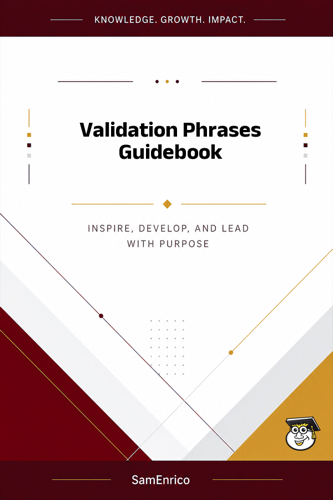
Validation Phrases Guidebook eBook
Use specific language to make others feel truly he
by Grubb Neida
Use specific language to make others feel truly heard with this practical communication guide.
Formats
Free sample
Chapter 1: The Empty Cup...--–- Every morning at 7:42 AM, Sarah poured herself a cup of coffee. She was good at pouring. She was good at listening, too. For thirty-seven years, she had been the friend everyone called after a breakup, the coworker who stayed late to hear complaints about the boss, the wife who nodded through her husband's work rants while her own words dissolved in her throat. She knew exactly what to say to calm a crying child, to de-escalate an angry client, to make her mother feel heard during their weekly phone calls.
Her friends called her "the therapist." Her performance reviews praised her "interpersonal skills." Her husband said she was "the most understanding person I know."Then one Tuesday, Sarah sat in her parked car in the garage, engine off, keys in her lap, and realized she could not remember the last time anyone had asked how she was feeling. Not a casual "How are you?" tossed over a shoulder while walking away. A real question. A pause. A moment of someone else's silence holding space for her words.
She sat there for eleven minutes. No one called. No one texted. The garage was quiet. And Sarah, who had a thousand validation phrases memorized for everyone else, could not find a single one to say to herself.This book exists because of Sarah.
And because of you. Because the most overlooked truth in every bestselling communication guide—from Carnegie to Gottman to the latest DBT workbook—is this: you cannot pour from an empty cup. You can memorize every script, master every level of validation, and recite "It makes sense that you feel that way" in your sleep. But if you have no language for your own inner experience, your validation of others will eventually crack. It will sound hollow.
It will become resentful. Or, most likely, it will simply exhaust you until you stop offering it altogether.This chapter is the foundation of everything that follows. Before you learn how to make others feel heard, you must learn how to make yourself heard—by yourself. Self-validation is not self-indulgence. It is not narcissism.
It is not an excuse for bad behavior. Self-validation is emotional hygiene. It is the difference between offering someone a glass of water from a full pitcher versus squeezing the last drops from a sponge. One feels generous. The other feels desperate, and the person receiving it can tell the difference.Over the next twenty pages, you will learn why self-validation is the prerequisite for all external validation, how to distinguish self-validation from self-excuse, and three specific practices—the Mirror Script, the Past Self Letter, and the Inner Child Pause—that will rewire your internal dialogue.
By the end of this chapter, you will have a concrete, repeatable method for turning the H.E.A.R.D. method (introduced in the Introduction, detailed in Chapter 3) inward. And you will understand why the 30-Day Challenge in Chapter 12 demands that you spend your first full week on self-validation alone, before you say a single validating word to another human being.The Great Inversion: Why Communication Books Have It Backwards Every popular communication book follows the same structure. First, they diagnose the problem: you are bad at listening. Second, they present a framework: here are the four steps, six levels, or eight skills of effective validation.
Third, they offer scripts: say this, not that. Fourth, they send you out into the world to practice on your spouse, your children, your colleagues, your difficult mother-in-law.There is nothing wrong with these steps. They are useful. They are evidence-based. They have helped millions of people argue less and connect more.
But they share a fatal assumption: that the reader is already capable of offering genuine, sustainable validation to others. This assumption is false for the majority of people who pick up books like this one.Here is what the research actually shows, drawn from clinical psychologist Caroline Fleck's recent synthesis of validation studies. People who score highest on measures of empathic accuracy—the ability to accurately identify what another person is feeling—also score highest on measures of self-neglect. They report higher rates of burnout, resentment, and emotional exhaustion. They are more likely to say "I'm fine" when they are not.
They are more likely to rate their own emotional needs as less important than the needs of others. In other words, the people who are best at validating everyone else are often the worst at validating themselves.This is the Great Inversion. We assume that learning to validate others will make us better people. But the causal arrow may point the opposite direction. Learning to validate yourself may be the only path to sustainable, authentic validation of others.
Because when you have no practice turning your own "It makes sense that I feel this way" inward, your external validation becomes a performance. You are acting. And the people you are validating can feel it.Let me prove this to you with a simple exercise. Think of the last time someone said to you, "I understand how you feel." Not the last time someone actually understood—the last time someone said the words. Now think about the difference between the times those words landed as genuine versus the times they landed as hollow.
What was the difference? In almost every case, the difference was not the words. The difference was the speaker's capacity to tolerate their own discomfort with your emotion. People who are comfortable with their own anger can validate yours without flinching. People who have made peace with their own sadness can sit in yours without rushing to fix it.
People who have learned to say "It makes sense that I feel this way" to themselves can say the same to you without it sounding like a script.Self-validation is not a warm-up exercise for the real work of external validation. Self-validation is the real work. Everything else is technique.The Three Myths That Keep You from Validating Yourself Before we get to the practices, we need to clear away three myths that prevent smart, empathic, well-intentioned people from learning self-validation. These myths are not your fault. They are baked into the culture.Myth #1: Self-validation is selfish.This is the most pervasive and destructive myth.
We are taught from childhood that paying attention to our own feelings is narcissistic. "Stop thinking about yourself" is a common reprimand. "Other people have it worse" is considered comfort. The result is a population of adults who can list everyone else's emotions in exquisite detail but cannot name their own without a thesaurus.Here is the truth: self-validation is the opposite of selfishness. Selfishness is taking emotional resources from others without replenishing them.
Self-validation is generating emotional resources internally so that you have something to give. The research on caregiver burnout is unequivocal: the most compassionate nurses, therapists, and parents are not the ones who sacrifice themselves endlessly. They are the ones who practice rigorous self-care, including the emotional care of acknowledging their own difficult feelings. Self-validation is not a luxury. It is the maintenance schedule for your compassion engine.Myth #2: Self-validation is just making excuses.This myth confuses validation…
This is the end of the free sample. Get the eBook to keep going. Buy now
About this book
Details
- Author
- Grubb Neida
- Publisher
- SamEnrico
- Language
- English
- Genre
- Non-Fiction, Self-Help, Communication
- Released
- 2026-06-06
- Pages (approx.)
- 133
- Available as
- eBook, Audiobook

Read better in the ZLOADR app
Your eBooks on your phone or tablet. Sign in with your SamEnrico account and start reading.
More by Grubb Neida
 Service Level Agreement DesignGrubb Neida$11.99
 The Improv Life MemoirGrubb Neida$11.99
 Portion Control Without ScalesGrubb Neida$11.99
 The Jay Z Business of Hip HopGrubb Neida$11.99
 Galen of Pergamon: The Architect of Roman MedicineGrubb Neida$11.99
 How to Become a Title SupervisorGrubb Neida$11.99
 Startup Payment ProcessingGrubb Neida$12.99
 Wildfire Insurance GuideGrubb Neida$12.99
 SARIMA Model OperatorGrubb Neida$11.99
You may also like
 Hong Kong Handover 1997Dunn Johnnie$11.99
 Zumba For Postnatal Recovery CourseNeal Christian$11.99
 Zumba for BeginnersLadner Nikia$11.99
 YouTube Comment Mining GuideHumes Pandora$12.99
 Worry Box MeditationCarlin Rudy$11.99
 Workplace Stress MeditationNguyen Lynn$11.99
 Workplace Stress and Sleep RepairHawley Ivory$11.99
 Workplace Perfectionism CureDelaney Jeffry$11.99
 Workplace Injustice Anger GuideWallen Isabelle$11.99
 Work Addiction and Burnout LinkGreenwood Ester$11.99
 Women in Yoga and WellnessBeattie Galina$11.99
 Women in Stand Up ComedyChun Evangeline$11.99