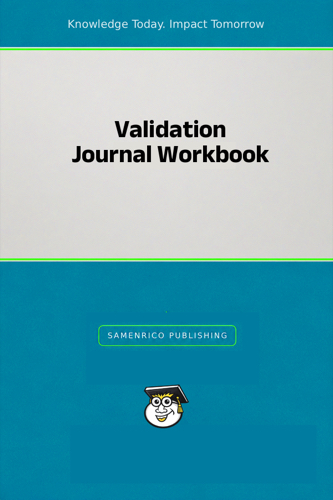
Validation Journal Workbook eBook
Practice writing validating responses to hypotheti
Practice writing validating responses to hypothetical and real situations.
Formats
Free sample
Chapter 1: The Invalidation Hangover...--–- You know the feeling. Someone you love is upset. Their voice cracks, or their jaw tightens, or they go very, very quiet. You want to help. You need to help.
So you offer a solution: "Why don't you just..." Or you try to comfort them: "It's not that bad." Or you explain why they shouldn't feel that way: "You're overreacting." And then it happens. The shutdown. The sigh. The words that land like a door slamming: "You don't get it."You are left standing there, confused and a little defensive. I was only trying to help, you think.
Why are they pulling away?Welcome to the invalidation hangover.This chapter is not about what to do right. It is about what you are doing wrong. Before you can learn the six levels of validation, before you can practice reflective listening or normalize someone's shame, you must first see the invisible wounds you are leaving behind. Because here is the hard truth that no one tells you: Most of what we call "helping" is actually harming. And the person on the receiving end feels it in their body—even if they cannot name it.By the end of this chapter, you will have a name for that feeling.
You will understand why your best intentions go sideways. And you will complete your own Invalidation Audit—a personal inventory of the toxic patterns you reach for when someone is suffering. This is not about shame. It is about sight. You cannot change what you cannot see.The Invalidation Hangover: A Definition Let’s name the elephant in the room.
An invalidation hangover is the lingering emotional pain, defensiveness, shutdown, or resentment that occurs after someone minimizes, dismisses, problem-solves, or otherwise fails to acknowledge your emotional experience. It is called a hangover because the effects are delayed and physiological. You do not always feel the sting in the moment. Sometimes you walk away feeling fine, only to realize an hour later—or a day later—that you feel small, angry, or profoundly alone.Invalidation hangovers happen in every relationship: between parents and children, partners, friends, coworkers, and even the voice inside your own head. They accumulate.
One invalidating comment might be survivable. But a childhood of them? A marriage of them? A workplace culture of them? That changes your nervous system.Consider this scenario: You come home from a brutal day at work.
Your boss publicly criticized your presentation. You held back tears in the meeting. You tell your partner, "I feel so humiliated."Your partner responds: "Don't let him get to you. You're great at your job. Just ignore him."On paper, this sounds supportive.
But notice what happens inside you. You do not feel better. You feel... dismissed. Because your partner skipped over the emotion (humiliation) and jumped straight to fixing (ignore him).
The underlying message, whether intended or not, is: Your feeling is an inconvenience. Let's move past it.That is an invalidation hangover.The Biosocial Theory: Why It Hurts So Much Why does invalidation hurt more than a simple disagreement? The answer lies in the biosocial theory, developed by psychologist Marsha Linehan, the creator of Dialectical Behavior Therapy (DBT). The theory has two parts: bio and social.The Bio Part: Some people are born with a more sensitive nervous system. Their emotions are more intense, rise more quickly, and take longer to return to baseline.
This is not a flaw; it is a biological variation, like having blue eyes or being tall. These individuals feel everything more—joy, grief, anger, and fear.The Social Part: When a biologically sensitive person grows up in an environment that repeatedly invalidates their emotions (e.g., "You're too sensitive," "Stop crying," "It's not a big deal"), two things happen. First, they never learn to trust their own emotional reality. Second, their nervous system stays in a state of high alert because their distress signals are consistently ignored.The result is chronic emotional dysregulation. The person cannot calm down because their environment has taught them that their internal experience is wrong.But here is the crucial insight for this workbook: You do not need to be biologically sensitive to be harmed by invalidation.
And you do not need to have grown up in an invalidating environment to experience a hangover. Invalidation raises everyone's physiological arousal. Studies show that when someone is invalidated, their heart rate increases, cortisol (stress hormone) spikes, and the parts of the brain associated with social rejection light up. In other words, invalidation is not just "hurt feelings." It is a biological event.A study from UCLA found that social rejection activates the same neural pathways as physical pain. When someone invalidates you, your brain processes it like a punch.
The only difference is that bruises fade faster.The Four Faces of Invalidation Invalidation wears many masks. Most people do not realize they are being invalidating because our culture has taught us that these responses are helpful. Let us examine the four most common invalidating patterns. As you read, ask yourself: Which of these faces do I wear?Face 1: The Minimizer The Minimizer shrinks emotions down to a manageable size. They mean well.
They want to help you see that things are not as bad as they seem. But here is the problem: When you are drowning in ten feet of water, being told that the water is only eight feet does not help you breathe.Common Minimizer phrases:"It's not that bad.""Don't cry.""Look on the bright side.""At least you have your health.""Other people have it worse."The Minimizer's fatal flaw is that they skip over the emotion entirely. They move straight to reframing. But reframing only works after the emotion has been acknowledged. Try telling a toddler who just dropped their ice cream that "at least it wasn't cake." They will still scream.
And they should. The ice cream is gone.Face 2: The Justifier The Justifier explains why you should not feel the way you feel. They are often logical, rational people who believe that emotions are problems to be solved with reasoning. They will listen to your pain and then explain, step by step, why your perception is wrong.Common Justifier phrases:"You shouldn't feel that way because...""Here's why you're actually wrong about that.""If you think about it logically...""You're being irrational.""Let me play devil's advocate."The Justifier's fatal flaw is that they treat emotions as arguments. But emotions are not arguments.
They are not right or wrong. They just are. When you justify against an emotion, you are not changing the emotion; you are adding shame on top of it. Now the person feels sad and stupid for being sad.Face 3: The Problem-Solver The Problem-Solver is the most well-intentioned of the four. They genuinely want to help.
They hear a problem, and their brain immediately jumps to solutions. They offer advice, suggestions, and action steps. They cannot understand why the other person is not grateful.Common Problem-Solver phrases:"Why don't you just...""Have you tried...?""Here's what you should do.""The first step is...""Let me help you fix this."The Problem-Solver's fatal flaw is that most people do not want solutions.…
This is the end of the free sample. Get the eBook to keep going. Buy now
About this book
Details
- Author
- Raymond Joseph
- Publisher
- SamEnrico
- Language
- English
- Genre
- Non-Fiction, Self-Help, Journal
- Released
- 2026-06-09
- Pages (approx.)
- 143
- Available as
- eBook, Audiobook

Read better in the ZLOADR app
Your eBooks on your phone or tablet. Sign in with your SamEnrico account and start reading.
More by Raymond Joseph
 HIIT For New Moms GuideRaymond Joseph$11.99
 The ADHD Parent Anger GuideRaymond Joseph$11.99
 Twelve Step for IncarceratedRaymond Joseph$11.99
 The Cost Plus Pricing GuideRaymond Joseph$11.99
 The Phoenix Protocol: When Fire Wrote HistoryRaymond Joseph$11.99
 Lava Flow MonitoringRaymond Joseph$11.99
 How to Start a Blood Pudding Business (Beginners Guide)Raymond Joseph$11.99
 Federal 8a Program BlueprintRaymond Joseph$12.99
 LinkedIn PR for StartupsRaymond Joseph$12.99