
Non-FictionSelf-HelpRelationships
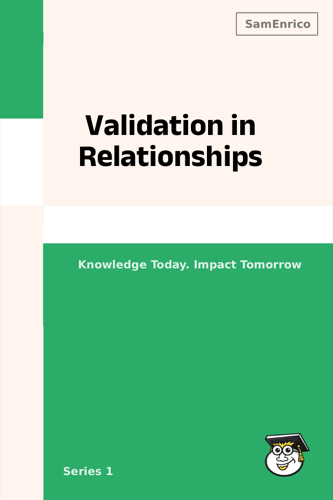
Validation in Relationships eBook
Make your partner feel heard and understood in con
by Richey Graig
Make your partner feel heard and understood in conflict.
Formats
Free sample
Chapter 1: The Protest Polka--Every fight about the dishes is actually a fight about something else entirely. Not metaphorically. Literally. When you scream at your partner for leaving the trash can overflowing, you are not, on a neurological level, experiencing anger about garbage. You are experiencing a primal, ancient terror that your attachment figure has turned away from you.
The trash is just the nearest weapon. This chapter will rewire how you understand every argument you have ever had or will ever have. It introduces the single most important diagnostic tool in this book—the Demon Dialogues—and establishes a foundational truth that will echo through every subsequent chapter: anger is almost never the real emotion. Behind every explosion is a softer, more vulnerable feeling: fear, shame, loneliness, or the desperate cry to be held. Learn to see the dance beneath the words, and you have already won half the battle.The Dishes Are a Lie Let us begin with a scene so common it has become a cliché.
It is 6:47 PM on a Tuesday. You have worked nine hours, sat in traffic for forty-five minutes, and walked through the door carrying groceries. The first thing you see is the kitchen sink. It is overflowing with dishes from breakfast. The second thing you see is your partner, sitting on the couch, scrolling through their phone.Something snaps."You NEVER help around here," you say.
Or perhaps you are on the receiving end: "Why are you always on my case? I was just about to do them."Within ninety seconds, you are in a full-scale argument about dishwashing. Someone storms out. Someone cries in the bathroom. The evening is ruined.
Tomorrow, you will apologize awkwardly, or you will not, and the resentment will settle into your bones like sediment.Here is what this book wants you to understand with absolute clarity: The fight was never about the dishes.Not once. Not ever. Not in the history of human relationships has a marriage ended because of unwashed porcelain. Marriages end because of what the dishes represent. The dishes are a protest.
They are a desperate, clumsy, inarticulate cry from your attachment system—the ancient, hardwired survival mechanism in your brain that constantly monitors whether your primary person is emotionally available to you.Dr. Sue Johnson, the founder of Emotionally Focused Therapy (EFT), calls these moments attachment protests. An attachment protest is any behavior—criticism, nagging, shouting, crying, clinging, or stonewalling—whose hidden purpose is to demand: "Are you still there? Do I still matter to you? Will you respond to me?"Your partner did not leave the dishes because they are lazy.
They left the dishes because they were exhausted, distracted, or dissociated. Your explosion about the dishes was not about hygiene. It was about the terrifying moment you walked in and saw them not looking at you. In that instant, your attachment system screamed: Danger! You are invisible!
Reconnect now!The content of the fight is always, always, always a decoy. The real fight is always about one question: Are you emotionally accessible to me right now?The Anatomy of an Attachment Protest To understand why a dish can trigger a divorce, you need to understand your brain. Deep in your limbic system, buried beneath the neocortex that handles language and logic, sits the amygdala. Its job is to scan for threats. It does not know the difference between a saber-toothed tiger and a partner who scrolls past you on their phone.
To your amygdala, emotional disconnection is a survival threat. In the ancestral environment, to be exiled from your tribe was to die alone on the savannah.When you perceive that your partner is not responding to you—they did not hear you, they did not look up, they chose the phone over you—your amygdala releases a flood of stress hormones: cortisol and adrenaline. Your heart rate spikes. Your blood pressure rises. Your prefrontal cortex, the part of your brain responsible for rational thought and impulse control, literally goes offline.
This is called amygdala hijack.You cannot think straight when you are hijacked. You cannot access your "good relationship advice." You cannot remember that you love this person. All you can do is act. And you have only two evolutionarily programmed responses to threat: attack or flee.Attack looks like criticism, nagging, yelling, name-calling, sarcasm, or contempt. "You are so selfish.
You never care about me. What is wrong with you?"Flee looks like stonewalling, leaving the room, going silent, saying "I'm fine" when you are not, or scrolling through your phone to escape.Both are attachment protests. Both are saying the same thing: "I am terrified of losing you, and I do not know how to say that, so I will scream or disappear instead."The tragedy is that the attack response terrifies the partner who tends to flee, making them run faster. And the flee response enrages the partner who tends to attack, making them chase harder. Neither partner is wrong.
Both are terrified. And neither knows how to say the one sentence that would actually fix it: "I am scared. Hold me."The Demon Dialogues: Three Dances of Destruction Most couples do not fight about one thing. They fight about the same thing, in the same pattern, over and over again, for decades. EFT has identified three primary destructive patterns—dances, really—that hijack relationships.
Dr. Johnson calls them the Demon Dialogues. Learn to recognize them, because you cannot change a dance until you can name it.Demon Dialogue 1: Find the Bad Guy This is the simplest and most seductive pattern. Something goes wrong—a late arrival, a forgotten anniversary, a harsh word. Immediately, both partners begin to assemble a case.
Their goal is not to solve the problem. Their goal is to prove who is at fault."You are always late because you do not respect my time.""You are controlling because you cannot handle five minutes of flexibility."Notice the language: "You are." Not "You did." Not "This happened." You are. This is character assassination disguised as conflict. When you say "You are lazy," you are not describing behavior. You are assigning a permanent, unchangeable identity to your partner.
And once someone has been assigned the identity of "the bad guy," there is no room for repair. The only way to win Find the Bad Guy is to make your partner lose. And when your partner loses, they feel shamed, humiliated, and abandoned. The victory is pyrrhic. You have won the argument and lost the connection.How to spot it: Listen for global, static accusations.
"You always," "You never," "You are," "You have always been." These are the linguistic fingerprints of Find the Bad Guy. The antidote, which we will explore in Chapter 5, is specificity and the Soft Startup.Demon Dialogue 2: The Protest Polka This is the most common dance, and the one that gives this chapter its title. The Protest Polka occurs when one partner attacks and chases, and the other withdraws and distances. The more the Pursuer chases, the more the Withdrawer runs. The more the Withdrawer runs, the more terrified the Pursuer becomes, so they chase harder.
It is a polka of escalating pain, and it has been danced for thousands of years.The Pursuer tends to feel…
This is the end of the free sample. Get the eBook to keep going. Buy now
About this book
Details
- Author
- Richey Graig
- Publisher
- SamEnrico
- Language
- English
- Genre
- Non-Fiction, Self-Help, Relationships
- Released
- 2026-06-08
- Pages (approx.)
- 136
- Available as
- eBook, Audiobook

Read better in the ZLOADR app
Your eBooks on your phone or tablet. Sign in with your SamEnrico account and start reading.
More by Richey Graig
 I Statements Mastery GuideRichey Graig$11.99
 Gaming for StudentsRichey Graig$11.99
 The Stress and ED GuideRichey Graig$11.99
 Number Shape System GuideRichey Graig$11.99
 Veteran Nightmare ReliefRichey Graig$11.99
 Wholesaling Deal AnalyzerRichey Graig$11.99
 Retirement Account Double DipRichey Graig$11.99
 The Silk Warriors: Japan's Textile Revolution and the Birth of Modern Fabric Innovation (1920s-1940s)Richey Graig$11.99
 The Fire and Fury of Imhotep: Egypt's Volcanic ArchitectRichey Graig$11.99
 Admiralty Law: Maritime Jurisdiction & ShippingRichey Graig$11.99
 How to Become a Abrasive MixerRichey Graig$11.99
 Co-Founder Communication Stack HandbookRichey Graig$12.99
You may also like
 Hong Kong Handover 1997Dunn Johnnie$11.99
 Zumba For Postnatal Recovery CourseNeal Christian$11.99
 Zumba for BeginnersLadner Nikia$11.99
 YouTube Comment Mining GuideHumes Pandora$12.99
 Worry Box MeditationCarlin Rudy$11.99
 Workplace Stress MeditationNguyen Lynn$11.99
 Workplace Stress and Sleep RepairHawley Ivory$11.99
 Workplace Perfectionism CureDelaney Jeffry$11.99
 Workplace Injustice Anger GuideWallen Isabelle$11.99
 Work Addiction and Burnout LinkGreenwood Ester$11.99
 Women in Yoga and WellnessBeattie Galina$11.99
 Women in Stand Up ComedyChun Evangeline$11.99