
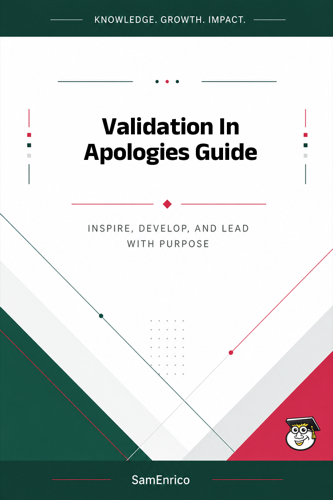
Validation In Apologies Guide
Validate hurt feelings before offering explanation
by Dube Soila
Validate hurt feelings before offering explanation or amends.
Formats
About this book
Free sample
Chapter 1: The Apology Lie--Every apology you have ever given or received that failed did so for the same reason. It was not because the harm was too great, the relationship too damaged, or the words poorly chosen. It was because someone explained too soon.Think of the last apology that landed like a slap instead of a balm. Perhaps you were the one apologizing. You said “I’m sorry” and then, because silence felt unbearable, you kept going.
You explained the traffic. You explained the stress at work. You explained that you never meant to hurt them, that it was a misunderstanding, that if they had just understood your intentions they would not be so upset. And the more you explained, the further they retreated. Or perhaps you were the hurt person.
Someone wronged you, and when they finally came to apologize, they spent ten minutes telling you why they did what they did. You heard their reasons. You understood their logic. And somehow you felt worse than before the apology started.This is the apology lie. It is the deeply embedded, culturally reinforced, intuitively appealing falsehood that a good apology requires an explanation.
We believe that if we can just make the other person understand our perspective, they will forgive us. We believe that hurt feelings are the result of misunderstanding, and that clarity will heal everything. We believe that the person who caused harm should have the chance to tell their side of the story before the injured party decides whether to accept the apology.Every single one of those beliefs is wrong. And until you unlearn them, your apologies will continue to fail.The truth is far simpler and far harder to accept: when someone is hurt, your explanation is not an apology. It is an obstacle.
It is a wall between their pain and your presence. It is the fastest way to turn a potential moment of repair into an argument about who is right. The single most powerful thing you can do in the first minutes of an apology is to say nothing about yourself…
This is the end of the free sample. Get the eBook to keep going. Buy now
Contents
- Chapter 1
- Chapter 2
- Chapter 3
- Chapter 4
- Chapter 5
- Chapter 6
- Chapter 7
- Chapter 8
- Chapter 9
- Chapter 10
- Chapter 11
- Chapter 12
Details
- Author
- Dube Soila
- Publisher
- SamEnrico
- Language
- English
- Genre
- Non-Fiction, Self-Help, Apology
- Released
- 2026-06-10
- Pages (approx.)
- 151
- Available as
- eBook, Audiobook

Read better in the ZLOADR app
Your eBooks on your phone or tablet. Sign in with your SamEnrico account and start reading.
More by Dube Soila
 Ten Second HIIT Sprint GuideDube Soila$11.99
 Twelve Step for Dual DiagnosisDube Soila$11.99
 The Adoptive Parent Anger GuideDube Soila$11.99
 The Service Tier Packaging GuideDube Soila$11.99
 The Cosmic Gambit: How the Trickster Stole the WorldDube Soila$11.99
 Journeyman Industrial ElectricianDube Soila$11.99
 Founder Story for PRDube Soila$12.99
 Economic Downturn RetentionDube Soila$12.99
 The Breeder's Guide to Lipizzan HorsesDube Soila$11.99
 How to Start a Board Game Business (Beginners Guide)Dube Soila$11.99
You may also like
 NVC Apology TechniqueHibbard Kitty$11.99
 The Apology That RepairsJose Sierra$11.99
 Stress and Apology RepairTong Dede$11.99
 The Partner Apology Letter GuideNowlin Adelia$11.99
 Parental Anger Apology GuideBair Rory$11.99
 NVC For Apology And RepairCarnahan Royal$11.99
 Anger Apology GuideBolling Earle$11.99
 The Apology NonverbalsHamilton Kristy$11.99
 NVC For Apology GuideBack Collene$11.99
 Compulsive Spender Apology GuideMaldonado Rick$11.99
 The Apology Parent GuidePeoples Shonda$11.99
 The Apology OfferingLabbe Birdie$11.99