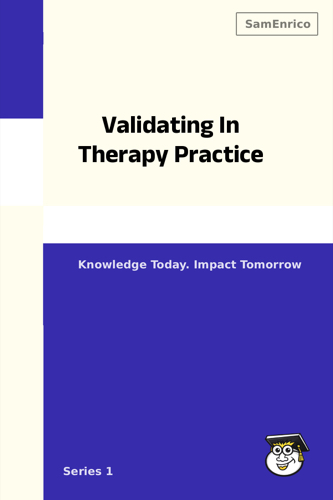
Validating In Therapy Practice
Use validation as a core therapeutic tool to build
Use validation as a core therapeutic tool to build alliance and regulate emotion.
Formats
About this book
Free sample
Chapter 1: The Silent Rupture...--It was the third session with Sarah, a 34-year-old graphic designer who had been struggling with panic attacks since her father’s sudden death six months earlier. In the first two sessions, she had been articulate, motivated, and eager to please. She had completed the anxiety tracking homework. She had arrived ten minutes early both times. She had laughed at my attempts at warmth and nodded along with my psychoeducation about the autonomic nervous system.But today, something was different.Sarah sat with her arms crossed so tightly her knuckles were white.
She answered my opening question—“How has your week been?”—with a flat “Fine.” When I asked about the panic attacks, she said “Same as always” without making eye contact. Her responses grew shorter. Her body seemed to shrink into the chair. And I, the well-trained therapist with two graduate degrees and a license on the wall, did exactly what so many of us do when a client withdraws: I tried harder.I leaned forward. I asked more questions.
I offered a thoughtful interpretation about her father. I suggested a breathing exercise. With each intervention, Sarah withdrew further. By minute forty, she was giving one-word answers. By minute forty-five, she looked at the clock.
By the end of the session, she had already decided—though she would not tell me this for another two weeks, when her cancellation email arrived—that therapy was not for her.I had no idea what had happened. I thought I had been warm, curious, and clinically sound. I had used all the active listening skills my graduate program had taught me. I had reflected her content. I had named emotions.
I had been empathic. And yet, I had lost her.What I did not understand that day—what this entire book exists to teach—is that empathy without validation is not enough. In fact, without validation, empathy can feel like surveillance. Sympathy can feel like pity. Active listening can feel like interrogation.
And the therapist, no matter how well-intentioned, becomes just another person who does not truly see the client.This chapter dismantles…
This is the end of the free sample. Get the eBook to keep going. Buy now
Contents
- Chapter 1
- Chapter 2
- Chapter 3
- Chapter 4
- Chapter 5
- Chapter 6
- Chapter 7
- Chapter 8
- Chapter 9
- Chapter 10
- Chapter 11
- Chapter 12
Details
- Author
- Neville Adrianne
- Publisher
- SamEnrico
- Language
- English
- Genre
- Non-Fiction, Self-Help, Therapeutic Skills
- Released
- 2026-06-09
- Pages (approx.)
- 146
- Available as
- eBook, Audiobook

Read better in the ZLOADR app
Your eBooks on your phone or tablet. Sign in with your SamEnrico account and start reading.
More by Neville Adrianne
 Pomodoro For OutliningNeville Adrianne$11.99
 LGBTQ Mayor's MemoirNeville Adrianne$11.99
 Dad Burnout Recovery GuideNeville Adrianne$11.99
 Financial Stress and Sleep RepairNeville Adrianne$11.99
 Central Sleep Apnea GuideNeville Adrianne$11.99
 Sleep For Memory Consolidation GuideNeville Adrianne$11.99
 Akkermansia MuciniphilaNeville Adrianne$11.99
 Forest Focus Memory AppNeville Adrianne$11.99
 Silk and Steel: The Rise and Fall of the Opium Wars' Forgotten TycoonNeville Adrianne$11.99
 The Silent Roar: The Larry Nassar Scandal and the Power of Survivor StoriesNeville Adrianne$11.99
 The Last Emperor's Secret: The Untold Story of Puyi's Escape to TaiwanNeville Adrianne$11.99
 The Mineral Guide to Gadolinite (Mineral Group)Neville Adrianne$11.99