
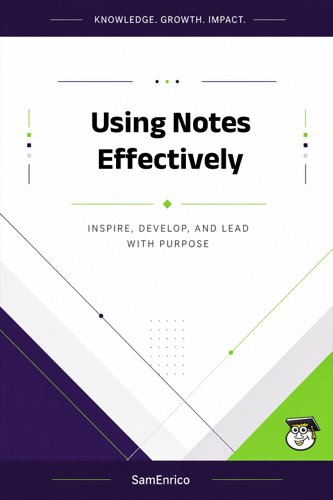
Free sample
Chapter 1: The Confession Booth--–- I have over fourteen thousand unread notes. They live in five different apps, three physical notebooks, a stack of napkins from coffee shops I no longer remember, and a single sticky note stuck to the back of my front door that says “don’t forget the thing.” I do not remember what the thing is. The sticky note has been there for eleven months.This is not a humble brag about being busy. It is a confession of failure. I am not a disorganized person because I have too much to do.
I am a disorganized person because I have been lying to myself about what notes are for.For most of my adult life, I believed that taking notes was about safety. Every quote I highlighted, every meeting scribble, every saved article was a tiny insurance policy against the terror of forgetting. If I wrote it down, I could relax. But I never relaxed. The more I captured, the more anxious I became.
My notes were not a safety net. They were a trap.This chapter is not about productivity systems or folder hierarchies. Those come later. This chapter is about the quiet shame of abandoned notebooks, the low-grade dread of a cluttered hard drive, and the single insight that changed everything for me: you do not have a memory problem. You have a trust problem.
And trust cannot be solved with another app.The Lie of the Blank Page Every note-taking journey begins with a lie. The lie is this: “If I just write this down, I will finally feel in control.”You buy a beautiful notebook. Moleskine, Leuchtturm, maybe something with a leather cover and a ribbon bookmark. You open to page one. The paper is crisp.
Your pen glides. You write a to-do list, a meeting agenda, a quote from a podcast. You feel virtuous. Productive. Adult.Then life happens.
You miss a day. Then two. Then a week. The notebook sits on your desk, page two still blank, and every time you look at it, you feel a small pang of failure. So you buy a new notebook.
A fresh start. This time, you tell yourself, you will be consistent.This cycle is not a personality flaw. It is a design flaw. You are trying to use a tool designed for gardeners to do the work of a banker.Let me explain.The Banker and the Gardener Imagine two people. The first is a banker.
She loves order. Every dollar that comes into her bank must be counted, categorized, and stored in the correct account. Deposits are never touched again unless absolutely necessary. The goal is preservation. The fear is loss.The second is a gardener.
He loves growth. Seeds go into the soil without a clear plan. Some will sprout. Some will die. He waters what grows, pulls what doesn’t, and trusts that the chaos of the garden will produce something beautiful over time.
The goal is cultivation. The fear is stagnation.Most people take notes like bankers. They highlight entire chapters. They organize notes into elaborate folders by subject. They treat information as a deposit to be preserved forever.
Then they wonder why they never look at those notes again.The gardener takes notes differently. A gardener knows that most seeds will not become trees. That is fine. A gardener captures what resonates in the moment, links it to other notes, and lets the system grow organically. A gardener trusts that value emerges from connection, not from collection.Here is the hard truth: you have been a banker.
That is why your notes are a graveyard.The book you are holding is an intervention. It will teach you to become a gardener. But before we plant anything, we need to clear the soil. That means deleting most of what you have saved.The Forgetting Curve Does Not Care About Your Feelings In the 1880s, a German psychologist named Hermann Ebbinghaus conducted a brutal series of experiments on himself. He memorized lists of nonsense syllables—meaningless combinations like “ZOF” and “KAD”—then tested himself at intervals to see how much he had forgotten.The results, now known as the Forgetting Curve, are humbling.
Within one hour of learning something new, you forget about fifty percent of it. Within twenty-four hours, you forget about seventy percent. Within a week, you are down to about ten percent.This is not a bug in your brain. It is a feature. Your memory is designed to prioritize survival-relevant information—where the water is, which berries are poisonous, who in your tribe cannot be trusted—not the name of the client you met last Tuesday.
Your brain is doing exactly what evolution designed it to do.But here is the problem. Most people respond to the Forgetting Curve by taking more notes. They think, “I forget things, so I should write down more things.” This is like responding to a leaky roof by buying more buckets. You are treating the symptom, not the cause.The cause is not a lack of capture. The cause is a lack of review.A note that is never reviewed is not a note.
It is a digital tombstone. You wrote it, you buried it, and now you feel vaguely guilty every time you scroll past it. The Forgetting Curve does not care about your feelings. It will erase that note from your working memory whether you like it or not.The only cure is to build a system that forces review at strategic intervals. We will get to that in Chapter 10.
For now, you need to accept a brutal fact: most of the notes you have taken in your life have been a complete waste of time. Not because you are lazy. Because you were never taught how to use them.Cognitive Load and the Myth of Multitasking There is a reason you feel anxious when your desk is cluttered, your inbox is full, and your notes are scattered across five apps. It is not a personality quirk. It is cognitive load.Cognitive load theory, developed by John Sweller in the 1980s, describes the limited capacity of your working memory.
You can hold approximately four chunks of information in your mind at once. That is it. Four.When you try to remember a deadline, a grocery list, a meeting note, and an idea for a project all at the same time, you are not multitasking. You are thrashing. Your brain is constantly swapping chunks in and out of working memory, each swap costing you energy and focus.
This is why you feel tired at the end of the day even if you did not do anything physically demanding. You spent your mental energy on the overhead of remembering.Here is the cruel irony: taking a note is supposed to reduce cognitive load. You write something down so you can stop thinking about it. But if your notes are disorganized, you cannot find them when you need them. So you keep the information in your head anyway, just in case.
Now you have both the cognitive load of the original information and the cognitive load of managing your chaotic note…
This is the end of the free sample. Get the eBook to keep going. Buy now
About this book
Details
- Author
- Banks Linda
- Publisher
- SamEnrico
- Language
- English
- Genre
- Non-Fiction, Self-Help / Notes
- Released
- 2026-06-08
- Pages (approx.)
- 105
- Available as
- eBook, Audiobook

Read better in the ZLOADR app
Your eBooks on your phone or tablet. Sign in with your SamEnrico account and start reading.
More by Banks Linda
 Borderline Rage RestructuringBanks Linda$11.99
 Upwork Job Feed Filtering SystemBanks Linda$11.99
 Montenegrin Sailor To CaptainBanks Linda$11.99
 Rescripting Recurring NightmaresBanks Linda$11.99
 The Trance Confusion MethodBanks Linda$11.99
 Doe Network Accidental Death CasesBanks Linda$11.99
 Low Glycemic DietBanks Linda$11.99
 The Calculus of the Cosmos: Benjamin Banneker's Stellar LegacyBanks Linda$11.99
 The Perfect Pitch: How Nike and LeBron James Redefined Sports Marketing (2003-Present)Banks Linda$11.99
 How to Produce Non-dairy MilkBanks Linda$11.99
 Growing CardiospermumBanks Linda$11.99
 Franchise Site Selection GuideBanks Linda$12.99
You may also like
 Hong Kong Handover 1997Dunn Johnnie$11.99
 Zumba For Postnatal Recovery CourseNeal Christian$11.99
 Zumba for BeginnersLadner Nikia$11.99
 YouTube Comment Mining GuideHumes Pandora$12.99
 Worry Box MeditationCarlin Rudy$11.99
 Workplace Stress MeditationNguyen Lynn$11.99
 Workplace Stress and Sleep RepairHawley Ivory$11.99
 Workplace Perfectionism CureDelaney Jeffry$11.99
 Workplace Injustice Anger GuideWallen Isabelle$11.99
 Work Addiction and Burnout LinkGreenwood Ester$11.99
 Women in Yoga and WellnessBeattie Galina$11.99
 Women in Stand Up ComedyChun Evangeline$11.99