

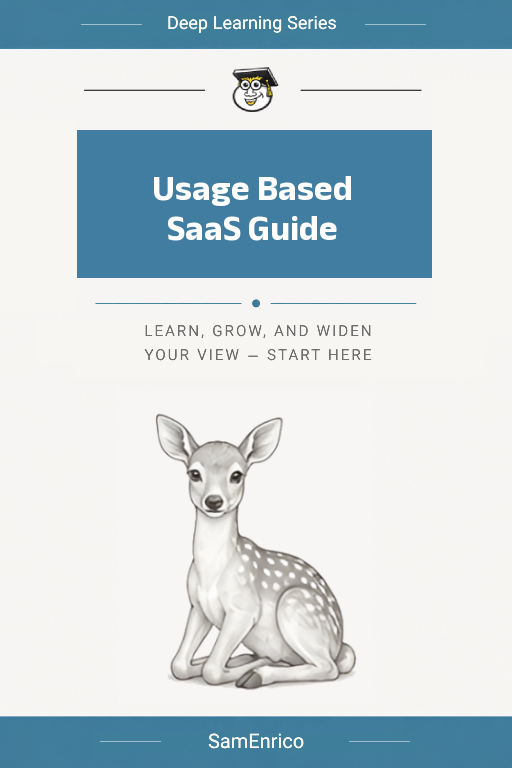
Non-FictionForecast & OutlookConsumption SaaS
Usage Based SaaS Guide eBook
Analyze consumption-based pricing models for cloud
Analyze consumption-based pricing models for cloud infrastructure, APIs, and data services gaining traction.
Formats
Free sample
Chapter 1: The Flat Fee Trap--–- The email arrived at 3:14 AM on a Tuesday. Sarah Chen, founder of a promising fintech API startup, watched her phone buzz with a fraud alert from her corporate credit card issuer. Fifty-seven thousand dollars had been charged in the last hour. Her heart stopped. She logged into her cloud provider's dashboard and watched the usage meter climbing in real time—58,200,58,200, 58,200,59,100, 60,400.Acustomerhaddeployedamisconfiguredscriptthatmorning.Itwasnowloopingher APIendpoint10,000timespersecond.Herflat−feesubscriptionplanhadnooverageprotection.Hercontracthadnocaps.Bythetimeshereachedherengineerat4:00AM,thebillhadhit60,400.
A customer had deployed a misconfigured script that morning. It was now looping her API endpoint 10,000 times per second. Her flat-fee subscription plan had no overage protection. Her contract had no caps. By the time she reached her engineer at 4:00 AM, the bill had hit 60,400.Acustomerhaddeployedamisconfiguredscriptthatmorning.Itwasnowloopingher APIendpoint10,000timespersecond.Herflat−feesubscriptionplanhadnooverageprotection.Hercontracthadnocaps.Bythetimeshereachedherengineerat4:00AM,thebillhadhit89,000.
The customer refused to pay, claiming the overages were her fault for not implementing safeguards. Sarah's startup folded six weeks later. She had built a great product. She had happy customers. But she chose the wrong pricing model, and it killed her company.This is not a cautionary tale about a bug.
This is a cautionary tale about pricing model risk—the hidden exposure that most Saa S founders discover only when it is too late. The flat-fee subscription, that beloved workhorse of the software industry, is quietly becoming a liability. And the companies that do not understand why will be the ones waking up to 3:00 AM fraud alerts.Welcome to the usage economy. It is not coming. It is already here.The 41% Tipping Point Let us start with a number that should terrify anyone still charging a flat monthly fee: 41% of Saa S companies have already adopted or are actively testing usage-based pricing models, according to the 2024 Usage-Based Pricing Benchmark Report by Open View Partners.
This is not a niche trend among developer tools and cloud infrastructure companies anymore. It has spread to fintech, marketing software, HR platforms, collaboration tools, and even vertical Saa S for industries like construction and logistics.But the raw percentage tells only half the story. The other half is growth rate. Among companies that switched from pure subscription to usage-based or hybrid models within the last three years, the median revenue growth acceleration was 23% in the first twelve months. Companies that remained on pure subscription models saw growth decelerate by an average of 7% over the same period.
In other words, usage-based pricing is not just a different way to charge—it is a growth lever.Why? Because customers have changed. The buyer of software in 2026 is not the buyer of software in 2016. A decade ago, purchasing software meant a six-month procurement process, a signed multi-year contract, and a budget line item approved by finance. Today, the same buyer signs up with a credit card in sixty seconds, expects to cancel with one click, and refuses to pay for anything they do not use.
This is the consumerization of enterprise software, and flat fees are its biggest casualty.The Historical Arc: From Cap Ex to Op Ex to Variable To understand why flat fees are dying, you have to understand how we got here. The history of software pricing is the history of shifting risk between buyer and seller.Phase 1: On-Premise (1980s–2000s). You bought software like you bought a factory machine: large upfront capital expenditure (Cap Ex), perpetual license, plus an annual maintenance fee of 15-22%. The buyer bore all the risk. If you bought a thousand seats of Oracle and only used three hundred, too bad.
If your business shrank, you were still on the hook. If the software became obsolete, you ate the loss. This model worked when software was scarce and switching costs were astronomical. It died because cloud computing made scarcity a lie.Phase 2: Subscription Saa S (2000s–2020s). Salesforce proved that renting software by the month was not only viable but superior.
Operating expenditure (Op Ex) replaced Cap Ex. Customers loved the predictability: one monthly bill, no surprises. Vendors loved the recurring revenue: predictable, financeable, valuable. The subscription model created the modern Saa S industry, and for nearly two decades, it was the default. But subscriptions never solved the value gap—they just hid it behind a veneer of predictability.Phase 3: Usage-Based (2020s–present).
AWS proved that charging only for what you consume—by the compute hour, the API call, the gigabyte stored—aligned price with value perfectly. The customer pays exactly for what they use, nothing more, nothing less. The vendor captures upside when customers succeed (because success drives more usage). This is not a pricing change. It is a business model change.
It requires different architecture, different metrics, different sales compensation, and different customer success motions. Which is why most companies fail at it the first time.The companies that survive the transition will be the ones that understand usage-based pricing not as a billing feature, but as a product architecture philosophy. You cannot bill for what you do not measure. And you cannot measure what you do not instrument from day one.The Taxonomy of Pricing Models: Know Your Container Before we go any further, we need a common language. Throughout this book, when I say "usage-based," I am referring to a family of four distinct models.
Confusing them is the fastest way to implement the wrong solution for your customers.Model 1: Pure Consumption (Pay After Use). This is the simplest form of usage-based pricing. The customer uses the product, and at the end of the billing period (usually monthly), they receive an invoice for exactly what they consumed. Twilio charges per API call. AWS charges per compute hour.
Open AI charges per token. No base fee. No commitment. No penalties for low usage. This model maximizes value alignment but minimizes predictability.
It is ideal for products where usage is highly variable and customers are price-sensitive enough to switch vendors over small differences.Model 2: Pre-Paid Credits (Pay Before Use). The customer buys a block of credits upfront—say, $500 per month for 10,000 API calls—and then consumes against that balance. Credits may expire monthly (Snowflake) or roll over (some cloud providers). This model gives the vendor predictable cash flow (the customer has already paid) while giving the customer predictable costs (they know their maximum exposure). The downside is that unused credits are pure profit for the vendor and pure waste for the customer—a value gap that erodes trust over time.Model 3: Hybrid (Base Fee + Overage).
The customer pays a flat base fee (say, $499 per month for up to 10,000 calls) and then a per-unit overage fee for anything above that threshold. Datadog uses this model for its infrastructure monitoring: you pay per host, but if a host generates more than a certain volume of metrics, you pay overages. This model gives customers the predictability of a subscription for baseline usage while letting vendors capture upside from power users. The trade-off is that light users overpay (they pay the base fee even if they use almost nothing).Model 4: Tiered Volume (Price Breaks at Scale). The per-unit price decreases as usage increases.
The first 1,000 API calls cost 0.10each.Thenext9,000cost0.10 each. The next 9,000 cost 0.10each.Thenext9,000cost0.05 each. The next 90,000 cost $0.02 each. Stripe uses this model for payment…
This is the end of the free sample. Get the eBook to keep going. Buy now
About this book
Details
- Author
- Reeves Christine
- Publisher
- SamEnrico
- Language
- English
- Genre
- Non-Fiction, Forecast & Outlook, Consumption SaaS
- Released
- 2026-06-01
- Pages (approx.)
- 142
- Available as
- eBook, Audiobook

Read better in the ZLOADR app
Your eBooks on your phone or tablet. Sign in with your SamEnrico account and start reading.
More by Reeves Christine
 MBSR For Caregiver BurnoutReeves Christine$11.99
 Burnout Prevention for Nonprofit Workers GuideReeves Christine$11.99
 Confucius Life and TeachingsReeves Christine$11.99
 AI Whistleblower Protections GuideReeves Christine$11.99
 The Self Esteem Journaling Prompts GuideReeves Christine$11.99
 Margaret Thatcher's Iron Gamble: The Falklands War and the Making of a Political LegacyReeves Christine$11.99
 How to Start a One-Hour Photofinishing BusinessReeves Christine$11.99
 AcupuncturistReeves Christine$11.99
 Understanding Klippel–feil Syndrome Dominant TypeReeves Christine$17.99
 Journal Entry Review ManualReeves Christine$12.99
You may also like
 Hong Kong Handover 1997Dunn Johnnie$11.99
 Zumba For Postnatal Recovery CourseNeal Christian$11.99
 Zumba for BeginnersLadner Nikia$11.99
 YouTube Comment Mining GuideHumes Pandora$12.99
 Worry Box MeditationCarlin Rudy$11.99
 Workplace Stress MeditationNguyen Lynn$11.99
 Workplace Stress and Sleep RepairHawley Ivory$11.99
 Workplace Perfectionism CureDelaney Jeffry$11.99
 Workplace Injustice Anger GuideWallen Isabelle$11.99
 Work Addiction and Burnout LinkGreenwood Ester$11.99
 Women in Yoga and WellnessBeattie Galina$11.99
 Women in Stand Up ComedyChun Evangeline$11.99