
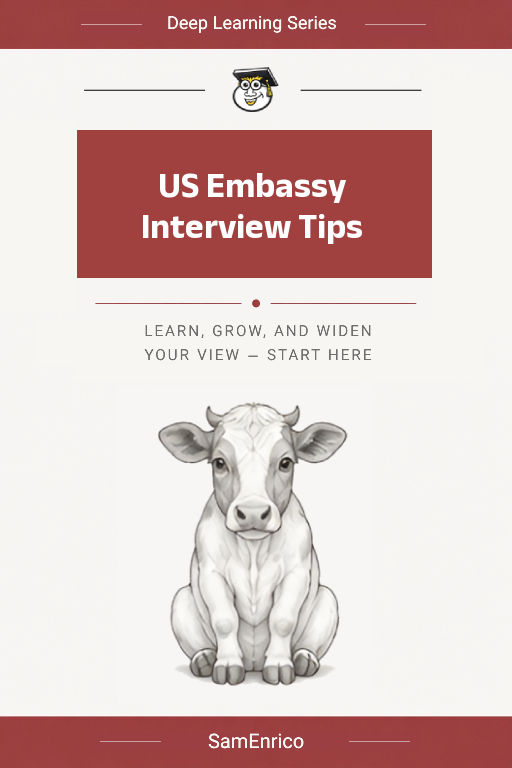
Non-FictionAnnual CheckupEmbassy InterviewQuestions
US Embassy Interview Tips eBook
Prepare for US embassy visa interview including do
Prepare for US embassy visa interview including document presentation and common H-1B questions.
Formats
Free sample
Chapter 1: The Silent Betrayal...--The moment you click “Submit” on your DS-160, you have already begun your interview. The consular officer you will meet in three weeks has not yet seen your face, but they have already formed a preliminary opinion about your case. This is the single most misunderstood reality of the US embassy visa process. Most applicants believe the interview begins when they step up to the glass window. They spend weeks rehearsing answers, organizing documents, and worrying about their tone of voice.
All of that matters. But by the time you utter your first word to the officer, approximately seventy percent of their decision has already been influenced by a document you filled out alone, often in a hurry, often with small errors you thought were meaningless.The DS-160 is not merely a form. It is a sworn affidavit. Every answer you provide is submitted under penalty of perjury. When you sit across from the consular officer, that officer has a printed summary of your DS-160 on their screen.
They have already scanned it for inconsistencies, gaps, and what immigration lawyers call “triggers” – specific patterns that correlate with denial rates. The officer’s first question is rarely random. It is almost always designed to test a specific vulnerability in your DS-160.This chapter will teach you something that the best-selling visa guides all agree on but rarely state plainly: the interview is won or lost in the DS-160 stage. Your documents, your confidence, your answers – these are all secondary to the foundational truth embedded in that online application. If your DS-160 contains errors, omissions, or logical contradictions, no amount of interview preparation will save you.
The officer has already decided to deny you; the interview is merely a formality to confirm the denial on the record.Conversely, a meticulously prepared DS-160 can turn a nervous, imperfect interview into an approval. Officers are trained to look for honesty and consistency above all else. A clean DS-160 signals that you are organized, truthful, and serious about compliance with US immigration law. A sloppy DS-160 signals the opposite, regardless of how well you speak or how legitimate your job offer might be.Let us begin with the anatomy of the DS-160 and then move into the specific traps that catch ninety percent of applicants.The Architecture of the DS-160: Why Small Fields Matter More Than You Think The DS-160 contains approximately one hundred and twenty data fields. Most applicants focus on the obvious ones: name, date of birth, passport number, employer information.
These are certainly important. But the denials rarely come from mistakes in your name. They come from the fields that applicants rush through or dismiss as unimportant.Consider the “Previous Employment” section. Many applicants list only their current job. They reason that their previous work is irrelevant because their current job is the basis for the visa.
This is a dangerous assumption. Consular officers look for gaps in employment history. A gap of more than three months without explanation triggers a mental note. Two gaps trigger a question. Three gaps often trigger a denial under the theory that the applicant is not genuinely employed or is misrepresenting their work history.The same principle applies to travel history.
The DS-160 asks for every international trip you have taken in the past five years, including the specific dates and durations. Applicants frequently guess at dates or omit short trips to nearby countries. The officer has access to passport scanning records from your previous entries and exits. When your DS-160 omits a trip that appears in your passport, you have created an inconsistency. Whether you intended to deceive or simply forgot does not matter.
The officer is trained to assume the worst.Then there is the question of “Do you have any relatives in the United States?” This single field causes more denials than almost any other. Many applicants fear that admitting to a relative will trigger an accusation of immigrant intent. So they answer “no” when the truth is “yes, I have an uncle in Chicago.” The officer can cross-reference names, addresses, and family trees using databases you cannot see. When they discover the relative, your credibility is destroyed. The correct strategy – which we will explore in depth – is to answer truthfully and then explain why that relative does not create immigrant intent.The DS-160 is not an enemy.
It is a tool. When used correctly, it establishes your credibility before you ever speak to an officer. When used carelessly, it becomes exactly what this chapter’s title warns: a silent betrayal.The Ninety-Day Rule: What It Is and Why It Does Not Belong in This Book Before going further, a necessary clarification. Some immigration guides discuss a concept called the “ninety-day rule.” This rule states that if a non-immigrant visa holder violates their status or acts inconsistently with their visa within ninety days of entering the United States, the government may presume misrepresentation. That rule applies to actions taken after entry.
It governs what happens when you are already inside the United States.This book is about embassy interviews. You are outside the United States when you fill out the DS-160 and when you speak to the consular officer. The ninety-day rule has no application at the interview stage. If you encounter this rule in other guides, understand that it concerns a different phase of the immigration process. We mention it only to clarify its absence from our discussion.
Your DS-160 interview preparation should focus on the accuracy of your application, not on post-entry behavioral rules.The Binder Method: Organizing Documents for the “Window Drop”Once your DS-160 is submitted and your interview is scheduled, you must prepare your physical documents. The organization of these documents can be as important as their content. Consular officers process dozens of applicants per hour. They have approximately two to three minutes per person. An officer who must shuffle through loose papers or ask you to locate a specific document is an irritated officer.
An irritated officer is more likely to deny.The Binder Method is a document organization strategy synthesized from the practices of top immigration attorneys and the best-selling guides mentioned in this book’s introduction. It is called the Binder Method because you will use a clear, dual-pocket document folder – not a three-ring binder, which is too bulky, but a slim, transparent folder that allows the officer to see the contents at a glance.Here is the exact arrangement. The folder has two pockets: left and right. In the left pocket, you place all documents related to the petitioner – the person or entity sponsoring your visa. For an H-1B applicant, this means the I-797 approval notice, the certified Labor Condition Application (Form ETA-9035), a copy of the I-129 petition, the employer verification letter, and any supporting documents about the company’s legitimacy.
In the right pocket, you place all documents related to the beneficiary – that is, you. This includes your degree diploma, transcripts, experience letters, pay stubs, and any evidence of home ties.Why left and right? When you approach the window, the officer will ask you to slide your documents under the glass or hold them up to…
This is the end of the free sample. Get the eBook to keep going. Buy now
About this book
Details
- Author
- Cathey Ayanna
- Publisher
- SamEnrico
- Language
- English
- Genre
- Non-Fiction, Annual Checkup, Embassy Interview, Questions
- Released
- 2026-06-01
- Pages (approx.)
- 148
- Available as
- eBook, Audiobook

Read better in the ZLOADR app
Your eBooks on your phone or tablet. Sign in with your SamEnrico account and start reading.
More by Cathey Ayanna
 Social Phobia Self Help GuideCathey Ayanna$11.99
 Spin Class Instructor Certification Prep CourseCathey Ayanna$11.99
 Securities Fraud PenaltiesCathey Ayanna$11.99
 Meditation for Post Polio PainCathey Ayanna$11.99
 The Equipment Familiarity TranceCathey Ayanna$11.99
 The Frozen Frontier: The First Crossing of the Middle East's Polar Ice CapCathey Ayanna$11.99
 Soulful Rebellion: The Unlikely Rise of The Temptations' 'Ball of Confusion'Cathey Ayanna$11.99
 Understanding Dissecting Cellulitis of The ScalpCathey Ayanna$17.99
 UFRGS Free University GuideCathey Ayanna$12.99
 Biological ScientistCathey Ayanna$11.99
 How to Become a Mold MakerCathey Ayanna$11.99
You may also like
 Hong Kong Handover 1997Dunn Johnnie$11.99
 Zumba For Postnatal Recovery CourseNeal Christian$11.99
 Zumba for BeginnersLadner Nikia$11.99
 YouTube Comment Mining GuideHumes Pandora$12.99
 Worry Box MeditationCarlin Rudy$11.99
 Workplace Stress MeditationNguyen Lynn$11.99
 Workplace Stress and Sleep RepairHawley Ivory$11.99
 Workplace Perfectionism CureDelaney Jeffry$11.99
 Workplace Injustice Anger GuideWallen Isabelle$11.99
 Work Addiction and Burnout LinkGreenwood Ester$11.99
 Women in Yoga and WellnessBeattie Galina$11.99
 Women in Stand Up ComedyChun Evangeline$11.99