
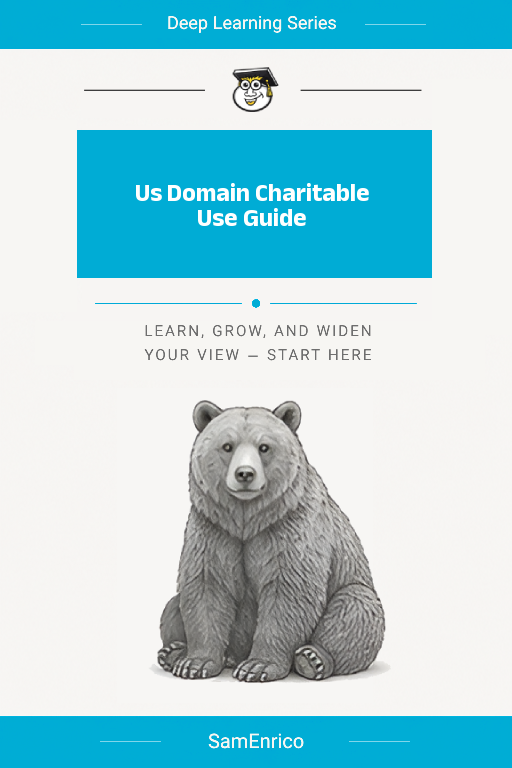
Non-FictionFirst 30 DaysNonprofit Domains
Us Domain Charitable Use Guide eBook
Register .us domains for nonprofits, religious org
Register .us domains for nonprofits, religious organizations, and charities with nexus verification.
Formats
Free sample
Chapter 1: The $10 Mistake--The first time Matthew lost a domain, he was sitting in a church basement folding chairs after a Sunday service. His phone buzzed with an email from his registrar: "Your .us domain has been revoked due to Nexus violation. No further action required." No warning. No appeal. No refund.
Just a digital eviction notice for a domain he had registered three years earlier for the Atlanta Hope Mission, a faith-based homeless shelter he had founded with $400 and a broken coffee maker.Matthew had paid 10.99forthatdomain.Therevocationcosthisshelternearly10.99 for that domain. The revocation cost his shelter nearly 10.99forthatdomain.Therevocationcosthisshelternearly47,000 in donations over the next four months.This is not a story about technical incompetence. Matthew was a former IT coordinator before he answered his calling. He knew how to renew domains, set up SSL certificates, and troubleshoot DNS errors. What he did not know was that the .us domain space operates under a set of rules so distinct, so unforgiving, and so poorly understood that even experienced nonprofit leaders routinely make fatal mistakes.
The purpose of this chapter is to ensure you never become Matthew.The .us domain is not a commodity. It is a privilege granted by the United States government to organizations that genuinely serve the American public. And like any privilege, it comes with obligations that, if violated, trigger consequences far more severe than losing a web address. When a .us domain is revoked for a Nexus violation—the legal term for your "genuine connection" to the United States—there is no grace period, no redemption window, and no customer service representative who can reverse the decision. Your website simply disappears from the internet, and all the search engine rankings, email accounts, and donor trust built on that domain evaporate with it.This book exists because the vast majority of nonprofits, religious organizations, and charities have no idea that their .us domain is at risk.
They register through Go Daddy or Namecheap, check a box that says "Nonprofit," and assume the work is done. It is not. The .us registry audits thousands of domains each year, and the most common target is not foreign squatters or commercial abusers. It is well-meaning charities that made an honest mistake on their registration form, used the wrong address, or changed their organization's name without updating their WHOIS record.The Atlanta Hope Mission's mistake was simple. Matthew had registered the domain using the church's address where the shelter held its meals and services.
When the church closed its doors due to a lease dispute, Matthew updated his shelter's mailing address with the post office but never logged into his registrar to update the WHOIS information. Six months later, a routine audit flagged the discrepancy between the address on file and the address on his IRS determination letter. The registry did not ask for clarification. It did not send a warning. It revoked the domain.What Matthew learned—and what you will learn in this chapter—is that .us domains are governed by a fundamentally different legal framework than .com, .org, or .net.
Understanding this framework is not optional. It is the price of admission to the .us namespace. By the end of this chapter, you will understand why the .us domain exists, who actually controls it, what the Nexus requirement means for your organization, and why the $10 you pay for your domain is the smallest cost you will ever incur. More importantly, you will understand the single most important rule of .us domain ownership: compliance is not a one-time event. It is a permanent, ongoing obligation that begins the moment you register and ends only when you willingly give up the domain or the registry takes it from you.Why the .us Domain Is Different The .us country-code top-level domain (cc TLD) was created in 1985, making it one of the oldest domain extensions on the internet.
Unlike .com, which was designed for commercial entities, or .org, which was intended for any organization regardless of location, .us was explicitly created to serve the American public. Its original charter, still largely intact after four decades, states that the namespace "shall be used primarily for the benefit of the United States community." This is not marketing language. It is a binding policy directive.For the first fifteen years of its existence, .us domains were available only through a cumbersome hierarchy of delegated registrars, and registration was restricted to organizations with a demonstrable US presence. In 2001, the US Department of Commerce transferred management of the .us registry to Neu Star, which opened up direct registration to the public. But the core restriction—the Nexus requirement—remained in place.
In 2023, the registry transitioned to Go Daddy Registry, but the Nexus rules were preserved and, in some interpretations, strengthened.Here is what makes .us fundamentally different from every other major domain extension. When you register a .com domain, the registry's primary concern is whether you have paid your fee. As long as the credit card clears, your domain is safe. The .com registry does not audit your business license. It does not care if you move your office.
It has no mechanism for revoking your domain because you failed to update your address. The .org registry, now owned by a private equity firm called Ethos Capital, similarly imposes almost no ongoing compliance obligations beyond renewal fees.The .us registry, by contrast, is legally obligated to ensure that every single domain in its namespace is held by a legitimate US-based entity. This is not a theoretical obligation. The National Telecommunications and Information Administration (NTIA), which oversees the .us registry under a cooperative agreement, conducts regular compliance audits and requires the registry to maintain accurate, up-to-date WHOIS information for every domain. When the registry finds a violation, it has no discretion.
It must revoke the domain.Think of it this way. A .com domain is like renting an apartment from a landlord who only cares that you pay the rent on time. A .us domain is like receiving a government-issued professional license. The license costs less than the rent, but it comes with annual continuing education requirements, mandatory address updates, and the constant risk of revocation if you fail to comply. The license is cheaper until you lose it.
Then it becomes very expensive.The Nexus Requirement Explained Nexus is the legal term for the connection between a registrant and the United States that justifies their use of the .us domain. The registry recognizes three categories of Nexus, each with its own documentation requirements. Understanding which category applies to your organization is the first and most important step in the registration process.Category 1, designated as C11 for individuals and C12 for sole proprietors, covers US citizens, permanent residents, and domestic entities. This category is relevant for very small charities operating without formal incorporation. If you are a single person running a mutual aid network from your home, you can register under Category 1 using your Social Security number and a residential address.
However, Category 1 offers no protection if your organization grows. You cannot transfer a Category 1 registration to a Category 2 organization without releasing the domain and re-registering it.Category 2, designated as C21, is the primary category for…
This is the end of the free sample. Get the eBook to keep going. Buy now
About this book
Details
- Author
- Worth Willena
- Publisher
- SamEnrico
- Language
- English
- Genre
- Non-Fiction, First 30 Days, Nonprofit Domains
- Released
- 2026-05-29
- Pages (approx.)
- 147
- Available as
- eBook, Audiobook

Read better in the ZLOADR app
Your eBooks on your phone or tablet. Sign in with your SamEnrico account and start reading.
More by Worth Willena
 Parentified Child Self EsteemWorth Willena$11.99
 Healthcare Persuasion TacticsWorth Willena$11.99
 Elderly Nightmare ProcessingWorth Willena$11.99
 Bipolar and Gambling DisorderWorth Willena$11.99
 Low Carb Work Lunch SolutionsWorth Willena$11.99
 Boulder Fields Danger ZonesWorth Willena$11.99
 Law Degrees In DubaiWorth Willena$11.99
 Assertive Communication SkillsWorth Willena$11.99
 Angels of the Eastern Front: The Forgotten Medics of Khalkhin GolWorth Willena$11.99
 The Undisputed: How Australia and New Zealand Forged Boxing LegendsWorth Willena$11.99
 How to Produce Speed and Agility Ladders and HurdlesWorth Willena$11.99
 How to Produce Golf BagsWorth Willena$11.99
You may also like
 Hong Kong Handover 1997Dunn Johnnie$11.99
 Zumba For Postnatal Recovery CourseNeal Christian$11.99
 Zumba for BeginnersLadner Nikia$11.99
 YouTube Comment Mining GuideHumes Pandora$12.99
 Worry Box MeditationCarlin Rudy$11.99
 Workplace Stress MeditationNguyen Lynn$11.99
 Workplace Stress and Sleep RepairHawley Ivory$11.99
 Workplace Perfectionism CureDelaney Jeffry$11.99
 Workplace Injustice Anger GuideWallen Isabelle$11.99
 Work Addiction and Burnout LinkGreenwood Ester$11.99
 Women in Yoga and WellnessBeattie Galina$11.99
 Women in Stand Up ComedyChun Evangeline$11.99