
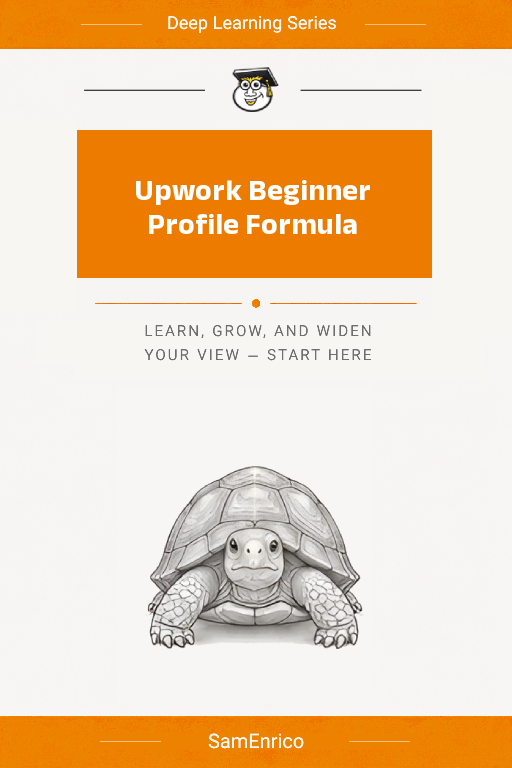
Non-FictionFirst 30 DaysUpwork StrategyProfile Optimization
Upwork Beginner Profile Formula eBook
Build a high-converting Upwork profile with niche
Build a high-converting Upwork profile with niche specialization and a portfolio that wins first projects.
Formats
Free sample
Chapter 1: The Invisible Graveyard--The average Upwork beginner sends forty-three proposals before receiving their first “maybe.” Forty-three. That is nearly two full workdays of writing, clicking, hoping, and waiting. Of those forty-three, thirty-two will never even be opened. Eleven will be opened and immediately closed. Zero point seven—less than one—will result in an interview.
And after all of that effort, the vast majority will still earn less than five hundred dollars in their first six months.This is not a skill problem. This is not a talent problem. This is not even a “you need more experience” problem. This is a positioning problem. And it is killing your chances before you ever get to prove what you can do.I know because I lived it.
My first three months on Upwork, I sent one hundred and twenty proposals. One hundred and twenty. I earned exactly zero dollars. I watched my Connects balance drain like a bank account with no deposits. I watched freelancers with half my experience, half my education, and half my talent get hired for projects I knew I could do better.
I sat in a Starbucks on a Tuesday afternoon—the kind of Tuesday where the rain won’t stop and your laptop battery is dying and you cannot afford another latte—and I nearly quit.But then I noticed something. The freelancers who were getting hired were not the most skilled. They were not the cheapest. They were not the most experienced. They were the most specific.
They had figured out something that I had not: on Upwork, being a generalist is not safety. It is invisibility.This chapter is about why your current profile is repelling clients, why the “safe” approach of offering many services is actually the most dangerous thing you can do, and how a single shift in your positioning can take you from forty-three proposals per interview to three. The rest of this book will give you the exact tools to build that profile. But first, you need to understand the graveyard you are currently walking through—and why most freelancers never leave it.The Six-Second Test Let me describe a scene that happens ten thousand times per day on Upwork.A client posts a job. Let us call her Sarah.
Sarah runs a small ecommerce brand selling organic baby food. She needs someone to write product descriptions for her new line of pouches. She has a budget of three hundred dollars and a deadline of next Friday. She posts the job at 9:14 AM.By 9:47 AM, she has sixty-three proposals.Sarah opens her dashboard. She has a meeting in twelve minutes.
She has sixty-three proposals to review. She is not going to read sixty-three proposals. She is not even going to open sixty-three proposals. She is going to scan. She is going to filter.
She is going to reject fifty-nine of them in less than six seconds each.This is not cruelty. This is efficiency. Every client on Upwork operates this way because every client on Upwork is overwhelmed. The platform has more than eighteen million freelancers. Clients receive an average of fifty to one hundred proposals per job post.
They cannot read them all. They will not read them all. They will read the first two lines of your proposal, glance at your profile headline, and decide—in less time than it takes to tie a shoelace—whether you are worth a click.Here is what Sarah is looking for in those six seconds. First, she wants to know if you understand her specific problem. She is not selling pet food.
She is not selling fitness supplements. She is selling organic baby food to exhausted parents who are terrified of putting the wrong thing into their child’s mouth. That is a very specific emotional and logistical problem. If your profile says “I write product descriptions for ecommerce brands,” Sarah has already moved on. That is too generic.
She needs someone who understands her audience. Her audience is not “ecommerce shoppers.” Her audience is “parents who haven’t slept in eight months and will read every ingredient label three times.”Second, Sarah wants proof of results. She does not need a decade of experience. She does not need a portfolio of Fortune 500 clients. She needs to see that you have done something similar before—or that you have a methodology that makes her believe you can do it now.
A single sentence like “I’ve written product descriptions that increased conversion rates by twenty-two percent for three baby brands” would stop her scrolling immediately. But if you have no reviews and no portfolio, she will keep scrolling unless you give her something else to hold onto.Third, Sarah wants professionalism. This does not mean formality. It means clarity, specificity, and the absence of desperation. A profile that says “I can do anything you need, I’m hardworking and reliable, please give me a chance” smells like fear.
Clients can smell fear. It repels them like smoke from a fire alarm.This is the six-second test. Your profile passes or fails it before you have any opportunity to explain yourself, to share your story, or to demonstrate your skills. And the single biggest reason that beginner profiles fail this test is not lack of talent. It is lack of specificity.The Myth of Generalist Safety Let me tell you about a belief that is so common, so intuitive, and so completely wrong that it has destroyed more freelance careers than any other single idea.The belief is this: “If I offer more services, I will attract more clients.”It makes sense on the surface.
If you own a restaurant, you put more items on the menu to attract more diners. If you run an online store, you stock more products to attract more shoppers. So why would freelancing be any different? If you offer writing, editing, proofreading, and social media management, surely you are casting a wider net than someone who only offers “email copywriting for DTC food brands.”Here is why this logic fails on Upwork. You are not a restaurant.
You are not a store. You are a answer to a very specific question that a client is asking at a very specific moment. And that question is almost never “Does anyone here offer writing?” That question is far too broad. The actual question is closer to “Who has written abandoned cart emails for a Shopify store that sells organic baby food and can show me proof?”When clients search Upwork, they do not type “writer” into the search bar—at least not the clients you want. They type “Shopify email copywriter.” They type “conversion copywriter for DTC.” They type “baby food brand copywriter.” They type specific, long, detailed queries because they have a specific, urgent problem.
If your profile does not contain those exact words or very close variations, the algorithm will never show you to them. You will be invisible not because you are bad at your job, but because you never entered the room.The data backs this up. Internal platform research has consistently shown that freelancers with a declared, narrow niche earn two to three times…
This is the end of the free sample. Get the eBook to keep going. Buy now
About this book
Details
- Author
- Applegate Gabriela
- Publisher
- SamEnrico
- Language
- English
- Genre
- Non-Fiction, First 30 Days, Upwork Strategy, Profile Optimization
- Released
- 2026-05-29
- Pages (approx.)
- 135
- Available as
- eBook, Audiobook

Read better in the ZLOADR app
Your eBooks on your phone or tablet. Sign in with your SamEnrico account and start reading.
More by Applegate Gabriela
 Migraine and Nausea ManagementApplegate Gabriela$11.99
 Vitamin A Vision Health GuideApplegate Gabriela$11.99
 Senior Cancer SurvivorApplegate Gabriela$11.99
 NVC for TherapistsApplegate Gabriela$11.99
 The Stress and Lupus ConnectionApplegate Gabriela$11.99
 Neil Patrick Harris DoogieApplegate Gabriela$11.99
 Task Parking LotApplegate Gabriela$11.99
 Great Mother Dream SymbolApplegate Gabriela$11.99
 Mirroring Rapport TechniquesApplegate Gabriela$11.99
 Silent Codebreakers: The AI Whisperers of Cold War EspionageApplegate Gabriela$11.99
 Echoes of the Red Code: How a Soviet AI Nearly Started World War IIIApplegate Gabriela$11.99
 The Alpine Innovators: How Swiss Cuisine Conquered the WorldApplegate Gabriela$11.99
You may also like
 Hong Kong Handover 1997Dunn Johnnie$11.99
 Zumba For Postnatal Recovery CourseNeal Christian$11.99
 Zumba for BeginnersLadner Nikia$11.99
 YouTube Comment Mining GuideHumes Pandora$12.99
 Worry Box MeditationCarlin Rudy$11.99
 Workplace Stress MeditationNguyen Lynn$11.99
 Workplace Stress and Sleep RepairHawley Ivory$11.99
 Workplace Perfectionism CureDelaney Jeffry$11.99
 Workplace Injustice Anger GuideWallen Isabelle$11.99
 Work Addiction and Burnout LinkGreenwood Ester$11.99
 Women in Yoga and WellnessBeattie Galina$11.99
 Women in Stand Up ComedyChun Evangeline$11.99