
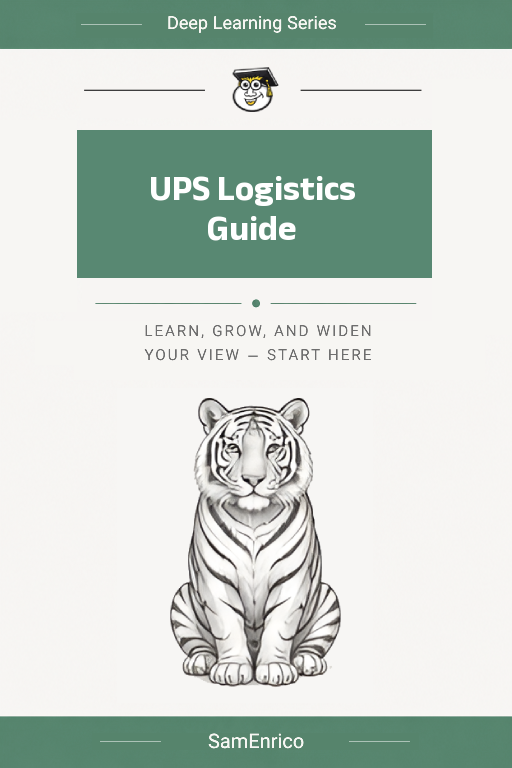
Non-FictionStrategic AtlasParcel Logistics
UPS Logistics Guide
Discover routing optimization, delivery density, a
by Peeler Glady
Discover routing optimization, delivery density, and ground fleet management that built a global small-package powerhouse.
Formats
About this book
Free sample
Chapter 1: The $100 Constraint--In the summer of 1907, a nineteen-year-old named James E. Casey borrowed one hundred dollars from a friend in Seattle, Washington. That sum—roughly two thousand six hundred dollars today—was not intended for luxury, expansion, or marketing. It was intended to prevent collapse. Casey had been running a small messenger service since he was seventeen, delivering packages and telegrams on foot and by bicycle.
But his company, then called the American Messenger Company, was hemorrhaging money. The hundred dollars covered payroll for one week and nothing more. What happened next was not a story of visionary genius. It was a story of mathematical desperation.Most business origin stories celebrate the moment of inspiration—the light bulb, the garage, the napkin sketch. UPS has no such moment.
Instead, it has a ledger. And that ledger, from the very first month, told a brutal truth: every mile traveled without a package in hand was a mile that lost money. Casey did not discover this truth through insight. He discovered it because he could not afford to ignore it. A richer founder might have absorbed the losses, expanded recklessly, and failed spectacularly.
Casey had no margin for error. The hundred-dollar constraint forced him to ask a question that no logistics company had asked systematically before: how do we move packages such that nothing moves unnecessarily?This chapter reframes the founding of UPS not as an entrepreneurial fairy tale but as a forced evolution under financial duress. The "Purple Promise" that UPS drivers recite today—"We will deliver your package on time, every time"—is not a motto. It is a residual of a mathematical formula developed by a teenager who could not afford to waste a single block of travel. The core concepts introduced here—Waste Miles, the tripartite waste framework, and the rejection of the simple hub-and-spoke model—will serve as the foundation for every subsequent chapter.
Understanding why UPS became obsessed with routing, density, and fleet management begins with understanding what Casey understood: capital constraints are the mother of logistics efficiency.The Ledger That Changed Everything Before there were algorithms…
This is the end of the free sample. Get the eBook to keep going. Buy now
Contents
- Chapter 1
- Chapter 2
- Chapter 3
- Chapter 4
- Chapter 5
- Chapter 6
- Chapter 7
- Chapter 8
- Chapter 9
- Chapter 10
- Chapter 11
- Chapter 12
Details
- Author
- Peeler Glady
- Publisher
- SamEnrico
- Language
- English
- Genre
- Non-Fiction, Strategic Atlas, Parcel Logistics
- Released
- 2026-06-01
- Pages (approx.)
- 144
- Available as
- eBook, Audiobook

Read better in the ZLOADR app
Your eBooks on your phone or tablet. Sign in with your SamEnrico account and start reading.
More by Peeler Glady
 Senegalese French Return To Saint Louis HandbookPeeler Glady$11.99
 Metta for Infertility JourneyPeeler Glady$11.99
 Forest Sanctuary JourneyPeeler Glady$11.99
 Morocco Independence King GuidePeeler Glady$11.99
 The Imposter Syndrome Success Log GuidePeeler Glady$11.99
 Lee vs. Grant: The Civil War Generals Who Shaped World War IPeeler Glady$11.99
 Understanding Morel's EarPeeler Glady$17.99
 A Beginners Guide to Cycling (Volume 1)Peeler Glady$11.99
 Technical Writing Metrics AIPeeler Glady$12.99
 Idrialite MiningPeeler Glady$11.99
You may also like
 Hong Kong Handover 1997Dunn Johnnie$11.99
 Zumba For Postnatal Recovery CourseNeal Christian$11.99
 Zumba for BeginnersLadner Nikia$11.99
 YouTube Comment Mining GuideHumes Pandora$12.99
 Worry Box MeditationCarlin Rudy$11.99
 Workplace Stress MeditationNguyen Lynn$11.99
 Workplace Stress and Sleep RepairHawley Ivory$11.99
 Workplace Perfectionism CureDelaney Jeffry$11.99
 Workplace Injustice Anger GuideWallen Isabelle$11.99
 Work Addiction and Burnout LinkGreenwood Ester$11.99
 Women in Yoga and WellnessBeattie Galina$11.99
 Women in Stand Up ComedyChun Evangeline$11.99