
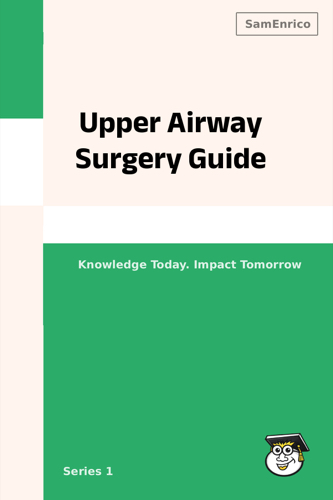
About this book
Free sample
Chapter 1: The Collapsing Tube--–- The anesthesiologist’s voice cut through the pre-operative bustle with practiced calm. “Sixty-two-year-old male, BMI of thirty-eight, scheduled for uvulopalatopharyngoplasty. Mallampati class four, short neck, limited neck extension. History of severe obstructive sleep apnea, AHI of seventy-two, oxygen nadir of sixty-two percent on his diagnostic study. Failed CPAP due to claustrophobia.
Refused oral appliance.”The surgeon paused, marker poised over the patient’s neck where a planned tracheostomy mark had been hastily drawn and then erased. “Why is the trach mark gone?” he asked.The resident shifted uncomfortably. “The patient refused. He said he’d rather live with the apnea than wake up with a hole in his neck.”This scene plays out in operating rooms every week. A patient with severe obstructive sleep apnea, high-risk anatomy, and limited options presents for upper airway surgery.
The team knows the procedure carries significant risk of post-operative airway compromise. The patient knows he cannot tolerate another night of choking, gasping, and terror. And somewhere in the gap between surgical possibility and physiological reality, a decision must be made that will determine whether this patient leaves the hospital breathing through his nose or through an emergency tracheostomy placed at two in the morning.This chapter exists to ensure that when that moment arrives, you understand exactly what is happening inside the collapsing tube we call the upper airway. Not the anatomy memorized for medical school exams. Not the physics reduced to multiple-choice questions.
But the real, dynamic, life-or-death behavior of a structure that must remain open for approximately 25,000 breaths per day, every day, for the rest of your patient’s life.The Central Problem: A Tube That Wants to Close Every upper airway surgery ultimately addresses a single mechanical problem: a collapsible tube subjected to negative pressure during inspiration. The upper airway from the choanae (the posterior nasal openings) to the larynx is not a rigid pipe like the trachea with its cartilaginous rings. It is a muscular tube supported only by intermittent bony and cartilaginous structures—the hard palate, the hyoid bone, the thyroid cartilage—with long segments of unsupported…
This is the end of the free sample. Get the eBook to keep going. Buy now
Contents
- Chapter 1
- Chapter 2
- Chapter 3
- Chapter 4
- Chapter 5
- Chapter 6
- Chapter 7
- Chapter 8
- Chapter 9
- Chapter 10
- Chapter 11
- Chapter 12
Details
- Author
- Benedict Rubin
- Publisher
- SamEnrico
- Language
- English
- Genre
- Non-Fiction, Health & Wellness / Surgery
- Released
- 2026-06-06
- Pages (approx.)
- 149
- Available as
- eBook, Audiobook

Read better in the ZLOADR app
Your eBooks on your phone or tablet. Sign in with your SamEnrico account and start reading.
More by Benedict Rubin
 Empathy For Adoption JourneyBenedict Rubin$11.99
 The Mayor's Police Reform YearsBenedict Rubin$11.99
 Teen Parenting Stress Relief GuideBenedict Rubin$11.99
 Sleep Before Study GuideBenedict Rubin$11.99
 Flickr Photo Comparison TrapBenedict Rubin$11.99
 The Financial Anxiety JournalBenedict Rubin$11.99
 Pomodoro For FlashcardsBenedict Rubin$11.99
 Logseq Outliner MemoryBenedict Rubin$11.99
 The Wolf King: Arpad’s Magyar Storm Across Europe (895 AD)Benedict Rubin$11.99
 The Great Bitcoin Heist: How a Single Email Brought Down the World’s Largest ExchangeBenedict Rubin$11.99
 The Mineral Guide to Garnet (Mineral Group)Benedict Rubin$11.99
 Real-Time Bidding StrategiesBenedict Rubin$11.99
You may also like
 Hong Kong Handover 1997Dunn Johnnie$11.99
 Zumba For Postnatal Recovery CourseNeal Christian$11.99
 Zumba for BeginnersLadner Nikia$11.99
 YouTube Comment Mining GuideHumes Pandora$12.99
 Worry Box MeditationCarlin Rudy$11.99
 Workplace Stress MeditationNguyen Lynn$11.99
 Workplace Stress and Sleep RepairHawley Ivory$11.99
 Workplace Perfectionism CureDelaney Jeffry$11.99
 Workplace Injustice Anger GuideWallen Isabelle$11.99
 Work Addiction and Burnout LinkGreenwood Ester$11.99
 Women in Yoga and WellnessBeattie Galina$11.99
 Women in Stand Up ComedyChun Evangeline$11.99