
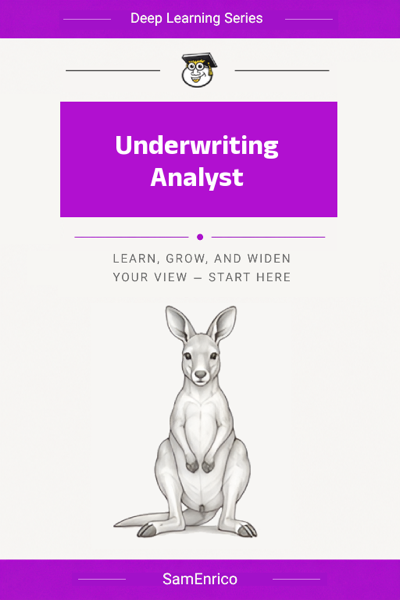
Non-FictionInformativeEducational
Underwriting Analyst eBook
A Coursebook on Underwriting Analyst
A Coursebook on Underwriting Analyst
Formats
Free sample
Chapter 1: The Great Illusion--–- The young woman across the desk had just finished her fourth interview of the week. She had a master’s degree in finance, three years of experience as a credit analyst at a regional bank, and a spreadsheet model so sophisticated it could predict equipment failure rates within a 2% margin of error. She had prepared diligently. She knew the loss ratios for the company’s commercial auto book going back seven years. She had memorized the difference between occurrence and claims-made policies.
She felt ready.Her interviewer, a senior underwriting manager with twenty-three years in the business, leaned back in his chair and asked a single question: “If I give you a $5 million binding authority tomorrow, what keeps you from losing money on every single risk you touch?”She answered with statistics. She talked about probability distributions, about the law of large numbers, about how her models would flag outliers before they became problems. The manager listened patiently, nodded, and then said something that would take her another five years to fully understand: “Models don’t lose money. People do. The question isn’t whether you can calculate risk.
The question is whether you can recognize when the person sitting across from you is lying, when the broker is manipulating the numbers, and when your own judgment is compromised by pressure to produce premium volume. That’s what this job actually is.”The young woman did not get the job that day. But she did get an education. The manager had handed her a paradox that lies at the heart of modern underwriting: we have more data, more computing power, and more sophisticated algorithms than ever before, yet the fundamental question of underwriting has not changed since the days when merchants gathered at Lloyd’s Coffee House to insure ships they would never see. The question is not “What does the model say?” The question is “Can I trust this?”This book is about that question.
It is about the art and science of underwriting analysis, a discipline that sits at the intersection of mathematics, psychology, law, and strategy. It is for people who want to move beyond the illusion that underwriting is simply about saying yes or no to applications. It is for people who understand that every policy is a bet on the future, and that the difference between a profitable book and a disastrous one lies not in the algorithm but in the analyst who interprets it.The Great Illusion of modern underwriting is that technology has made judgment obsolete. We see this illusion everywhere: in the rise of automated underwriting systems that promise instant quotes, in the proliferation of predictive models that claim to eliminate human bias, in the whispers that artificial intelligence will soon replace the underwriter altogether. This illusion is seductive because it offers the promise of certainty in an uncertain world.
If the model says the risk is acceptable, we can bind it without anxiety. If the model says decline, we can move on without guilt.But the illusion collapses the moment we encounter a risk that does not fit neatly into any category. What do you do with the manufacturing company that has perfect loss runs but a new owner with a history of bankruptcy? What do you do with the life insurance applicant who has impeccable health metrics but whose family history suggests a genetic time bomb? What do you do when the model says one thing, your gut says another, and your regional vice president is calling to ask why you are turning down a million-dollar premium?These are not hypothetical edge cases.
They are the daily reality of underwriting analysis. And they require something that no algorithm can provide: judgment informed by experience, structured by frameworks, and grounded in a deep understanding of how risk actually works in the world.This chapter is called The Great Illusion because its purpose is to shatter the myths that prevent analysts from becoming truly excellent at their craft. We will explore three foundational myths that plague the profession. We will examine the real role of the underwriting analyst in a modern insurance enterprise. And we will establish the core competencies that separate merely adequate analysts from those who consistently build profitable books of business over decades.By the end of this chapter, you will understand why underwriting analysis remains stubbornly human despite all efforts to automate it.
You will have a framework for thinking about your own development as an analyst. And you will be equipped with a practical self-assessment tool to diagnose where you stand on the spectrum from traditional underwriter to modern analyst—and where you need to go.Let us begin by naming the enemy. The enemy is not technology. The enemy is not competition from other carriers. The enemy is not even the occasional fraudulent claim.
The enemy is the comfortable belief that underwriting can be reduced to a formula.The Three Myths That Keep Analysts Average Every profession has its comforting fictions. Medicine has the belief that more tests always lead to better outcomes. Law has the belief that the most aggressive argument always wins. Underwriting has three particularly persistent myths, and they deserve to be dismantled one by one before we proceed any further.Myth One: More Data Always Means Better Decisions This myth is the favorite of spreadsheet enthusiasts and junior analysts who mistake information for insight. It rests on the plausible premise that if we simply collect enough data points—credit scores, loss runs, inspection reports, motor vehicle records—the correct decision will reveal itself like a photograph developing in a darkroom.The reality is more complicated.
More data does not automatically produce better decisions. It produces more data. And data, left to its own devices, tends to create three specific problems for the underwriting analyst.The first problem is noise. When you collect hundreds of data points on a single risk, many of them will be irrelevant, contradictory, or simply random. The human brain, hungry for pattern recognition, will find signals in that noise even when none exist.
You will convince yourself that the applicant’s credit score correlates with their claims history in ways that are statistically meaningless. You will weight minor factors as though they were major indicators. You will build elaborate rationales for decisions that are actually driven by nothing more than random variation.The second problem is paralysis. The more data you collect, the longer it takes to analyze it. In a competitive market, speed matters.
While you are waiting for the third inspection report and the fifth year of loss runs, a more agile competitor has already bound the risk, collected the premium, and moved on to the next opportunity. The perfect is the enemy of the good, and the exhaustive is the enemy of the executable.The third and most dangerous problem is false confidence. Data creates an aura of objectivity that can mask subjective errors. It is easy to convince yourself that a decision must be correct because it is “based on the data,” even when the data itself is incomplete, outdated, or misinterpreted. The analyst who trusts the data more than…
This is the end of the free sample. Get the eBook to keep going. Buy now
About this book
Details
- Author
- Williamson Christine
- Publisher
- SamEnrico
- Language
- English
- Genre
- Non-Fiction, Informative, Educational
- Released
- 2026-06-02
- Pages (approx.)
- 114
- Available as
- eBook, Audiobook

Read better in the ZLOADR app
Your eBooks on your phone or tablet. Sign in with your SamEnrico account and start reading.
More by Williamson Christine
 Passing as White ImmigrantWilliamson Christine$11.99
 Managing Virtual MeetingsWilliamson Christine$11.99
 Brainwriting 635 TechniqueWilliamson Christine$11.99
 Working Parent Anger SpilloverWilliamson Christine$11.99
 Mirroring Rapport BuildingWilliamson Christine$11.99
 Small Talk for Digital NomadsWilliamson Christine$11.99
 Dream Portal JournalWilliamson Christine$11.99
 Male Sleep Apnea RisksWilliamson Christine$11.99
 The Admiral's Crescent Moon: Yi Sun-sin and the Turtle Ships of GoryeoWilliamson Christine$11.99
 Fire and Empire: The Volcanic Legacy of the Holy Roman EmpireWilliamson Christine$11.99
 How to Produce Off-road and All-terrain Vehicle Rims and WheelsWilliamson Christine$11.99
 How to Produce Coaching Education MaterialsWilliamson Christine$11.99
You may also like
 Hong Kong Handover 1997Dunn Johnnie$11.99
 Zumba For Postnatal Recovery CourseNeal Christian$11.99
 Zumba for BeginnersLadner Nikia$11.99
 YouTube Comment Mining GuideHumes Pandora$12.99
 Worry Box MeditationCarlin Rudy$11.99
 Workplace Stress MeditationNguyen Lynn$11.99
 Workplace Stress and Sleep RepairHawley Ivory$11.99
 Workplace Perfectionism CureDelaney Jeffry$11.99
 Workplace Injustice Anger GuideWallen Isabelle$11.99
 Work Addiction and Burnout LinkGreenwood Ester$11.99
 Women in Yoga and WellnessBeattie Galina$11.99
 Women in Stand Up ComedyChun Evangeline$11.99