
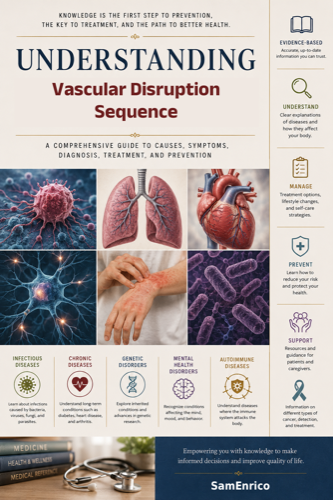
Non-FictionInformativeEducational
Understanding Vascular Disruption Sequence eBook
This disease publication, published by SamEnrico,
This disease publication, published by SamEnrico, covers Understanding Vascular Disruption Sequence
Formats
Free sample
Chapter 1: The Invisible Injury...--–- The first time Dr. Elena Vasquez saw a Vascular Disruption Sequence on an ultrasound, she almost missed it entirely. At 28 weeks gestation, the fetus appeared otherwise healthy—normal cardiac activity, appropriate growth parameters, no obvious hydrops. But the left hand, visible in profile against the uterine wall, ended at the wrist. Five tiny metacarpals were present, but no phalanges.
The fingers were simply not there. The mother, a 32-year-old primigravida with an unremarkable pregnancy, had no risk factors. No fever. No medications. No family history of birth defects.
Elena spent forty-five minutes searching for an explanation that did not exist. There was no amniotic band. No chromosomal abnormality. No teratogen. Just a hand that had formed perfectly at six weeks and then, sometime between the seventh and eighth week, lost its blood supply.
The tissue died. The body absorbed it. The pregnancy continued as if nothing had happened. That was the paradox of Vascular Disruption Sequence: something catastrophic occurred inside the womb, leaving permanent evidence on the child's body, yet the event itself was invisible to every test modern medicine could offer.This chapter establishes the foundation for everything that follows. It defines Vascular Disruption Sequence (VDS) not as a disease in the traditional sense—there is no pathogen, no progressive degeneration, no biochemical imbalance—but as an event.
A single, often unrepeatable, intrauterine vascular accident that destroys previously normal fetal tissue. Understanding this distinction is the first and most important step for clinicians, researchers, and parents alike. Because once the injury occurs, it does not worsen. It does not spread. It does not predict future illness.
The child born with a VDS-related limb difference, brain lesion, or facial cleft is not sick. The child is an otherwise healthy individual who experienced a temporary disruption of blood flow during a critical window of development. The remainder of this chapter will define VDS with precision, distinguish it from other congenital anomalies that it is frequently mistaken for, introduce the historical terminology that persists in the literature, and provide a clinical framework for recognizing VDS at the bedside.Defining the Invisible Injury Vascular Disruption Sequence is best understood as a cascade of events that begins with an interruption of fetal blood flow and ends with the destruction or absence of a body part that had already formed. The term "sequence" is critical here. In medical genetics, a sequence refers to a chain of abnormalities that stems from a single initial insult.
In VDS, the initial insult is vascular—a hemorrhage that compresses surrounding tissue, a thrombus that occludes a nutrient artery, or a period of hypoperfusion that drops pressure below what is needed to maintain cellular viability. The secondary event is ischemia, the starvation of oxygen and glucose. The tertiary event is necrosis, the death of cells that were, moments before, completely normal. The final event is resorption or reorganization, where the fetal body eliminates the dead tissue, often leaving a smooth, healed contour that can look surprisingly natural.This distinguishes VDS from malformations. A malformation is an intrinsic abnormality in the formation of a tissue, typically caused by a genetic mutation or a teratogen that disrupts development before the tissue ever achieves normal architecture.
In a malformation, the tissue never had a chance to be normal. In VDS, the tissue was normal, then it was destroyed. A helpful analogy: a malformation is like a blueprint error in the construction of a house—the wall was always going to be missing. A disruption is like a fire that burns down a wall after the house was already framed and sheathed.The distinction carries profound implications for prognosis and recurrence risk. Malformations, particularly those caused by single gene mutations or chromosomal abnormalities, often recur in future pregnancies at rates ranging from 25 to 50 percent.
VDS, being sporadic and non-hereditary, recurs at less than 2 percent in most cases, rising only when an underlying maternal thrombophilia is identified. This means that a parent who delivers a child with a VDS-related limb deficiency can be counseled with cautious optimism about future pregnancies. The tragedy is not destined to repeat itself.The Four Categories of Congenital Anomalies To fully appreciate VDS, it must be situated within the broader classification system of birth defects. This system, refined over decades by dysmorphologists and geneticists, divides anomalies into four overlapping categories: malformations, deformations, disruptions, and dysplasias. VDS occupies the disruption category, but the boundaries can be subtle, and many conditions involve more than one mechanism.Malformations are morphologic defects of an organ or body part that result from intrinsically abnormal developmental processes.
The abnormality is present from the earliest stages of formation. Examples include cleft lip due to failure of fusion of the medial nasal and maxillary processes, ventricular septal defect due to abnormal cardiac septation, and polydactyly due to ectopic signaling in the apical ectodermal ridge. Malformations can be caused by chromosomal abnormalities (trisomy 21, Turner syndrome), single gene mutations (Holt-Oram, Fanconi anemia), or environmental teratogens (isotretinoin, valproic acid). The key feature is that the tissue never developed correctly from the start.Deformations are abnormalities of form or position caused by mechanical forces acting on otherwise normal tissue. The classic example is clubfoot (talipes equinovarus) resulting from uterine constraint in oligohydramnios.
The foot is structurally normal—the bones, muscles, and nerves are all present and correctly formed—but the position has been distorted by prolonged compression. Deformations typically resolve after birth with positioning or casting, because the underlying tissue is intact.Disruptions are morphologic defects of an organ or body part that result from the breakdown of previously normal tissue. This is the category that contains VDS. Other disruptions include amniotic band sequence (where ruptured amnion wraps around fetal parts, causing constriction and amputation), gastroschisis (where vascular compromise of the abdominal wall leads to herniation of bowel), and some forms of transverse limb deficiency following chorionic villus sampling. In all disruptions, the tissue was initially normal, then destroyed.Dysplasias are abnormalities in the organization of cells into tissues, often affecting the skeleton or connective tissue systemically.
Examples include thanatophoric dysplasia (a lethal skeletal dysplasia) and osteogenesis imperfecta (brittle bone disease). Dysplasias are typically genetic and progressive.For the clinician evaluating a newborn with an unusual finding, the first question should be: was this tissue ever normal? If the answer is yes, and if the pattern is asymmetric, non-progressive, and unexplained by genetics, VDS should be high on the differential.Why "Sequence" Matters More Than "Syndrome"In medical terminology, a syndrome is a collection of anomalies that occur together and are thought to be causally related, often by a common genetic or teratogenic mechanism. Down syndrome, Marfan syndrome, and Ehlers-Danlos syndrome are examples. A sequence, by contrast, is a chain of anomalies that follows from a single initiating event.
The term "sequence" emphasizes that the anomalies are not independent; each one is a consequence of the previous one.In VDS, the sequence proceeds as follows: vascular accident → ischemia → necrosis → resorption → absence or scarring of affected tissue. If the vascular accident occurs at six weeks gestation, affecting the upper limb bud, the result may be a terminal transverse limb deficiency. If the same accident…
This is the end of the free sample. Get the eBook to keep going. Buy now
About this book
Details
- Author
- Colson Eneida
- Publisher
- SamEnrico
- Language
- English
- Genre
- Non-Fiction, Informative, Educational
- Released
- 2026-05-18
- Pages (approx.)
- 137
- Available as
- eBook, Audiobook

Read better in the ZLOADR app
Your eBooks on your phone or tablet. Sign in with your SamEnrico account and start reading.
More by Colson Eneida
 Scott Peterson Affair EvidenceColson Eneida$11.99
 Affirmation Breathing Pocket CardColson Eneida$11.99
 The Nap Timing ChronobiologyColson Eneida$11.99
 SAP ERP Outage ProtocolColson Eneida$11.99
 Czech Business GuideColson Eneida$11.99
 Tom Stoppard's Arcadia: The Play That Rewrote Time ItselfColson Eneida$11.99
 Lead QA Automation EngineerColson Eneida$11.99
 How to Become a Gas-regulator RepairerColson Eneida$11.99
 Promotion Case Mindset GuideColson Eneida$12.99
 Bubble API Integration GuideColson Eneida$12.99
You may also like
 Hong Kong Handover 1997Dunn Johnnie$11.99
 Zumba For Postnatal Recovery CourseNeal Christian$11.99
 Zumba for BeginnersLadner Nikia$11.99
 YouTube Comment Mining GuideHumes Pandora$12.99
 Worry Box MeditationCarlin Rudy$11.99
 Workplace Stress MeditationNguyen Lynn$11.99
 Workplace Stress and Sleep RepairHawley Ivory$11.99
 Workplace Perfectionism CureDelaney Jeffry$11.99
 Workplace Injustice Anger GuideWallen Isabelle$11.99
 Work Addiction and Burnout LinkGreenwood Ester$11.99
 Women in Yoga and WellnessBeattie Galina$11.99
 Women in Stand Up ComedyChun Evangeline$11.99