
Non-FictionInformativeEducational
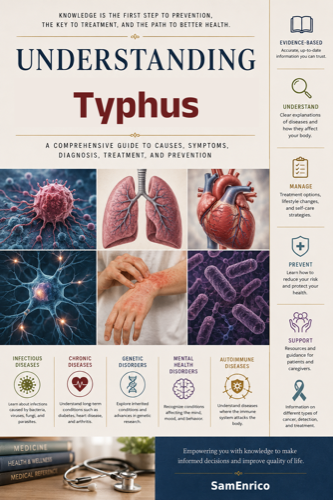
Understanding Typhus eBook
This disease publication, published by SamEnrico,
This disease publication, published by SamEnrico, covers Understanding Typhus
Formats
Free sample
Chapter 1: The Forgotten Killer...--–- The young soldier’s name was Jean-Baptiste, and he had survived fifteen battles across Europe. He had charged into cannon fire at Austerlitz, stood firm against cavalry charges at Jena, and watched his closest friend bleed out from a musket ball at Wagram. Jean-Baptiste was certain, in the way only the young and the fortunate can be, that he was immortal.On October 19, 1812, as the first snow of the Russian winter began to fall on the remnants of Napoleon’s Grande Armée, Jean-Baptiste felt a tickle at the back of his throat. He dismissed it as nothing—a scratch from the cold air, perhaps, or the dust of the long retreat. By the following morning, his head throbbed with a pain so fierce it seemed to split his skull in two.
His teeth chattered uncontrollably, not from the cold alone, but from a fever that would soon climb to 105 degrees Fahrenheit. Within forty-eight hours, a rash had bloomed across his chest—first pink, then deepening to the color of bruised plums. By the fifth day, Jean-Baptiste no longer recognized his own comrades. He mumbled nonsense about his mother, then fell silent. On the sixth day, he died.Jean-Baptiste was not killed by a Russian bullet, nor by starvation, nor by the legendary cold that would later claim thousands of Napoleon’s soldiers.
He was killed by an insect no larger than a sesame seed, carrying a bacterium so small that a million of them could fit on the head of a pin. He was killed by epidemic typhus.And he was not alone.Of the approximately 600,000 soldiers who crossed the Niemen River into Russia in June 1812, fewer than 40,000 returned to France in any condition to fight. Historians have long debated the precise numbers, but one fact remains undisputed: typhus killed more of Napoleon’s men than all the Russian military forces combined. The disease did not discriminate by rank, by courage, or by the number of battles one had survived. It swept through the Grand Army like a scythe through wheat, leaving behind a trail of frozen corpses with lice still crawling through their hair and seams.The Russian campaign was not an anomaly.
It was a pattern—one of countless moments in human history when a tiny arthropod and an even tinier microbe altered the destiny of nations. Typhus has toppled armies, emptied prisons, and turned crowded cities into charnel houses. It has accompanied every major war of the last five centuries, from the Thirty Years’ War to World War II, and it has thrived in the shadow of every famine, every refugee crisis, every collapse of social order. And yet, ask the average person today what typhus is, and you will likely receive a blank stare or a confused guess involving typhoid fever or some vague notion of “old-timey diseases.”This book exists to correct that ignorance. Because typhus is not a historical curiosity.
It is not a disease safely confined to the pages of medical textbooks or the diaries of Napoleon’s surgeons. In the past decade alone, epidemic typhus has erupted in refugee camps in Burundi, Ethiopia, and South Sudan. Endemic typhus—a milder cousin carried by fleas rather than lice—has surged in suburban Texas and Southern California, infecting hundreds of people who had never heard of the disease before their own blood tests came back positive. And lurking in the lymph nodes of elderly survivors of World War II, the bacterium Rickettsia prowazekii waits in latent hibernation, capable of reawakening as Brill-Zinsser disease and, under the right conditions, sparking a new epidemic in a population with no immunity.Typhus is the forgotten killer. This chapter, and the chapters that follow, will ensure it is forgotten no longer.The Great Confusion: Typhus vs.
Typhoid Before we can understand what typhus is, we must first understand what it is not. For much of human history, physicians confused typhus with several other feverish illnesses, most notably typhoid fever. The names themselves are a testament to this confusion: “typhus” comes from the Greek typhos, meaning “smoke” or “stupor,” referring to the characteristic clouding of consciousness that afflicts severe cases. “Typhoid” simply means “resembling typhus.” For centuries, doctors used the terms interchangeably, lumping together diseases that were, in fact, entirely different in their causes, their modes of transmission, and their treatments.The confusion was not merely academic. It had deadly practical consequences.
If you believed that typhus was spread by contaminated food or water (as typhoid is), you would focus your public health efforts on cleaning up wells and improving sewage systems—measures that would do nothing to stop an epidemic of louse-borne typhus. Conversely, if you believed that typhoid was spread by lice (as typhus is), you would waste precious resources on delousing campaigns while people continued to drink from contaminated sources.The great disentanglement of typhus and typhoid began in the early nineteenth century but was not fully resolved until the first decade of the twentieth. In 1837, the American physician William Gerhard of Philadelphia published a meticulous study comparing patients with what he called “typhus” and “typhoid” fever. He noted that typhus produced a rash that appeared early, often on the fifth day of illness, and that tended to be darker and more widespread. Typhoid, by contrast, produced a lighter, sparser rash that typically appeared later—around the eighth or ninth day.
More importantly, Gerhard observed that typhus was highly contagious among the poor and the crowded, while typhoid seemed to affect rich and poor alike. He did not yet understand the mechanisms, but he had drawn the first clear clinical distinction between the two diseases.Today, we know that typhus and typhoid are separated by fundamental biological chasms. Typhoid fever is caused by the bacterium Salmonella enterica serovar Typhi, a relative of the bacteria that cause food poisoning. It is transmitted through the fecal-oral route—that is, by consuming food or water contaminated with the feces of an infected person. It affects primarily the gastrointestinal tract, causing prolonged fever, abdominal pain, and, in severe cases, intestinal perforation and bleeding.
Typhus, as we shall see, is an entirely different animal.The Third Imitator: Malaria If the typhus-typhoid confusion was the most persistent diagnostic error of the eighteenth and nineteenth centuries, the confusion between typhus and malaria was the most understandable. Both diseases cause high fevers, severe headaches, and profound weakness. Both can be fatal if untreated. And both were, for centuries, associated with the same environmental conditions: poverty, poor sanitation, and proximity to what the Romans called mal aria—“bad air.”But malaria is no more like typhus than typhoid is. Malaria is caused not by a bacterium but by a single-celled parasite of the genus Plasmodium.
It is transmitted not by lice or fleas but by the bite of an infected female Anopheles mosquito. Its fever pattern is distinctive: unlike the steady, unremitting fever of typhus, malaria produces cyclical fevers that spike and fall every forty-eight or seventy-two hours, corresponding to the synchronized bursting of parasites from red blood cells. And while typhus attacks the blood vessels and the brain, malaria attacks the red blood cells themselves, leading to…
This is the end of the free sample. Get the eBook to keep going. Buy now
About this book
Details
- Author
- Canez Joannie
- Publisher
- SamEnrico
- Language
- English
- Genre
- Non-Fiction, Informative, Educational
- Released
- 2026-06-02
- Pages (approx.)
- 150
- Available as
- eBook, Audiobook

Read better in the ZLOADR app
Your eBooks on your phone or tablet. Sign in with your SamEnrico account and start reading.
More by Canez Joannie
 The 'Not Yet' Family GuideCanez Joannie$11.99
 Mirror Affirmations Practice CourseCanez Joannie$11.99
 We Language InfluenceCanez Joannie$11.99
 Opioid Overdose ResponseCanez Joannie$11.99
 The Concord Academy InsiderCanez Joannie$11.99
 The Last Waltz of the Ritz: Secrets of the 1974 New Year's Eve PartyCanez Joannie$11.99
 VAT Dispute ResolutionCanez Joannie$12.99
 Lagos Angel Investor GuideCanez Joannie$12.99
 Dutch Belted Cattle BreedingCanez Joannie$11.99
 Ultimate Handbook Guide to Ankang : (China) Travel GuideCanez Joannie$11.99
You may also like
 Hong Kong Handover 1997Dunn Johnnie$11.99
 Zumba For Postnatal Recovery CourseNeal Christian$11.99
 Zumba for BeginnersLadner Nikia$11.99
 YouTube Comment Mining GuideHumes Pandora$12.99
 Worry Box MeditationCarlin Rudy$11.99
 Workplace Stress MeditationNguyen Lynn$11.99
 Workplace Stress and Sleep RepairHawley Ivory$11.99
 Workplace Perfectionism CureDelaney Jeffry$11.99
 Workplace Injustice Anger GuideWallen Isabelle$11.99
 Work Addiction and Burnout LinkGreenwood Ester$11.99
 Women in Yoga and WellnessBeattie Galina$11.99
 Women in Stand Up ComedyChun Evangeline$11.99