
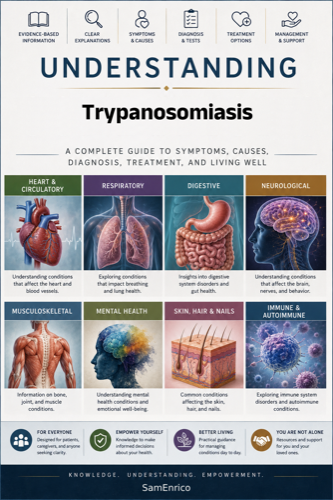
Non-FictionInformativeEducational
Understanding Trypanosomiasis eBook
This condition publication, published by SamEnrico
by Mclain Alysa
This condition publication, published by SamEnrico, covers Understanding Trypanosomiasis
Formats
Free sample
Chapter 1: The Quiet Burden--In the remote riverside village of Mambasa, deep within the Democratic Republic of the Congo’s Ituri Forest, a twelve-year-old boy named Kambale began sleeping through his morning chores. His mother, Amani, thought little of it at first—adolescents are lazy, she told herself, and the rains had been heavy, making the night air damp and conducive to long slumber. But within three weeks, Kambale was sleeping fourteen hours during the day and wandering the village paths at night, mumbling to ancestors only he could see. His younger sister found him face-down in the cassava field one afternoon, not dead but unreachable, his eyes open and rolling slowly like marbles in a bowl. Amani carried him forty kilometers on a bicycle taxi to the nearest clinic, where the nurse took one look at the swollen lymph nodes in Kambale’s neck and said a single word: “Trypanosomiasis.”Five hundred kilometers to the south, in the dusty Bolivian town of Monteagudo, a fifty-three-year-old tin miner named Hector collapsed while dancing at his daughter’s wedding.
He had felt tired for years—short of breath, his ankles swelling by evening, a persistent cough that he attributed to a lifetime of dust. His wife had urged him to see a doctor. The local physician, overworked and undersupplied, had diagnosed “chronic bronchitis” and sent him away with antibiotics. Hector’s heart, when the emergency room physicians finally visualized it on a portable ultrasound, was three times its normal size, flaccid and scarred, with a thrombus lodged in the apex like a stone in a sock. He died before midnight.
An autopsy revealed trypanosomes in the tissue of his heart muscle. He had never heard of Chagas disease. Neither had his doctor.These two stories—one African, one Bolivian; one of a child who might survive, one of a man who did not; one caused by a parasite that lives in the blood, the other by a parasite that hides inside the cells of the heart—are the dual faces of trypanosomiasis. They are separated by nine thousand kilometers, two oceans, and a scientific distinction that took nearly a century to fully understand. Yet they are bound together by a common thread: both are diseases of poverty, neglect, and invisibility.
Both afflict people who lack political power, economic resources, and access to the basic infrastructure of modern medicine. Both are classified by the World Health Organization as Neglected Tropical Diseases (NTDs), a designation that functions simultaneously as a badge of urgency and an admission of abandonment.The Two Sisters of Suffering Trypanosomiasis is not one disease but a family of diseases caused by parasitic protozoa of the genus Trypanosoma. These single-celled organisms have plagued humans and their livestock for millennia, shaping migration patterns, agricultural practices, and even the course of colonialism. The genus contains two primary species responsible for human disease: Trypanosoma brucei in Africa and Trypanosoma cruzi in the Americas. Despite their shared genus, the two could scarcely be more different.Trypanosoma brucei exists in two subspecies that matter to clinicians.
Trypanosoma brucei gambiense, found in West and Central Africa, causes a chronic form of Human African Trypanosomiasis (HAT) that progresses over months to years. This is the classical “sleeping sickness” of colonial literature—a slow dissolution of consciousness as the parasite invades the brain. Trypanosoma brucei rhodesiense, found in East and Southern Africa, causes an acute form that kills within weeks to months. The two subspecies differ not only in their clinical course but in their epidemiology: gambiense is primarily an anthroponosis (maintained by humans), while rhodesiense is a zoonosis (maintained by wild and domestic animals, particularly cattle and antelope). This distinction, as we will see repeatedly throughout this book, has profound implications for elimination strategies.Trypanosoma cruzi, the cause of American trypanosomiasis (Chagas disease), operates on a completely different biological and clinical logic.
Unlike its African cousin, which lives freely in the bloodstream and lymphatic system, cruzi invades host cells—particularly cardiac myocytes, smooth muscle cells, and neuronal cells of the enteric nervous system. It replicates within these cells as amastigotes, then bursts out to infect neighboring cells, all while evading immune detection through a combination of intracellular hiding and molecular mimicry. The result is a disease with two distinct phases: an acute phase that is often asymptomatic or mild, followed by a chronic phase that may not manifest for ten to thirty years, at which point it presents as devastating cardiomyopathy (dilated heart), megaesophagus, or megacolon. Unlike HAT, which kills quickly if untreated, Chagas disease kills slowly, silently, and often without a correct diagnosis ever being made.The Epidemiology of Neglect How many people suffer from these diseases? The answer depends on whom you ask and what they count.For Human African Trypanosomiasis, the news has been remarkably good over the past two decades.
In 1998, the WHO reported nearly 40,000 new cases of HAT, with estimates suggesting that the true number (accounting for underreporting) exceeded 300,000. Today, thanks to sustained surveillance and treatment campaigns led by the WHO, the Drugs for Neglected Diseases initiative (DNDi), Médecins Sans Frontières (MSF), and national ministries of health, the number of reported cases has fallen below 1,000 annually. In 2022, the Democratic Republic of the Congo—historically the most affected country, accounting for over 70% of cases—reported only 589 cases. This represents one of the great public health victories of the twenty-first century, almost entirely unrecognized by the global media.But these numbers conceal as much as they reveal. Active case finding (sending mobile teams into remote villages to test everyone) has been scaled back in many regions as cases have declined, raising the risk of re-emergence.
Conflict in eastern DRC, the Central African Republic, and South Sudan has disrupted surveillance and treatment programs. In the former sleeping sickness belt of Côte d’Ivoire and Ghana, no cases have been reported for a decade—but no active surveillance has been conducted either. The parasite is patient. It does not need humans; it has animal reservoirs, particularly for rhodesiense. When surveillance stops, we learn about re-emergence only when patients begin showing up at hospitals, by which time they are often in the late neurological stage.For Chagas disease, the news is sobering.
The WHO estimates that 6 to 7 million people are infected worldwide, with 75 million at risk. The vast majority of these infections occur in Latin America, from Mexico to Argentina, but Chagas has spread globally through migration. The United States has an estimated 300,000 infected residents, almost all immigrants from endemic countries. Spain has approximately 80,000. France, Italy, Japan, and Australia have smaller but significant populations.
Unlike HAT, where control has made dramatic progress, Chagas remains stubbornly entrenched. The Southern Cone Initiative—a collaborative effort launched in 1991 by Argentina, Bolivia, Brazil, Chile, Paraguay, and Uruguay—successfully interrupted vector-borne transmission by triatomine bugs (the kissing bugs) in Uruguay (1997), Chile (1999), and Brazil (2006). But transmission continues in Bolivia, Peru, Ecuador, Colombia, Venezuela, and parts of Mexico and Central America. And even where vector-borne transmission has been interrupted, congenital transmission (mother to child) continues unabated, as does transmission through blood transfusion and organ transplant in countries with inadequate screening.The Vector: Nature’s Perfect Delivery System Understanding trypanosomiasis requires understanding the…
This is the end of the free sample. Get the eBook to keep going. Buy now
About this book
Details
- Author
- Mclain Alysa
- Publisher
- SamEnrico
- Language
- English
- Genre
- Non-Fiction, Informative, Educational
- Released
- 2026-05-11
- Pages (approx.)
- 131
- Available as
- eBook, Audiobook

Read better in the ZLOADR app
Your eBooks on your phone or tablet. Sign in with your SamEnrico account and start reading.
More by Mclain Alysa
 Retail Sales PsychologyMclain Alysa$11.99
 Park Ranger Suspect TheoryMclain Alysa$11.99
 Small Talk That Actually WorksMclain Alysa$11.99
 Police Showup DangersMclain Alysa$11.99
 Inner Child Letter WritingMclain Alysa$11.99
 Overstimulation TriggersMclain Alysa$11.99
 Nightmare Rescripting Audio GuideMclain Alysa$11.99
 Note Taking For LecturesMclain Alysa$11.99
 The Master Forger of Bruges: How Han van Meegeren Fooled the WorldMclain Alysa$11.99
 The Ballerina of the Andes: The Untold Story of the First Female Chasqui RunnerMclain Alysa$11.99
 How to Produce Sport Safety Lights and ReflectorsMclain Alysa$11.99
 A Collector's Handbook to the Daimler El24Mclain Alysa$11.99
You may also like
 Hong Kong Handover 1997Dunn Johnnie$11.99
 Zumba For Postnatal Recovery CourseNeal Christian$11.99
 Zumba for BeginnersLadner Nikia$11.99
 YouTube Comment Mining GuideHumes Pandora$12.99
 Worry Box MeditationCarlin Rudy$11.99
 Workplace Stress MeditationNguyen Lynn$11.99
 Workplace Stress and Sleep RepairHawley Ivory$11.99
 Workplace Perfectionism CureDelaney Jeffry$11.99
 Workplace Injustice Anger GuideWallen Isabelle$11.99
 Work Addiction and Burnout LinkGreenwood Ester$11.99
 Women in Yoga and WellnessBeattie Galina$11.99
 Women in Stand Up ComedyChun Evangeline$11.99