
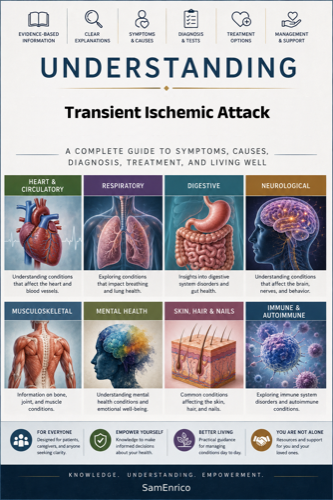
Understanding Transient Ischemic Attack eBook
This condition publication, published by SamEnrico
This condition publication, published by SamEnrico, covers Understanding Transient Ischemic Attack
Formats
Free sample
Chapter 1: The Warning Shot--The first sign that something was wrong came without warning. Margaret, a 64-year-old retired schoolteacher, was standing in her kitchen preparing dinner when her right hand suddenly felt heavy and clumsy. The knife she had been holding clattered into the sink. She tried to speak, to call out to her husband in the next room, but the words came out slurred, as if she had been drinking—though she had not touched alcohol in years. Then, as quickly as it had arrived, the sensation vanished.
Her hand worked again. Her speech cleared. She shrugged, assumed she had been tired or stressed, and finished making dinner. Three days later, Margaret suffered a massive left-sided stroke that paralyzed her right side permanently. She never returned to her classroom, never walked unaided again, and spent the remaining eight years of her life in a nursing home.Margaret’s story is not unique.
It is repeated thousands of times every year across the United States and around the world. And it is almost entirely preventable.This book is about a condition that has been misunderstood, underestimated, and mismanaged for decades. It is called a transient ischemic attack—often referred to by its acronym, TIA, or by the dangerously misleading nickname, a “mini-stroke.” That nickname is one of the greatest misnomers in all of medicine. There is nothing “mini” about a TIA. It is not a minor event.
It is not a gentle warning that allows you to schedule a doctor’s appointment at your convenience. A TIA is, in the most literal sense, a stroke that fails to complete itself—a bullet that misses its mark by millimeters, leaving the target intact but the shooter still armed and aiming again.Every year, more than 240,000 Americans experience a TIA. Among them, approximately 10 to 15 percent will suffer a full-blown, often disabling, sometimes fatal stroke within the next forty-eight hours. Another 20 percent will have a stroke within ninety days. These are not abstract statistics plucked from obscure medical journals.
They represent real people—mothers, fathers, colleagues, neighbors—who dismiss fleeting symptoms, delay seeking care, and pay for that delay with their independence, their ability to speak, their ability to walk, or their lives.The tragedy is that this devastation is almost entirely avoidable. A TIA is not a death sentence. It is not even a guaranteed precursor to disaster. It is, instead, the single greatest opportunity in all of vascular medicine to prevent a catastrophic event. No other condition offers such a clear window of intervention, such a dramatic reduction in risk with timely treatment.
When a patient with a TIA receives urgent evaluation—ideally within hours of symptom onset—the ninety-day risk of a major stroke can be driven down from nearly 20 percent to less than 2 percent. That is a tenfold reduction. Few interventions in medicine achieve such a dramatic payoff.This book will teach you everything you need to know about transient ischemic attacks: how to recognize them, how to respond when they occur, how doctors investigate their cause, and how to prevent the second, devastating hit. Whether you are a patient who has experienced a TIA, a family member caring for someone at risk, a medical student, or a practicing clinician, the information in these pages will change how you think about this condition and, more importantly, how you act when it matters most.Before we dive into the details of diagnosis and treatment, we must first confront the most dangerous misconception about TIA: the belief that transient symptoms equal trivial risk. That misconception has killed more people than the condition itself, and dismantling it is the first and most essential step toward changing outcomes.The Dangerous Myth of the "Mini-Stroke"Imagine, for a moment, that you are walking down the street and a car swerves onto the sidewalk, missing you by inches.
The driver corrects, the car returns to the road, and you are unharmed. Do you walk away thinking, “Well, that was a minor event,” and continue with your day? Of course not. You recognize that you narrowly escaped catastrophe, that the driver remains a threat, and that the conditions that caused the near-miss have not changed.A TIA is the medical equivalent of that near-miss. The clot that temporarily blocked blood flow to part of your brain dissolved or moved before it could cause permanent damage.
You are, for the moment, neurologically intact. But the underlying condition that produced that clot—whether it be an unstable plaque in your carotid artery, a paroxysmal irregular heart rhythm, or a hypercoagulable state in your blood—has not changed. It remains, waiting to produce another clot, one that might not dissolve in time.The term “mini-stroke” is dangerous precisely because it sounds reassuring. It evokes images of something small, inconsequential, perhaps even cute. There is nothing cute about a TIA.
Calling it a mini-stroke is like calling a live grenade a “minor explosive device” just because the pin is still in place. The potential for devastation is identical; the only difference is timing.Patients who experience a TIA and hear the word “mini-stroke” often delay seeking medical care. They assume that because the symptoms resolved, the danger has passed. They take an aspirin, make a mental note to mention it at their next checkup, and go about their lives. Then, hours or days later, the second clot arrives—and this time, it does not dissolve.Family members make the same mistake.
They witness a loved one suddenly unable to speak or move an arm, watch the symptoms vanish within minutes, and conclude that it must have been a fluke, a moment of low blood sugar, simple fatigue, or stress. By the time they realize their error, the window for prevention has often closed.Even some healthcare providers have historically perpetuated this misunderstanding. For decades, medical textbooks defined a TIA based solely on duration: any focal neurologic symptoms lasting less than twenty-four hours, regardless of whether tissue damage had occurred, was labeled a TIA. This time-based definition created a perverse incentive. If a patient’s symptoms resolved within an hour, they were often discharged from the emergency department with little more than an aspirin prescription and a follow-up appointment scheduled for weeks later.
Meanwhile, the clock was ticking, and the risk of a major stroke remained dangerously high.Fortunately, that era is ending, driven by a revolution in how we understand the biology of brain ischemia.The Modern Definition: A Stroke That Spares No Tissue The modern understanding of TIA is fundamentally different from the old model. It is not based on how long symptoms last, but on whether brain tissue dies. The current, tissue-based definition, endorsed by the American Heart Association and the World Stroke Organization, is this: a transient ischemic attack is a transient episode of neurologic dysfunction caused by focal brain, spinal cord, or retinal ischemia without acute infarction.Let us translate that into plain English. Ischemia means inadequate blood flow. Infarction means tissue death.
So a TIA is a temporary episode of neurological symptoms caused by a lack of blood flow to a specific area of the brain (or eye or spinal cord) that does not result in…
This is the end of the free sample. Get the eBook to keep going. Buy now
About this book
Details
- Author
- Sherrill Krysten
- Publisher
- SamEnrico
- Language
- English
- Genre
- Non-Fiction, Informative, Educational
- Released
- 2026-05-06
- Pages (approx.)
- 151
- Available as
- eBook, Audiobook

Read better in the ZLOADR app
Your eBooks on your phone or tablet. Sign in with your SamEnrico account and start reading.
More by Sherrill Krysten
 Customer Support InfluenceSherrill Krysten$11.99
 Homophobic Childhood RecoverySherrill Krysten$11.99
 Physical Discomfort TriggersSherrill Krysten$11.99
 Low Carb Food Journal MethodSherrill Krysten$11.99
 Nightmare Rescripting For AddictionSherrill Krysten$11.99
 Due Date Grief GuideSherrill Krysten$11.99
 Crime Scene Visibility FactorsSherrill Krysten$11.99
 The Phoenix Protocol: How the Library of Alexandria Burned TwiceSherrill Krysten$11.99
 Ravens and the Rune of Fate: Odin’s GambitSherrill Krysten$11.99
 How to Produce Golf FlagsSherrill Krysten$11.99
 10 Ways to Use Tamari (Recipe Book)Sherrill Krysten$11.99
 Africa Domain Registrant RightsSherrill Krysten$12.99