
Non-FictionInformativeEducational
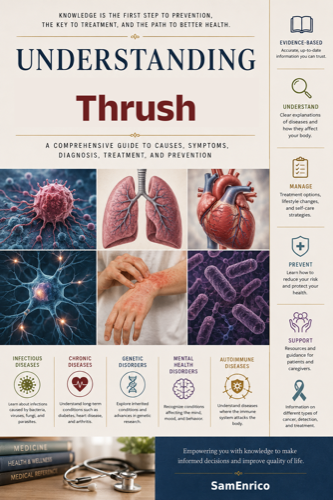
Understanding Thrush eBook
This disease publication, published by SamEnrico,
by Orta Jesica
This disease publication, published by SamEnrico, covers Understanding Thrush
Formats
Free sample
Chapter 1: The Unseen Invader...--It begins so subtly that most people don’t notice at first. A faint itch here. A slight burning sensation there. Perhaps a strange, cottony feeling in the mouth after brushing your teeth, or a patch of unexplained redness in a skin fold that you assume is just heat rash. You ignore it, hoping it will simply go away on its own.
Sometimes it does. But often, it returns—louder, more insistent, harder to ignore. And eventually, you find yourself standing in a pharmacy aisle, staring at a wall of creams, pessaries, and tablets, wondering which one will finally solve the problem. This book is written for that moment. But more importantly, it is written for every moment that follows—when the treatment works only temporarily, when the symptoms come back again and again, when you begin to feel that your own body has somehow turned against you.Thrush.
The word itself is deceptively simple. It sounds almost quaint, like something out of a folk remedy book from the nineteenth century. But for the millions of people who suffer from recurrent, chronic, or complicated candidiasis, thrush is anything but quaint. It is a condition that can undermine physical comfort, emotional well-being, sexual intimacy, and even basic daily functioning. And yet, despite its prevalence—affecting an estimated seventy-five percent of women at least once in their lives, and a significant portion of men, infants, the elderly, and the immunocompromised—thrush remains remarkably misunderstood.
Patients are routinely misdiagnosed, mistreated, or dismissed with the condescending reassurance that “everyone gets it sometimes.” Healthcare providers, overburdened and under-trained in fungal medicine, often default to a single prescription of fluconazole and a suggestion to wear cotton underwear. And when the infection returns, as it so often does, the patient is left to wonder: Is there something wrong with me? Am I doing something wrong? Is this just my life now?The answer to all of these questions is no. There is nothing wrong with you as a person.
You are not failing at hygiene or self-care. And this is not an inevitable life sentence. The problem is not you. The problem is that the standard approach to thrush is incomplete, and the information available to patients is fragmented, contradictory, and often flat-out wrong. This chapter—and this entire book—exists to change that.Let us begin with the most fundamental question of all: What is thrush, really?
Not the colloquial definition. Not the oversimplified “yeast infection” label that gets tossed around in commercials and magazine articles. But the actual biological, microbiological, immunological reality of what happens when Candida transitions from a peaceful resident of your body into an aggressive, symptom-producing invader.At its core, thrush is a fungal infection caused by an overgrowth of yeast species belonging to the genus Candida. The word “overgrowth” is critical here, because Candida is not an external pathogen that you catch from someone else—at least, not usually. Instead, Candida is what microbiologists call a commensal organism.
It lives on and inside your body all the time, typically without causing any harm. In fact, the majority of human beings carry some amount of Candida on their mucous membranes, in their gastrointestinal tracts, and on their skin. This is normal. This is expected. This is, in a strange way, even beneficial, because the presence of commensal organisms helps train your immune system and occupies ecological niches that might otherwise be colonized by more dangerous pathogens.The problem, therefore, is not the presence of Candida.
The problem is the quantity and the form that Candida takes when conditions change. Under normal circumstances, your body maintains a delicate balance among trillions of microorganisms—bacteria, fungi, viruses, and protozoa—all living together in what is collectively called the microbiome. In a healthy mouth, vagina, or gut, Candida is kept in check by beneficial bacteria (primarily Lactobacillus species in the vagina and various Streptococci in the mouth), by the physical integrity of your mucous membranes, and by your immune system’s constant surveillance. This is a dynamic, active process. Your immune system does not ignore Candida.
It continuously monitors fungal populations and deploys defense mechanisms—antimicrobial peptides, secretory Ig A antibodies, phagocytic cells like neutrophils and macrophages—to ensure that yeast remains in its harmless, single-celled form.But when that balance is disrupted, everything changes. Candida is an opportunistic pathogen, meaning it waits for an opportunity to exploit weakness. And once it senses that the immune defenses have been lowered, or that competing bacteria have been wiped out, or that the local environment has become unusually rich in sugar or estrogen, Candida undergoes a remarkable and alarming transformation. It switches from its benign, round, single-celled yeast form into a branching, filamentous form called hyphae or pseudohyphae. This is not a subtle change.
In the yeast form, Candida is small, non-invasive, and easily cleared by immune cells. In the hyphal form, it grows into long, thread-like structures that physically penetrate the cells of your mucous membranes, tearing through tissue, creating microscopic wounds, and anchoring itself so deeply that your immune system struggles to dislodge it. This morphological switch—from yeast to hypha—is the biological definition of a Candida infection. Without hyphae, you do not have thrush. You simply have colonization.
With hyphae, you have tissue invasion, inflammation, and the classic symptoms of pain, itching, burning, and discharge.This distinction between yeast and hyphae is not just academic. It explains why some people carry Candida without symptoms while others suffer tremendously. It explains why certain treatments work and others fail. And it explains why recurrent thrush is so difficult to eradicate: because once Candida learns to form hyphae in your body, it can do so again and again whenever the conditions become favorable. You are not reinfected each time from an external source.
You are experiencing a reactivation of your own resident strain, which has been waiting in its yeast form for the opportunity to transform back into its invasive, hyphal self.Now that we understand the basic biology, let us turn to the different types of thrush. The word “thrush” is often used as a catch-all term, but in clinical medicine, it refers to three distinct presentations, each with its own symptoms, complications, and treatment considerations.The first and most commonly recognized form is oral thrush, medically known as pseudomembranous candidiasis. This occurs when Candida overgrows on the mucous membranes of the mouth and throat. The classic sign is creamy white plaques that look like cottage cheese or curdled milk, typically on the tongue, inner cheeks, gums, tonsils, or the roof of the mouth. Unlike milk curds or food debris, these plaques cannot be easily wiped away; if you try to scrape them off with a tongue depressor or toothbrush, the underlying tissue may bleed, revealing a raw, red, inflamed surface.
Patients often describe a persistent cottony or dry sensation, as if they have just eaten a mouthful of crackers without drinking water. Taste is frequently affected—foods may seem metallic, bland, or just wrong. In severe cases, the infection can spread to the esophagus, causing painful swallowing, chest pain, and the sensation that food is getting stuck halfway down. Oral thrush…
This is the end of the free sample. Get the eBook to keep going. Buy now
About this book
Details
- Author
- Orta Jesica
- Publisher
- SamEnrico
- Language
- English
- Genre
- Non-Fiction, Informative, Educational
- Released
- 2026-05-11
- Pages (approx.)
- 130
- Available as
- eBook, Audiobook

Read better in the ZLOADR app
Your eBooks on your phone or tablet. Sign in with your SamEnrico account and start reading.
More by Orta Jesica
 The IBS Bathroom Anxiety GuideOrta Jesica$11.99
 High Achievers Self Doubt GuideOrta Jesica$11.99
 Incubating Solutions For Insomnia HandbookOrta Jesica$11.99
 Anger at Child’s School RefusalOrta Jesica$11.99
 The Family Relapse Prevention GuideOrta Jesica$11.99
 The Roar of the Red Sea: How Al-Ahly Stadium Defined Egyptian Football (1980-2000)Orta Jesica$11.99
 Free Keyword Research GuideOrta Jesica$12.99
 Payment Annual Review 2025Orta Jesica$12.99
 Robotic TechnicianOrta Jesica$11.99
 How to Become a Plastic-joint MakerOrta Jesica$11.99
You may also like
 Hong Kong Handover 1997Dunn Johnnie$11.99
 Zumba For Postnatal Recovery CourseNeal Christian$11.99
 Zumba for BeginnersLadner Nikia$11.99
 YouTube Comment Mining GuideHumes Pandora$12.99
 Worry Box MeditationCarlin Rudy$11.99
 Workplace Stress MeditationNguyen Lynn$11.99
 Workplace Stress and Sleep RepairHawley Ivory$11.99
 Workplace Perfectionism CureDelaney Jeffry$11.99
 Workplace Injustice Anger GuideWallen Isabelle$11.99
 Work Addiction and Burnout LinkGreenwood Ester$11.99
 Women in Yoga and WellnessBeattie Galina$11.99
 Women in Stand Up ComedyChun Evangeline$11.99