
Non-FictionInformativeEducational
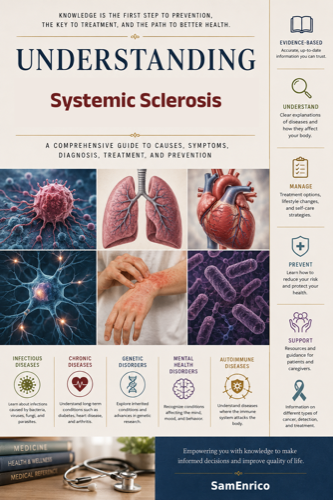
Understanding Systemic Sclerosis eBook
This disease publication, published by SamEnrico,
This disease publication, published by SamEnrico, covers Understanding Systemic Sclerosis
Formats
Free sample
Chapter 1: The Hardening Begins...--It starts with a finger. One finger, usually the index or middle finger, that turns white in the cold. Not pale like the rest of the hand, but a waxy, dead, unnatural white—as if the blood has simply vanished. The patient might notice it while reaching into the freezer for a bag of frozen vegetables, or while walking from the car to the office on a winter morning, or even while holding an iced drink on a summer afternoon. At first, it is a curiosity.
A party trick of circulation. "Look," they might say to a friend, "my finger looks like a corpse." They laugh. The friend laughs nervously. The color returns after a few minutes—first blue, then a painful, throbbing red—and life goes on.But then it spreads. A second finger.
Then both hands. Then the toes. The episodes last longer—ten minutes, twenty minutes, an hour. The pain intensifies from a mild numbness to a deep, burning ache that makes it impossible to type, cook, button a shirt, or hold a child's hand. The patient starts wearing gloves in the house.
They buy hand warmers by the case. They notice that stress triggers attacks as reliably as cold. A difficult phone call with a boss. An argument with a spouse. The announcement of a loved one's illness.
White fingers. Every time.This is how it begins for most people. Not with a dramatic collapse or a terrifying lab result, but with a quiet, creeping change in the body's most distant outposts. The fingers, those exquisitely sensitive instruments of touch and connection, become the first messengers of a disease that most people have never heard of and few doctors can confidently diagnose. By the time the patient finally sees a rheumatologist—if they are lucky enough to find one—the disease has often been quietly advancing for years, leaving a trail of subtle clues that were dismissed as "poor circulation" or "anxiety" or "Raynaud's, which is harmless, don't worry about it."Except that sometimes, Raynaud's is not harmless.
Sometimes it is the first whisper of a storm that will eventually engulf the entire body—a storm called systemic sclerosis.The Disease Without a Face Systemic sclerosis (SSc) is one of the most complex and misunderstood diseases in all of medicine. It is rare enough that most doctors will see only a handful of cases in their entire careers, yet common enough that millions of people worldwide suffer from its effects. It is an autoimmune disease, meaning the body's immune system—designed to protect against infections and cancers—instead turns its weapons inward, attacking healthy tissues. But unlike more familiar autoimmune diseases such as lupus or rheumatoid arthritis, SSc has a unique and terrifying signature: it does not just inflame; it scars. Unchecked, it transforms soft, supple tissues into hard, unyielding collagen.
The skin becomes tight as a drum. The lungs become stiff as concrete. The heart, the gut, the kidneys—all can be slowly strangled by the relentless deposition of excess connective tissue.The name itself tells a story. "Scleroderma" comes from the Greek words skleros (hard) and derma (skin). It was coined in the mid-19th century by a French physician named Guillaume Gibert, who described patients whose skin had turned to something resembling stone.
But the name has always been a problem. It focuses attention on the skin, the most visible organ, while obscuring the systemic nature of the disease. Many patients—and even some doctors—continue to believe that scleroderma is just a skin condition, like a severe form of eczema or psoriasis. They do not understand that the real threat lies beneath the surface, in the lungs that cannot expand, in the esophagus that cannot swallow, in the arteries that cannot relax, in the heart that cannot beat in rhythm.This is why the medical community now prefers the term systemic sclerosis (SSc). The word "systemic" is the crucial addition.
It signals that this is not a dermatological curiosity but a potentially fatal multi-organ disease that requires aggressive, multidisciplinary management. The skin is involved in nearly all cases, but it is not the whole story. A patient can have SSc with minimal skin changes but devastating lung disease (the "sine scleroderma" variant). Another patient can have profound skin thickening but remarkably preserved internal organ function. The heterogeneity is maddening.
No two patients are exactly alike. And because the disease is rare—affecting approximately 2.5 million people worldwide, or about 1 in 5,000 adults—research funding has historically lagged far behind that of more common autoimmune diseases like rheumatoid arthritis or lupus.The Spectrum of Suffering: Limited vs. Diffuse To make sense of this complexity, physicians classify SSc into two major subsets, plus one rare variant. These classifications are not arbitrary academic exercises. They predict prognosis, guide treatment decisions, and help patients understand what their individual journey might look like.Limited cutaneous SSc (lc SSc) is the more common form, accounting for approximately 60-70% of cases.
The name is somewhat misleading, because "limited" does not mean mild. It means that the skin thickening is restricted to certain areas: the hands, the face, the forearms, and the lower legs below the knees. The trunk—the chest, the back, the abdomen—is usually spared. The progression tends to be slow, sometimes glacially slow. A patient might have Raynaud's for a decade or more before any skin changes appear.
The face may tighten gradually over years, pulling the lips into a thin, pursed "fish mouth" appearance. The fingers may curl into a gentle, permanent flexure. But the internal organs are not necessarily spared. In fact, patients with limited disease have a strikingly high risk of developing pulmonary arterial hypertension (PAH) —a condition where the blood vessels in the lungs narrow and thicken, forcing the right side of the heart to work harder and harder until it fails. PAH is a silent killer.
It causes shortness of breath that patients often attribute to age, deconditioning, or anxiety. By the time it is diagnosed, the heart may already be irreversibly damaged.Diffuse cutaneous SSc (dc SSc) is less common but far more aggressive, accounting for 30-40% of cases. In diffuse disease, the skin thickening is widespread, involving the trunk, the upper arms, the thighs, and sometimes the entire body. The progression is rapid. A patient might develop Raynaud's in the fall, notice puffy fingers by winter, and have tight, shiny skin covering their chest and abdomen by the following spring.
The risk of internal organ involvement is much higher and occurs much earlier. The lungs, the kidneys, the heart, the gastrointestinal tract—all can be attacked within the first three to five years of diagnosis. The old teaching, now somewhat outdated but still useful as a rule of thumb, was that "what happens in the first three years defines the rest of the disease." Patients who survive the early aggressive phase with preserved organ function often stabilize or even improve over time. Patients who develop severe lung fibrosis or renal crisis in those first years have a much graver prognosis.The third variant, sine scleroderma (from the Latin sine meaning "without"), is the rarest and most confusing of all.…
This is the end of the free sample. Get the eBook to keep going. Buy now
About this book
Details
- Author
- Duckworth Latrice
- Publisher
- SamEnrico
- Language
- English
- Genre
- Non-Fiction, Informative, Educational
- Released
- 2026-06-02
- Pages (approx.)
- 143
- Available as
- eBook, Audiobook

Read better in the ZLOADR app
Your eBooks on your phone or tablet. Sign in with your SamEnrico account and start reading.
More by Duckworth Latrice
 Jacques Villeneuve Rookie ChampDuckworth Latrice$11.99
 Dreams And Burn Trauma GuideDuckworth Latrice$11.99
 Emotional Regulation For FearDuckworth Latrice$11.99
 The Grade Pressure JournalDuckworth Latrice$11.99
 The Climate Tech Business DevelopmentDuckworth Latrice$11.99
 The Silk Road to Stardom: The Forgotten Actress Who Bridged East and WestDuckworth Latrice$11.99
 Jacarandá De Brasil HarvestingDuckworth Latrice$11.99
 Research Master's to PhD BridgeDuckworth Latrice$12.99
 Pop Up Platform ComparisonDuckworth Latrice$12.99
 How to Start a Palm Kernel Crushing Business (Beginners Guide)Duckworth Latrice$11.99
You may also like
 Hong Kong Handover 1997Dunn Johnnie$11.99
 Zumba For Postnatal Recovery CourseNeal Christian$11.99
 Zumba for BeginnersLadner Nikia$11.99
 YouTube Comment Mining GuideHumes Pandora$12.99
 Worry Box MeditationCarlin Rudy$11.99
 Workplace Stress MeditationNguyen Lynn$11.99
 Workplace Stress and Sleep RepairHawley Ivory$11.99
 Workplace Perfectionism CureDelaney Jeffry$11.99
 Workplace Injustice Anger GuideWallen Isabelle$11.99
 Work Addiction and Burnout LinkGreenwood Ester$11.99
 Women in Yoga and WellnessBeattie Galina$11.99
 Women in Stand Up ComedyChun Evangeline$11.99