
Non-FictionInformativeEducational
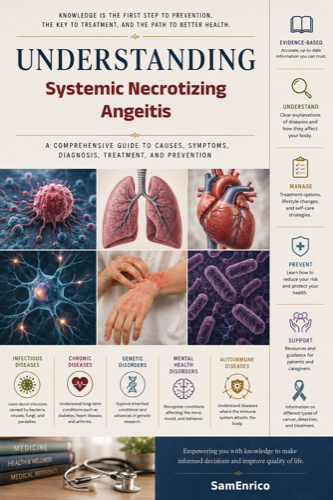
Understanding Systemic Necrotizing Angeitis eBook
This disease publication, published by SamEnrico,
by Paris Aisha
This disease publication, published by SamEnrico, covers Understanding Systemic Necrotizing Angeitis
Formats
Free sample
Chapter 1: The Longest Flu...--–- It started like a flu. Not the dramatic, fever-breaking-in-three-days kind of flu that everyone jokes about over soup, but something quieter and more sinister. A low-grade fatigue that settled into the bones like wet concrete. A persistent heaviness behind the eyes. Muscle aches that came and went without reason.
And then, one morning, the rash appeared—a latticework of purple-red spots across the ankles that did not blanch when pressed. The patient, a forty-two-year-old elementary school teacher we will call Sarah, pressed her thumb against the largest spot. It stayed purple. She showed her husband, who said it looked like a bruise. She showed her primary care doctor, who said it looked like a viral exanthem.
"Give it a week," the doctor said. "Drink fluids. Rest." Sarah gave it a week. The rash spread to her calves. Then came the numbness in her left foot—not the pins-and-needles of a sleeping limb, but a true deadness, as if the foot belonged to someone else.
Three weeks after the rash appeared, Sarah's left foot began to flop when she walked. She caught her toe on the living room rug and fell forward, catching herself with her hands. Her husband drove her to the emergency department. The emergency physician ordered an MRI of her lumbar spine, suspecting a herniated disc. The MRI was normal.
A neurologist was consulted. The neurologist performed a nerve conduction study and found something alarming: Sarah had mononeuritis multiplex, a pattern of nerve damage that affects individual peripheral nerves in an asymmetric, patchy distribution. "This is not a disc problem," the neurologist said. "This is a systemic problem." But what systemic problem? Over the next six months, Sarah would see four specialists, undergo three unnecessary procedures, and receive two incorrect diagnoses before someone finally said the word that changed everything: vasculitis.This chapter is not only Sarah's story.
It is the story of nearly every patient who will ever read this book. Systemic necrotizing angiitis—the family of diseases more commonly known today as systemic necrotizing vasculitis—is a rare group of autoimmune disorders that destroy blood vessel walls, leading to tissue death, organ failure, and, if untreated, death. But its rarity is precisely why it is so frequently misdiagnosed. The average time from first symptom to correct diagnosis for a patient with granulomatosis with polyangiitis (GPA), the most common form of necrotizing vasculitis, is between six and nine months. For microscopic polyangiitis (MPA), it is similar.
For polyarteritis nodosa (PAN) and eosinophilic granulomatosis with polyangiitis (EGPA), the delay can exceed one year. During that delay, blood vessels continue to necrose. Organs accumulate irreversible damage. Kidneys lose nephrons that will never regenerate. Nerves lose axons that will never regrow.
Lungs scar. Hearts weaken. And patients, through no fault of their own, are told again and again that their symptoms are "unexplained," "functional," or "all in their head."This book exists to end that diagnostic odyssey. It exists for the Sarahs of the world—for the patients who are living through the longest flu of their lives, for the families who watch helplessly as their loved ones deteriorate, and for the clinicians who want to recognize this disease earlier and treat it more effectively. Understanding Systemic Necrotizing Angiitis is not a textbook, though it contains textbook-level accuracy.
It is a guide, a roadmap, and a companion. It begins, as all journeys must, with the most fundamental question: What is this disease, and why does it take so long to find?The Name Itself Is a Problem Before we can understand what systemic necrotizing angiitis does to the body, we must understand what its name does to diagnosis. The term "angiitis" is derived from the Greek angeion (vessel) and the suffix -itis (inflammation). In strict histopathological terms, angiitis refers to inflammation that primarily involves the intima—the innermost layer of the blood vessel wall. "Vasculitis" is a broader term that encompasses inflammation of any layer of the vessel wall (intima, media, or adventitia).
"Arteritis" specifies inflammation of arteries specifically, excluding veins and capillaries. These distinctions matter to pathologists examining biopsy slides under a microscope. They matter far less to the patient who is bleeding into their lungs or losing sensation in their fingers.What matters is the word "necrotizing." Necrosis is not simple inflammation. Inflammation is the body's normal response to injury—redness, heat, swelling, pain. Necrosis is death.
When a blood vessel undergoes fibrinoid necrosis, its wall becomes thickened with a structureless, eosinophilic (pink-staining) material composed of deposited immune proteins, cellular debris, and dead smooth muscle cells. The vessel loses its elasticity. It loses its ability to constrict and dilate. It loses its integrity. And then one of three things happens: the vessel bulges outward like a weak spot in a garden hose, forming an aneurysm that may rupture; the vessel narrows and clots, causing thrombosis and downstream tissue death; or the vessel simply bursts, causing hemorrhage into surrounding tissues.
This is not a subtle process. It is not benign. It is destruction, pure and simple.The term "systemic" tells us that this destruction is not confined to one organ. Unlike a localized vasculitis that might affect only the skin (cutaneous small-vessel vasculitis) or only the central nervous system (primary angiitis of the central nervous system), systemic necrotizing angiitis can affect any blood vessel anywhere in the body. That is why the symptoms are so variable.
That is why the disease is so hard to recognize. And that is why the patient's journey to diagnosis is so often a tour of multiple medical specialties: dermatology (for the rash), neurology (for the neuropathy), nephrology (for the kidney failure), pulmonology (for the lung nodules), gastroenterology (for the abdominal pain), cardiology (for the heart failure), and finally rheumatology (for the unifying diagnosis).The Chapel Hill Consensus Conference: Naming the Unnameable In 1994, an international group of vasculitis experts gathered in Chapel Hill, North Carolina, to do something that had never been done before: agree on a standardized set of names and definitions for the vasculitides. Prior to the Chapel Hill Consensus Conference (CHCC), the literature on vasculitis was a Tower of Babel. The same disease was called different names by different authors. Different diseases were conflated under the same name.
Patients could not be reliably enrolled in clinical trials because investigators could not agree on who had what. The CHCC changed that.The original 1994 classification defined vasculitis based on the size of the affected blood vessel (small, medium, or large) and the presence of certain histopathological features (granulomas, eosinophils, immune complexes). It introduced the names we use today: granulomatosis with polyangiitis (Wegener's), microscopic polyangiitis, eosinophilic granulomatosis with polyangiitis (Churg-Strauss), polyarteritis nodosa, and others. It also retired several confusing or eponymous terms. The conference was revised and expanded in 2012, adding new disease entities and refining definitions based on two decades of research.Why does this matter to a patient?
Because standardized names mean standardized diagnosis. When a rheumatologist in Boston reads a biopsy report from a pathologist in Boise that says "changes consistent with granulomatosis with polyangiitis," they know exactly what that means. They know the expected clinical course. They know the evidence-based treatment protocols. They know the…
This is the end of the free sample. Get the eBook to keep going. Buy now
About this book
Details
- Author
- Paris Aisha
- Publisher
- SamEnrico
- Language
- English
- Genre
- Non-Fiction, Informative, Educational
- Released
- 2026-05-23
- Pages (approx.)
- 160
- Available as
- eBook, Audiobook

Read better in the ZLOADR app
Your eBooks on your phone or tablet. Sign in with your SamEnrico account and start reading.
More by Paris Aisha
 Attorney Billable Hour StressParis Aisha$11.99
 Dreams After Paralysis TraumaParis Aisha$11.99
 The Student Exercise GuideParis Aisha$11.99
 DBT For Law EnforcementParis Aisha$11.99
 The Climate Tech Customer SuccessParis Aisha$11.99
 The Iron Horse and the American Dream: How the Transcontinental Railroad United a NationParis Aisha$11.99
 Pop Up Locations NYC GuideParis Aisha$12.99
 Post Baccalaureate ProgramsParis Aisha$12.99
 IT Infrastructure SpecialistParis Aisha$11.99
 How to Start a Palm Oil (wholesale) Business (Beginners Guide)Paris Aisha$11.99
You may also like
 Hong Kong Handover 1997Dunn Johnnie$11.99
 Zumba For Postnatal Recovery CourseNeal Christian$11.99
 Zumba for BeginnersLadner Nikia$11.99
 YouTube Comment Mining GuideHumes Pandora$12.99
 Worry Box MeditationCarlin Rudy$11.99
 Workplace Stress MeditationNguyen Lynn$11.99
 Workplace Stress and Sleep RepairHawley Ivory$11.99
 Workplace Perfectionism CureDelaney Jeffry$11.99
 Workplace Injustice Anger GuideWallen Isabelle$11.99
 Work Addiction and Burnout LinkGreenwood Ester$11.99
 Women in Yoga and WellnessBeattie Galina$11.99
 Women in Stand Up ComedyChun Evangeline$11.99