
Non-FictionInformativeEducational
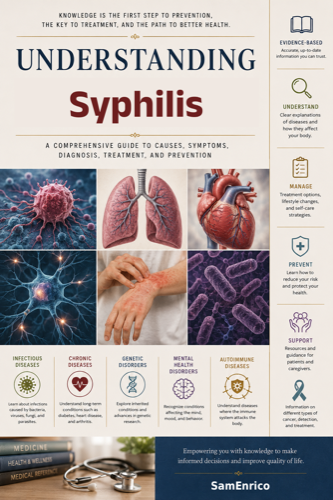
Understanding Syphilis eBook
This disease publication, published by SamEnrico,
by Enos Rema
This disease publication, published by SamEnrico, covers Understanding Syphilis
Formats
Free sample
Chapter 1: The Invisible Epidemic...--–- The text message arrived at 11:47 on a Tuesday night. "Hey, I think we need to talk. My test came back positive for something. Can you call me tomorrow?" Sarah stared at her phone, heart racing. She had been with Mark for three months.
They had used condoms most of the time, but not always. She felt fine. No sores, no rashes, no fever. Whatever "something" meant, surely she would know if she had it. She went to sleep convinced it was a mistake.The next morning, Mark told her the word: syphilis.
Sarah laughed out loud. "Isn't that a disease from the 1800s? Like something Oscar Wilde had?" She had learned about it in high school health class—a brief slide, a mention of penicillin, and a warning about "the old days." She did not know that in the year before her conversation with Mark, over 200,000 Americans received the same diagnosis. She did not know that syphilis had been quietly, relentlessly climbing for two decades. And she did not know that she was about to become one of them.This is the reality of syphilis in the twenty-first century.
It is not a ghost from the history books. It is not a disease of sailors and artists and forgotten asylums. It is a pressing, urgent, and entirely preventable public health crisis that has returned with a vengeance—and most people have no idea it is happening.The Disease You Thought Was Dead Syphilis is a systemic bacterial infection caused by a microscopic corkscrew-shaped organism called Treponema pallidum. It is transmitted primarily through sexual contact—vaginal, anal, or oral—and from a pregnant person to their fetus. That much is simple.
What makes syphilis so dangerous, so insidious, and so frequently overlooked is everything else about it.The bacterium that causes syphilis is a master of deception. It enters the body through microscopic tears in mucous membranes—the moist tissues of the mouth, genitals, and rectum—that are too small to notice. Within minutes, it begins its journey. Within hours, it reaches the bloodstream. It crosses the blood-brain barrier long before any symptoms appear.
And then it waits.Unlike most bacteria, Treponema pallidum divides very slowly. While E. coli can multiply every twenty minutes, syphilis takes thirty to thirty-three hours to complete a single division. This sluggish pace means the immune system often fails to mount an effective response. The bacteria essentially fly under the radar, camouflaging themselves with host proteins and evading detection.
By the time your body realizes there is an invader, the infection has already spread to every organ system.This biological cunning is why syphilis is known as "The Great Imitator." Its symptoms can mimic dozens of other conditions. A rash that looks like eczema. A fever that seems like the flu. Headaches that could be migraines. Hair loss that might be stress.
Joint pain that resembles arthritis. Dementia that appears to be Alzheimer's. Blindness that doctors attribute to other causes. Time and again, patients are treated for the wrong condition while syphilis quietly progresses.The Numbers That Demand Attention In the year 2000, public health officials in the United States announced an ambitious goal: eliminate syphilis entirely by 2005. Cases had fallen to historic lows, and with a cheap, effective cure available, eradication seemed within reach.
It did not happen. Instead of disappearing, syphilis began a steady, alarming climb that has not stopped.The numbers tell a stark story. In 2023, the Centers for Disease Control and Prevention reported over 200,000 new cases of syphilis in the United States—the highest number since 1950. This represents a 79% increase in just five years. The most dramatic rises have occurred in the most devastating categories: congenital syphilis, where the infection passes from parent to child during pregnancy, increased by more than 500% over the past decade.
Babies are dying of a disease that could have been prevented with a single blood test and a single shot of penicillin.The global picture is equally grim. The World Health Organization estimates that nearly 8 million adults between the ages of fifteen and forty-nine acquire syphilis each year worldwide. The disease is resurgent in high-income countries like the United States, the United Kingdom, Canada, and Australia, while remaining endemic in low- and middle-income nations where testing and treatment are less accessible. No corner of the world has been spared.One statistic is particularly chilling: the per-act transmission rate for syphilis is approximately 33%. That means if you have condomless sex with someone who has early-stage syphilis, you have a one-in-three chance of acquiring the infection.
To put that in perspective, the per-act transmission rate for HIV through receptive anal intercourse is about 1.4%. Syphilis is more than twenty times more transmissible than HIV. It spreads with terrifying efficiency.The Paradox of a Curable Epidemic Here is the central paradox of modern syphilis: we have an inexpensive, single-dose cure that has existed for over eighty years, yet rates continue to rise faster than at any point since the pre-antibiotic era. How can this be?The answer is not medical. It is behavioral, structural, and cultural.
A perfect storm of factors has allowed this disease to rebound, and understanding that storm is essential to protecting yourself.First, there is the problem of awareness. Syphilis has become a victim of its own historical narrative. Because it was once synonymous with the distant past—with mercury treatments and insane asylums and dying artists—young people today often do not consider it a present threat. In a survey conducted in 2022, only 38% of adults under thirty could correctly identify any symptom of syphilis. Most believed it was "rare" or "no longer a problem." They were wrong.Second, dating apps and geosocial networking have fundamentally changed sexual behavior.
Platforms like Grindr, Tinder, and others allow rapid partner change at unprecedented scale. A person can meet, connect, and have sex with multiple partners in a single day. This efficiency is wonderful for social connection but disastrous for sexually transmitted infection control. Contact tracing, the traditional public health method for containing outbreaks, becomes nearly impossible when partners are anonymous, fleeting, and numerous.Third, the success of HIV prevention has had an unintended consequence. The development of pre-exposure prophylaxis (Pr EP), a medication that reduces HIV acquisition risk by 99%, has led many people to stop using condoms.
This makes perfect sense from an HIV prevention standpoint—condoms are no longer the only option. But syphilis, gonorrhea, and chlamydia are not affected by Pr EP. As condom use has declined, bacterial sexually transmitted infections have surged. In some urban centers, up to 40% of men who have sex with men on Pr EP are diagnosed with a bacterial STI each year.Fourth, substance use—particularly methamphetamine and other chemsex drugs—is tightly linked to syphilis outbreaks. These substances lower inhibitions, increase sexual risk-taking, and are often associated with group sex and anonymous partners.
The overlap between the methamphetamine crisis and the syphilis surge is not coincidental.Finally, public health infrastructure has been systematically defunded for decades. Disease intervention specialists—the public health nurses who track down partners of infected individuals and ensure they receive treatment—have seen their numbers cut by 40% in some states. Clinics that once offered…
This is the end of the free sample. Get the eBook to keep going. Buy now
About this book
Details
- Author
- Enos Rema
- Publisher
- SamEnrico
- Language
- English
- Genre
- Non-Fiction, Informative, Educational
- Released
- 2026-05-25
- Pages (approx.)
- 150
- Available as
- eBook, Audiobook

Read better in the ZLOADR app
Your eBooks on your phone or tablet. Sign in with your SamEnrico account and start reading.
More by Enos Rema
 The Student Stress Relief GuideEnos Rema$11.99
 Name To Tame Emotion GuideEnos Rema$11.99
 Dream Rehearsal For Medical WorkersEnos Rema$11.99
 Kurt Busch Comeback KidEnos Rema$11.99
 The Non STEM Climate Career GuideEnos Rema$11.99
 The Battle of Khalkhin Gol: Wings Over the Steppe (1939)Enos Rema$11.99
 HTML DeveloperEnos Rema$11.99
 London Pop Up Retail GuideEnos Rema$12.99
 First Generation PhD StrategiesEnos Rema$12.99
 How to Become a SpringerEnos Rema$11.99
You may also like
 Hong Kong Handover 1997Dunn Johnnie$11.99
 Zumba For Postnatal Recovery CourseNeal Christian$11.99
 Zumba for BeginnersLadner Nikia$11.99
 YouTube Comment Mining GuideHumes Pandora$12.99
 Worry Box MeditationCarlin Rudy$11.99
 Workplace Stress MeditationNguyen Lynn$11.99
 Workplace Stress and Sleep RepairHawley Ivory$11.99
 Workplace Perfectionism CureDelaney Jeffry$11.99
 Workplace Injustice Anger GuideWallen Isabelle$11.99
 Work Addiction and Burnout LinkGreenwood Ester$11.99
 Women in Yoga and WellnessBeattie Galina$11.99
 Women in Stand Up ComedyChun Evangeline$11.99