
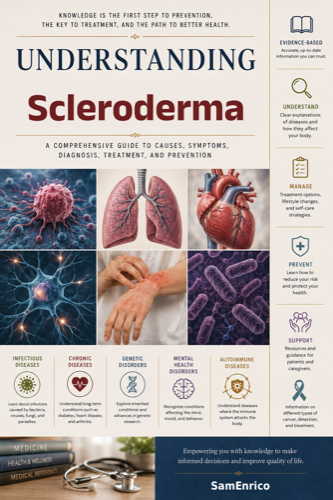
Understanding Scleroderma eBook
This disease publication, published by SamEnrico,
This disease publication, published by SamEnrico, covers Understanding Scleroderma
Formats
Free sample
Chapter 1: The Body’s Betrayal--–- At thirty-four years old, Maria was a professional violinist who had never missed a single rehearsal in twelve years. Then one winter morning, while loading her dishwasher, she watched her fingers turn white as paper, then blue as a bruise, and finally an angry, throbbing red. Her doctor told her it was stress. Her second doctor told her it was poor circulation. Her third doctor, a rheumatologist she had to wait seven months to see, looked at her fingernails through a specialized microscope and said three words that would change everything: "This is scleroderma."Maria’s story is not unique.
It is, in fact, the typical entry point for thousands of patients who will spend an average of three to five years searching for answers before receiving a correct diagnosis. During that time, they will be told they are anxious, that they have carpal tunnel syndrome, that their symptoms are "all in their head." They will be prescribed antidepressants, hand warmers, and, in the worst cases, ignored entirely. By the time a rheumatologist finally utters the word "scleroderma," the disease has often already begun its quiet, relentless work beneath the surface—thickening blood vessels, activating rogue immune cells, and depositing scar tissue in places no one can see.This chapter is not meant to frighten you. It is meant to arm you with the truth. Because here is the paradox of scleroderma: the disease is rare, but its effects are devastatingly common once you understand them.
The name itself is misleading. From the Greek skleros (hard) and derma (skin), scleroderma literally means "hard skin." But to reduce this disease to a skin condition is like calling a hurricane a light rain. The skin is merely the visible tip of an iceberg whose submerged mass can affect blood vessels, lungs, kidneys, the digestive tract, the heart, and the very fabric of how a person moves through the world.The central argument of this book—and of this opening chapter—is that understanding scleroderma requires unlearning what the name implies. You must see the skin as a window, not the whole house. You must understand that the same process that tightens a person’s hands is also stiffening their lungs, slowing their gut, and narrowing the arteries that carry oxygen to their vital organs.
And you must accept, from the very first page, that this disease does not follow rules. It is not linear. It is not predictable. It is, for many patients, a shapeshifter—appearing one way in one person and entirely differently in another.But here is the second paradox: unpredictability is not the same as powerlessness. The patients who do best with scleroderma are not those with the mildest cases.
They are those who understand the disease best. They are the ones who learn to read their own bodies, who track their own symptoms, who ask their doctors the right questions, and who refuse to be dismissed or demoralized. This book is written for those patients. It is written for Maria, and for you, and for the millions of people around the world who have been told, "There is nothing we can do."There is always something you can do. And it starts with understanding what exactly is happening inside your body.The Immune System’s Fatal Mistake To understand scleroderma, you must first understand a betrayal.
Every person is born with an immune system that functions like a highly trained army. It distinguishes friend from foe. It attacks bacteria, viruses, parasites, and cancer cells while leaving healthy tissues untouched. This is called self-tolerance, and it is one of the most remarkable achievements of human biology.In scleroderma, self-tolerance breaks down. The immune system makes a catastrophic error: it identifies the body’s own tissues as enemies and launches a full-scale attack against them.
This is not a single mistake but a cascade of errors involving multiple branches of the immune system. The result is a three-part process that doctors call the pathophysiology of scleroderma—a word that simply means "how the disease works." In plain language, scleroderma does three things at once, and they feed into one another like a fire that creates its own wind.First, it damages blood vessels. Second, it activates the immune system. Third, it overproduces collagen and other scar-forming materials.Each of these processes is dangerous alone. Together, they are devastating.The Vascular System: When Pipes Rust Shut Imagine the blood vessels of your body as a vast network of pipes.
In a healthy person, these pipes are flexible, elastic, and responsive. When you need more blood flow—while exercising, for example—the vessels widen (dilate). When you are cold, they narrow (constrict) to preserve heat. This is normal, and it is why everyone’s fingers turn a little pale in winter.In scleroderma, the innermost layer of these blood vessels—the endothelium—becomes damaged and activated. Instead of resting quietly, endothelial cells begin sending out chemical signals that attract immune cells and promote inflammation.
The blood vessels respond by narrowing excessively and staying narrowed longer than they should. Over time, the tiny capillaries that supply the fingers, toes, ears, nose, and internal organs actually disappear—a process visible only through a specialized microscope called a nailfold capillaroscope.This vascular damage is the engine that drives many of scleroderma’s most recognizable symptoms. Raynaud’s phenomenon—the painful color changes in fingers and toes that Maria experienced—is the most obvious result. But the same process is happening silently in the lungs, where narrowed arteries can lead to pulmonary arterial hypertension (PAH). It is happening in the kidneys, where damaged vessels can trigger a hypertensive emergency called scleroderma renal crisis.
It is happening in the heart, where microscopic blood vessels may fail to deliver enough oxygen to the muscle, causing fatigue, shortness of breath, and irregular heart rhythms.One of the most important insights of modern scleroderma research is that vascular damage is not merely a consequence of inflammation. It is a primary driver of the disease, occurring early—often years before skin thickening or other symptoms appear. This explains why Raynaud’s phenomenon is the first symptom in more than 90 percent of scleroderma patients. The blood vessels are sending an early warning signal. The tragedy is that most people, and even most doctors, do not recognize that signal for what it is.The Immune System’s Rogue Army The second process in scleroderma is immune dysregulation—a technical term for a simple concept: the immune system has gone rogue.In a healthy immune response, specific cells called T lymphocytes (T-cells) and B lymphocytes (B-cells) work together to identify and destroy threats.
T-cells are like intelligence officers: they recognize invaders and direct the attack. B-cells are like munitions factories: they produce antibodies that mark invaders for destruction.In scleroderma, both T-cells and B-cells become inappropriately activated. They infiltrate the skin, the lungs, the blood vessels, and other tissues. Once there, they release chemical signals called cytokines—molecules that normally coordinate immune responses but now serve as inflammatory fuel. Three cytokines in particular play starring roles: interleukin-4 (IL-4), interleukin-6 (IL-6), and transforming growth factor-beta (TGF-β).IL-4 and IL-6 recruit and activate…
This is the end of the free sample. Get the eBook to keep going. Buy now
About this book
Details
- Author
- Rafferty Kandra
- Publisher
- SamEnrico
- Language
- English
- Genre
- Non-Fiction, Informative, Educational
- Released
- 2026-06-03
- Pages (approx.)
- 159
- Available as
- eBook, Audiobook

Read better in the ZLOADR app
Your eBooks on your phone or tablet. Sign in with your SamEnrico account and start reading.
More by Rafferty Kandra
 The Mock Jury Study GuideRafferty Kandra$11.99
 Physical Medicine NaturopathyRafferty Kandra$11.99
 Divorce From Alcoholic SpouseRafferty Kandra$11.99
 Dogon Masked Dancer HogonRafferty Kandra$11.99
 The Focal Therapy Prostate GuideRafferty Kandra$11.99
 The Fires of Timbuktu: When Words Ignited the WorldRafferty Kandra$11.99
 Ghana Tracking Updates GuideRafferty Kandra$12.99
 Automobile Generations GuideRafferty Kandra$12.99
 Purchasing ClerkRafferty Kandra$11.99
 How to Become a Station Agent IRafferty Kandra$11.99