
Non-FictionInformativeEducational
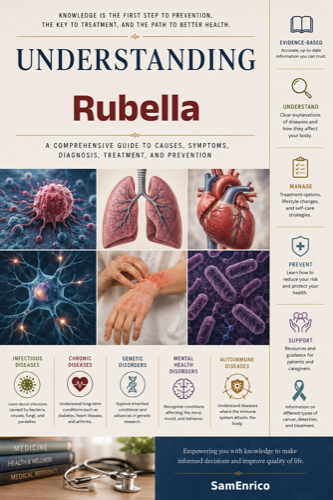
Understanding Rubella
This disease publication, published by SamEnrico,
This disease publication, published by SamEnrico, covers Understanding Rubella
Formats
About this book
Free sample
Chapter 1: The Quiet Invader...--Rubella does not announce itself with thunder. There is no violent fever, no dramatic collapse, no telltale sign that screams “Danger—stay away.” Instead, the virus slips into the body like a whisper, often so mild that those infected barely notice. A slight fever. A few pink spots that fade in three days. Perhaps nothing at all.
This is precisely what makes rubella one of the most deceptive and dangerous infectious diseases known to medicine. It preys on the very fact that it seems harmless.Yet beneath this gentle exterior lies a biological agent capable of extraordinary devastation—not to the person who carries it, but to the unborn child whose mother may never even know she was exposed. This chapter unravels the fundamental nature of rubella: what it is, how it differs from the diseases it is constantly confused with, where it still lurks in the world today, and why understanding these basics could save a life.The Virus: A Very Small Enemy Rubella is caused by a virus belonging to the Togaviridae family, genus Rubivirus. To put that in perspective, this family includes only a handful of viruses that infect humans, and rubella is the most famous among them. Under an electron microscope, the rubella virus appears as a spherical particle approximately 50 to 70 nanometers in diameter—so small that more than 200,000 of them could fit on the head of a pin.The virus carries a single strand of RNA, the genetic blueprint that allows it to hijack human cells and force them to produce millions of copies of itself.
Encasing this RNA is a protein shell called a capsid, and surrounding that is a lipid envelope studded with spike-like proteins (E1 and E2) that attach to receptors on human cells. These spikes are the keys that unlock the door to infection.Once rubella enters the body—typically through the nose or throat—it begins replicating in the respiratory tract and lymph nodes. From there, it spreads through the bloodstream to virtually every organ. In children and most adults, the immune system clears the infection within one to…
This is the end of the free sample. Get the eBook to keep going. Buy now
Contents
- Chapter 1
- Chapter 2
- Chapter 3
- Chapter 4
- Chapter 5
- Chapter 6
- Chapter 7
- Chapter 8
- Chapter 9
- Chapter 10
- Chapter 11
- Chapter 12
Details
- Author
- Mcclendon Vertie
- Publisher
- SamEnrico
- Language
- English
- Genre
- Non-Fiction, Informative, Educational
- Released
- 2026-05-11
- Pages (approx.)
- 160
- Available as
- eBook, Audiobook

Read better in the ZLOADR app
Your eBooks on your phone or tablet. Sign in with your SamEnrico account and start reading.
More by Mcclendon Vertie
 Sports Nutrition AssessmentMcclendon Vertie$11.99
 Travel Blue Zone GuideMcclendon Vertie$11.99
 The Self Hypnosis for ChemotherapyMcclendon Vertie$11.99
 Bipolar Disorder and CocaineMcclendon Vertie$11.99
 Anger Management for ConstructionMcclendon Vertie$11.99
 The Alchemists of Alexandria: Forging the Foundations of ScienceMcclendon Vertie$11.99
 Invoice Factoring vs Bank LoansMcclendon Vertie$12.99
 FinCEN Access and EnforcementMcclendon Vertie$12.99
 NFT Marketplace Business SetupMcclendon Vertie$11.99
 How to Become a Stamp-pad MakerMcclendon Vertie$11.99
You may also like
 Hong Kong Handover 1997Dunn Johnnie$11.99
 Zumba For Postnatal Recovery CourseNeal Christian$11.99
 Zumba for BeginnersLadner Nikia$11.99
 YouTube Comment Mining GuideHumes Pandora$12.99
 Worry Box MeditationCarlin Rudy$11.99
 Workplace Stress MeditationNguyen Lynn$11.99
 Workplace Stress and Sleep RepairHawley Ivory$11.99
 Workplace Perfectionism CureDelaney Jeffry$11.99
 Workplace Injustice Anger GuideWallen Isabelle$11.99
 Work Addiction and Burnout LinkGreenwood Ester$11.99
 Women in Yoga and WellnessBeattie Galina$11.99
 Women in Stand Up ComedyChun Evangeline$11.99