
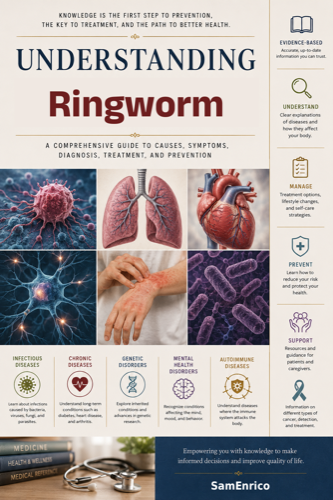
Non-FictionInformativeEducational
Understanding Ringworm eBook
This disease publication, published by SamEnrico,
by Wiley Aurea
This disease publication, published by SamEnrico, covers Understanding Ringworm
Formats
Free sample
Chapter 1: The Worm That Wasn‘t--–- On a humid summer evening in 2023, a 34-year-old elementary school teacher named Maria noticed a small, red, ring-shaped mark on her forearm. She had no memory of an insect bite or a scrape. Over the next week, the ring expanded outward while the center cleared, creating a perfect circle that looked as if someone had pressed a cookie cutter into her skin. Her grandmother told her it was a worm burrowing under her skin. Her pharmacist sold her an over-the-counter hydrocortisone cream for “rashes.” Her doctor, after a two-minute glance, prescribed a stronger steroid cream.
Nothing worked. The ring grew larger. Two more rings appeared. By the time Maria found her way to a dermatologist, she had been treating the wrong problem with the wrong medicine for nearly three months. The actual culprit was not a worm, not an allergy, and not eczema.
It was a microscopic fungus called a dermatophyte—and it was thriving precisely because everything she had been told was wrong.This book exists to ensure that you never become Maria. Whether you are reading this because you have a mysterious ring on your skin, because your child came home from school with a bald spot, because your new kitten has a patch of missing fur, or because you have battled recurring “jock itch” for years without success, the information in these pages will change how you understand this infection. The first step, however, requires unlearning something you have probably believed since childhood: the name itself. Ringworm has nothing whatsoever to do with worms. The name is a 400-year-old misunderstanding that has caused immeasurable confusion, delayed countless treatments, and led millions of people to reach for the wrong remedies.
This chapter demolishes that myth and builds in its place a solid foundation of biological truth—because without understanding what ringworm actually is, you cannot possibly understand why some treatments work and others fail.The Origin of a Terrible Name The story of how ringworm got its name begins in ancient Rome. Physicians observed circular, raised lesions on the skin that appeared to move or expand over time. They had no microscopes, no concept of fungi, and no ability to culture microorganisms. What they did have was a keen eye for pattern recognition. The lesions looked like the raised tunnels that parasitic worms create when they burrow through the skin in conditions like cutaneous larva migrans.
The logical but incorrect conclusion was that a worm caused the circular rash. The name stuck. By the 16th century, the Latin term tinea (meaning “moth” or “bookworm,” referring to the gnawing appearance of the lesion) was combined with the English word “worm” to create “ringworm.” The name persisted through the centuries, appearing in medical texts, home remedy books, and eventually television commercials for athlete‘s foot sprays. Even today, despite overwhelming evidence that no worm is involved, the name remains. It is a classic example of medical nomenclature frozen in time—a linguistic fossil that misleads every new generation.The consequences of this naming error are not merely academic.
When people believe they have a worm, they may seek deworming medications that have no effect on fungi. They may become terrified that the worm is migrating to their brain or heart. They may use topical antiseptics or antibiotics meant for bacterial infections. Or, as in Maria’s case, they may use steroid creams that suppress the body’s inflammatory response without killing the actual pathogen. Each of these mistakes allows the real fungus to spread further.
The first and most important step in understanding ringworm is to erase the word “worm” from your mental dictionary and replace it with the correct term: dermatophyte infection.The True Culprits: Meet the Dermatophytes Dermatophytes are a specialized group of fungi that have evolved to do one thing exceptionally well: digest keratin. Keratin is the tough, fibrous structural protein that makes up your skin‘s outermost layer (the stratum corneum), your hair shafts, and your fingernails and toenails. It is one of the most durable biological materials on the planet. It does not dissolve in water, resists most enzymes, and provides a formidable barrier against infection. Dermatophytes, however, produce an arsenal of enzymes called keratinases that break keratin down into absorbable nutrients.
This ability is their evolutionary niche. While other fungi decompose wood, leaves, or dead animals, dermatophytes have specialized in decomposing the dead tissue of living hosts—specifically, the skin, hair, and nails of humans and animals.It is crucial to understand that dermatophytes are not like the yeasts that cause vaginal infections or oral thrush (those are Candida species). They are not like the molds that grow on bread or in shower grout (though they are related). Dermatophytes are obligate parasites in the sense that they prefer living hosts, but they can also survive for months on dead skin cells, hair clippings, and environmental surfaces. This dual ability—to live on a host and to persist in the environment—is what makes them so difficult to eradicate from households and communal spaces like locker rooms and dormitories.There are approximately 40 species of dermatophytes that can infect humans, but the vast majority of human ringworm cases are caused by fungi belonging to just three genera.
Understanding these three groups is not merely an academic exercise; it can help you predict where the infection came from, how it might behave, and what treatment is most likely to work.Trichophyton: The most common and versatile genus. Trichophyton species are responsible for the majority of ringworm cases worldwide, including athlete‘s foot (tinea pedis), jock itch (tinea cruris), body ringworm (tinea corporis), nail infections (tinea unguium), and scalp infections (tinea capitis). Trichophyton rubrum is the single most common dermatophyte infecting humans today. It is almost exclusively human-adapted, meaning you catch it from other people rather than from animals. It causes chronic, difficult-to-treat infections that can persist for years if not properly managed.
Trichophyton tonsurans is the leading cause of scalp ringworm in children in North America. Trichophyton mentagrophytes is more often acquired from animals and tends to cause more inflammatory, aggressive infections.Microsporum: This genus is particularly associated with transmission from animals to humans. Microsporum canis is the classic “kitten ringworm” fungus. Cats—especially long-haired breeds and stray kittens—are frequent asymptomatic carriers. When a child gets ringworm from a new pet, Microsporum is often the culprit.
These infections are typically more inflammatory than Trichophyton infections, producing bright red, scaly rings that may be mistaken for allergic reactions. Importantly, Microsporum infections of the scalp often fluoresce under a Wood’s lamp (a special ultraviolet light), giving veterinarians and dermatologists a quick screening tool.Epidermophyton: The smallest and most restricted genus of the three. Epidermophyton floccosum infects only skin and nails—it never invades hair. It is a common cause of athlete‘s foot and jock itch but is not associated with scalp infections. Infections with Epidermophyton tend to be less chronic than those caused by Trichophyton rubrum and often respond well to standard treatments.The following simplified table may help you remember the differences:Genus Primary Hosts Body Sites Infected Key Feature Trichophyton Humans (mostly)Skin, hair, nails Most common; chronic infections Microsporum Animals (cats, dogs)Skin, hair…
This is the end of the free sample. Get the eBook to keep going. Buy now
About this book
Details
- Author
- Wiley Aurea
- Publisher
- SamEnrico
- Language
- English
- Genre
- Non-Fiction, Informative, Educational
- Released
- 2026-06-02
- Pages (approx.)
- 148
- Available as
- eBook, Audiobook

Read better in the ZLOADR app
Your eBooks on your phone or tablet. Sign in with your SamEnrico account and start reading.
More by Wiley Aurea
 Stress and Heart DiseaseWiley Aurea$11.99
 Eisenhower Matrix for Job SearchWiley Aurea$11.99
 Franchise Global Brand Ambassador ProgramWiley Aurea$11.99
 Eisenhower Matrix For Home RenovationWiley Aurea$11.99
 The Emotional Resilience WorkbookWiley Aurea$11.99
 Operation Iron Discipline: The Prussian War Machine UnveiledWiley Aurea$11.99
 How to Start a Nacelles for Aircraft Business (Beginners Guide)Wiley Aurea$11.99
 VAT for Freelancers GuideWiley Aurea$12.99
 Rwanda Research OpportunitiesWiley Aurea$12.99
 Mobile AdvisorWiley Aurea$11.99
You may also like
 Hong Kong Handover 1997Dunn Johnnie$11.99
 Zumba For Postnatal Recovery CourseNeal Christian$11.99
 Zumba for BeginnersLadner Nikia$11.99
 YouTube Comment Mining GuideHumes Pandora$12.99
 Worry Box MeditationCarlin Rudy$11.99
 Workplace Stress MeditationNguyen Lynn$11.99
 Workplace Stress and Sleep RepairHawley Ivory$11.99
 Workplace Perfectionism CureDelaney Jeffry$11.99
 Workplace Injustice Anger GuideWallen Isabelle$11.99
 Work Addiction and Burnout LinkGreenwood Ester$11.99
 Women in Yoga and WellnessBeattie Galina$11.99
 Women in Stand Up ComedyChun Evangeline$11.99