
Non-FictionInformativeEducational
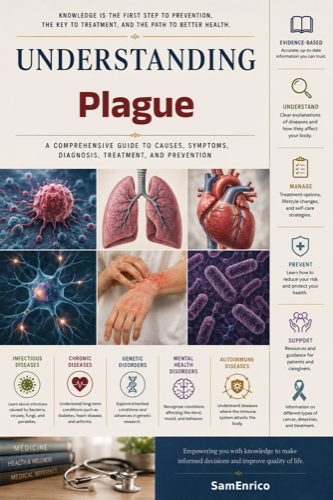
Understanding Plague eBook
This disease publication, published by SamEnrico,
This disease publication, published by SamEnrico, covers Understanding Plague
Formats
Free sample
Chapter 1: The Genetic Ninja...--On a sweltering June morning in 1894, a forty-one-year-old Swiss physician named Alexandre Yersin stepped out of a bamboo hut in Hong Kong and into medical history. He had arrived just days earlier, traveling from Paris by train and steamship, carrying little more than a microscope, a notebook, and an unshakable conviction. The British colony was in chaos. The dead were piling so fast that the living could not bury them. The streets, once crowded with merchants and sailors from every corner of the British Empire, had fallen eerily silent except for the creak of funeral carts and the distant wails of families trapped inside their own homes—doors painted with red crosses and the desperate plea, "Lord have mercy upon us."Yersin was not the only scientist racing against the clock.
Across the city, in a well-equipped laboratory at the Colonial Hospital, the renowned Japanese bacteriologist Shibasaburo Kitasato—a former student of Robert Koch, the father of modern bacteriology—worked with a team of assistants, ample funding, and the full support of the colonial government. Kitasato had already discovered the tetanus bacillus. He was, by every measure, the favorite in the race to identify the killer.But Yersin had something Kitasato lacked: a willingness to ignore conventional wisdom and a deep understanding of the disease's ecology. While Kitasato cultured samples from hospital patients who were already near death—patients whose blood was thick with secondary infections and contamination—Yersin did something audacious. He bribed a guard at the European cemetery.
In the dead of night, he exhumed the freshly buried body of a plague victim. He then extracted fluid from the buboes—the grotesque, egg-sized swellings in the armpit and groin that had become the disease's horrifying signature—and injected that fluid into laboratory rabbits.Within twenty-four hours, the rabbits were dead. And inside their bodies, Yersin found the same thing: rod-shaped bacteria, motionless, staining a distinctive bipolar "safety pin" pattern under his microscope. He had isolated the culprit. He named it Pasteurella pestis in honor of his mentor Louis Pasteur.
The name would later be changed to Yersinia pestis—a permanent monument to the quiet Swiss who outran a celebrity from a bamboo hut.This is where our story begins. Not in the Middle Ages, not in the plague pits of London, but in a laboratory at the edge of the British Empire, where science finally caught up to a killer that had stalked humanity for millennia. The bacterium that Yersin isolated in 1894 is the protagonist of this book. It is a single-celled organism, invisible to the naked eye, weighing virtually nothing. And yet, over the course of human history, it has killed more people than all wars, famines, and other infectious diseases combined—except possibly malaria and tuberculosis, and even then, the debate is close.This book is called Understanding Plague.
But to understand plague, you must first understand the microbe that causes it. You must understand its biology, its evolution, its strategies, and its weaknesses. You must understand that Yersinia pestis is not a simple bacterium. It is not a passive invader that merely multiplies until the host dies. It is an active, cunning, and remarkably sophisticated enemy—a genetic ninja, as we will call it throughout this book—that has spent millennia perfecting the art of killing humans.A Bacterium Like No Other What makes Yersinia pestis so uniquely lethal?
The answer begins with its genome. At roughly 4.6 million base pairs, the bacterium's DNA is not particularly large. In fact, it is smaller than the genome of E. coli, the harmless (and sometimes helpful) bacterium that lives in your gut. But genome size is not the measure of lethality.
What matters is what the genome encodes and how it has evolved.Yersinia pestis is a relatively recent evolutionary arrival. Its direct ancestor is a much milder bacterium called Yersinia pseudotuberculosis, which causes a minor gastrointestinal illness in humans—unpleasant but rarely fatal. At some point in the last 5,000 to 20,000 years, Y. pseudotuberculosis acquired a series of genetic mutations and extra-chromosomal DNA elements called plasmids. These plasmids are small, circular DNA molecules that can replicate independently of the bacterial chromosome.
They act like external hard drives, carrying specialized genes that the core genome does not need for everyday survival but that provide enormous advantages in specific circumstances.In the case of Y. pestis, the crucial plasmids are three: p CD1, p PCP1, and p MT1. Each one encodes a different set of weapons. Together, they transform a harmless gut bacterium into one of the deadliest pathogens known to science.The p CD1 plasmid carries the genes for the type III secretion system—a molecular syringe that Y. pestis uses to inject toxic proteins directly into human immune cells.
The p PCP1 plasmid encodes the plasminogen activator protease, an enzyme that allows the bacterium to break through tissue barriers and spread rapidly through the body. And the p MT1 plasmid carries the genes for the F1 capsule—a protein coat that protects the bacterium from being engulfed and destroyed by macrophages, the immune system's frontline defenders.But genes alone do not tell the full story. What makes Y. pestis truly terrifying is how these genetic tools are deployed in sequence. The bacterium does not simply attack the body all at once.
It follows a carefully orchestrated plan, a campaign of stealth, sabotage, and overwhelming force.The Stealth Attack: How Yersinia pestis Disarms the Immune System To understand the horror of plague, you must understand what happens in the first few hours after an infection—before any symptoms appear, before the victim even knows they have been exposed.Imagine you are a macrophage. You are a large, amoeba-like immune cell, and your job is to patrol the body, engulfing and digesting anything that does not belong—bacteria, viruses, fungi, cellular debris. You are the body's first and most important line of defense. For millions of years, your ancestors have protected your species from infection. You are good at your job.Now imagine that a flea has just bitten a human and, in the process of feeding, regurgitated a small number of Yersinia pestis bacteria into the skin.
The bacteria are few—perhaps only a hundred or so—and they are vulnerable. They have not yet multiplied. Any other bacterium, injected in such small numbers into a healthy human, would be rapidly destroyed by macrophages like you. You would engulf them, digest them, and present their fragments to other immune cells to generate a lasting defense. The infection would end before it began.But Y.
pestis is not any other bacterium.Even as you approach, the bacteria are already deploying their first countermeasure. They begin producing the F1 capsule—the protein coat encoded by the p MT1 plasmid. This capsule has two effects. First, it makes the bacterium slippery and difficult for you to grab. Second, and more importantly, it blocks the receptors that you would normally use to recognize bacteria as foreign.
You literally cannot see them. They are invisible to your primitive sensors.But you are persistent. You have other ways of detecting intruders. You sense chemical signals released by the bacteria, and even if…
This is the end of the free sample. Get the eBook to keep going. Buy now
About this book
Details
- Author
- Gaston Keesha
- Publisher
- SamEnrico
- Language
- English
- Genre
- Non-Fiction, Informative, Educational
- Released
- 2026-05-09
- Pages (approx.)
- 160
- Available as
- eBook, Audiobook

Read better in the ZLOADR app
Your eBooks on your phone or tablet. Sign in with your SamEnrico account and start reading.
More by Gaston Keesha
 The Traumatic Memory Sleep GuideGaston Keesha$11.99
 Social Media Distraction Detox WorkbookGaston Keesha$11.99
 Political Science Essay GuideGaston Keesha$11.99
 The Frugal VisionaryGaston Keesha$11.99
 Divorce and Credit ScoreGaston Keesha$11.99
 The Bloodbath of El Salvador: The 1872 Prison Massacre That Shocked Latin AmericaGaston Keesha$11.99
 QuickBooks Budgeting FeaturesGaston Keesha$12.99
 Private Equity Profiles GuideGaston Keesha$12.99
 How to Start a Operating Tables Business (Beginners Guide)Gaston Keesha$11.99
 Attic Stair Installation (Pre-fabricated)Gaston Keesha$11.99
You may also like
 Hong Kong Handover 1997Dunn Johnnie$11.99
 Zumba For Postnatal Recovery CourseNeal Christian$11.99
 Zumba for BeginnersLadner Nikia$11.99
 YouTube Comment Mining GuideHumes Pandora$12.99
 Worry Box MeditationCarlin Rudy$11.99
 Workplace Stress MeditationNguyen Lynn$11.99
 Workplace Stress and Sleep RepairHawley Ivory$11.99
 Workplace Perfectionism CureDelaney Jeffry$11.99
 Workplace Injustice Anger GuideWallen Isabelle$11.99
 Work Addiction and Burnout LinkGreenwood Ester$11.99
 Women in Yoga and WellnessBeattie Galina$11.99
 Women in Stand Up ComedyChun Evangeline$11.99