
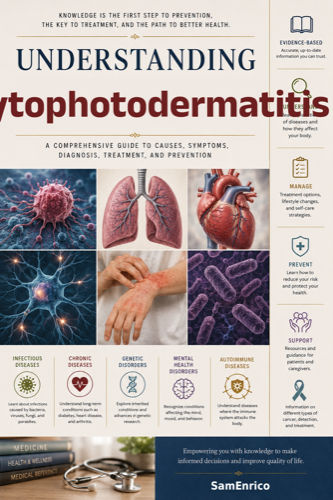
Understanding Phytophotodermatitis eBook
This disease publication, published by SamEnrico,
This disease publication, published by SamEnrico, covers Understanding Phytophotodermatitis
Formats
Free sample
Chapter 1: The Margarita Mystery...--–- The sun was blazing over a Cancún beach resort when twenty-two-year-old Sarah K. squeezed fresh limes into a pitcher of margaritas. It was a simple, joyful act—the centerpiece of a hard-earned spring break vacation. She rinsed her hands, dried them on a towel, and spent the next six hours alternating between the pool and a lounge chair, her skin slick with SPF 50 sunscreen. That night, her hands felt warm but she thought nothing of it.
The next morning, she woke to angry red streaks winding across her palms and fingers like a macabre painting. By midday, the streaks had transformed into blisters—large, fluid-filled, and exquisitely painful. She could not hold a fork. She could not button her shorts. She could not touch her own face without wincing.The resort doctor diagnosed a severe sunburn.
A second physician at a local clinic suggested an allergic reaction to something in the pool water. A third, reached by telemedicine, proposed poison ivy—despite the fact that she had not been anywhere near foliage. Sarah flew home to Ohio with her hands wrapped in gauze, terrified that she had contracted some exotic tropical disease. It took three more weeks and two dermatology appointments before she finally heard the word: Phytophotodermatitis. The lime juice, the sun, and her skin had conspired in a chemical reaction that most doctors had never been taught to recognize.Sarah's story is not an outlier.
It is the archetype of a condition that strikes thousands of people every year—gardeners, bartenders, hikers, children, chefs, and vacationers—yet remains stubbornly invisible to the medical mainstream. This chapter opens the door to that hidden world.The Case That Changed Everything Before we dissect the science, we need to understand why Phytophotodermatitis (PPD) has been called "the great masquerader" of dermatology. The condition occupies a strange clinical space: it is not rare, yet it is routinely misdiagnosed. It is not new, yet most medical textbooks devote at most a paragraph to it. It is not dangerous in most cases, yet it can produce burns severe enough to require hospitalization.The modern understanding of PPD can be traced to a series of case reports in the 1960s and 1970s, when dermatologists began noticing clusters of patients with peculiar, geometric burns.
In 1971, a Canadian physician published an account of three children who developed linear blisters on their legs after playing in a field of wild parsnip. In 1985, a Florida emergency room documented seven bartenders in a single month with identical hand burns—all from squeezing limes during their shifts. These reports established two critical facts: first, PPD follows predictable patterns; second, it is almost entirely preventable once those patterns are understood.Yet decades later, the condition remains underdiagnosed. A 2018 survey of emergency medicine physicians found that fewer than forty percent could correctly identify PPD from a photograph. Among general practitioners, the number dropped to twenty-two percent.
This is not a failure of individual doctors. It is a failure of medical education, and it is why books like this one are necessary.Defining the Beast: What PPD Actually Is Let us establish a clear, working definition. Phytophotodermatitis is a non-immunologic, phototoxic inflammatory reaction of the skin caused by concurrent exposure to photosensitizing compounds found in certain plants and ultraviolet A (UVA) radiation.Every word in that definition matters."Non-immunologic" means that PPD is not an allergy. This is perhaps the single most important concept for readers to internalize. Allergic reactions, such as poison ivy or latex allergy, require prior sensitization.
Your immune system must first be "introduced" to the allergen, often through a previous exposure, before it launches a full-blown immune response. PPD operates on a completely different principle. It does not involve antibodies, T-cells, or any form of immune memory. A person can develop PPD on their very first exposure to a plant—and the same person can develop it again and again, with no sensitization required."Phototoxic" distinguishes PPD from photoallergic reactions. In phototoxicity, the plant compound (furanocoumarin) absorbs UVA energy and transfers that energy to cellular structures, causing direct, predictable damage.
Think of it as a microscopic bomb: the compound is inert until sunlight provides the trigger. In photoallergic reactions, by contrast, the immune system must recognize the sun-altered chemical as a threat. Photoallergy is rare, idiosyncratic, and requires prior exposure. Phototoxicity is predictable, dose-dependent, and happens to anyone with sufficient exposure."Inflammatory reaction of the skin" captures the clinical outcome: redness, swelling, blistering, and pain. But unlike a thermal burn, which damages tissue through heat, PPD damages tissue through chemistry combined with radiation.The Three-Part Equation Every case of PPD can be reduced to a simple equation:Photosensitizing Plant Compound + UVA Radiation + Susceptible Skin = Phytophotodermatitis Remove any one of these three elements, and the reaction does not occur.
This equation is the foundation of everything that follows in this book, and it is worth examining each component in detail.Component One: Photosensitizing Plant Compounds. The primary culprits are a family of chemicals called furanocoumarins, with three specific molecules being the most clinically relevant: psoralen, 5-methoxypsoralen (bergapten), and 8-methoxypsoralen. These compounds are produced by plants as a natural defense mechanism against fungi, insects, and grazing animals. When a fungus attempts to colonize a lime peel, furanocoumarins punch holes in the fungal cell membranes. When an insect chews on a celery stalk, the same compounds intercalate into the insect's DNA, blocking replication.
And when human skin comes into contact with these compounds and then sunlight, the result is cellular suicide.Component Two: UVA Radiation. Not all sunlight is created equal. Ultraviolet radiation is divided into three bands: UVA (315-400 nanometers), UVB (280-315 nanometers), and UVC (100-280 nanometers). UVC is absorbed by the ozone layer and never reaches the earth's surface. UVB is responsible for standard sunburn—it is high-energy, damages the epidermis directly, and is partially blocked by most sunscreens.
But PPD is driven specifically by UVA. The furanocoumarin molecule has an absorption peak precisely in the UVA range. When UVA photons strike the molecule, they excite electrons to a higher energy state, and that energy is then transferred to oxygen molecules or directly to DNA. The specific wavelengths required—315 to 400 nanometers—are the same wavelengths that pass through clouds, glass windows, and many sunscreens. This is why people can develop PPD on overcast days, inside cars, or even behind home windows.Component Three: Susceptible Skin.
The final element is the skin itself—specifically, the presence of adequate UVA exposure on skin that has contacted furanocoumarins. Any skin is susceptible. There is no genetic predisposition, no racial variation in risk, no protective effect from age or gender. The only variable is the concentration of the plant compound and the duration and intensity of UVA exposure.Why Most Doctors Miss It Understanding why PPD goes undiagnosed requires a brief detour into medical training. Dermatology residency programs devote significant time to the most common conditions: acne, eczema, psoriasis, skin cancer, and fungal infections.
They devote moderate time to less common conditions like lupus, sarcoidosis, and blistering diseases. And they devote minimal time—often less than an hour in three years of training—to photodermatoses, the family of sun-induced skin…
This is the end of the free sample. Get the eBook to keep going. Buy now
About this book
Details
- Author
- Bryson Latoyia
- Publisher
- SamEnrico
- Language
- English
- Genre
- Non-Fiction, Informative, Educational
- Released
- 2026-05-11
- Pages (approx.)
- 150
- Available as
- eBook, Audiobook

Read better in the ZLOADR app
Your eBooks on your phone or tablet. Sign in with your SamEnrico account and start reading.
More by Bryson Latoyia
 Protector VisualizationBryson Latoyia$11.99
 The Aggressive Honk ProtocolBryson Latoyia$11.99
 The Assertiveness for Athletes GuideBryson Latoyia$11.99
 The Anabaptist Radical ReformationBryson Latoyia$11.99
 Teacher Anger ManagementBryson Latoyia$11.99
 Sunjata's Epic: The Lion King of Mali and the Battle of Kirina (1235 AD)Bryson Latoyia$11.99
 How to Start a Button Covering Business (Beginners Guide)Bryson Latoyia$11.99
 AI-Powered Digital Marketing AgencyBryson Latoyia$11.99
 Internet Backup for VAs GuideBryson Latoyia$12.99
 JEE Chemistry Shortcut GuideBryson Latoyia$12.99