
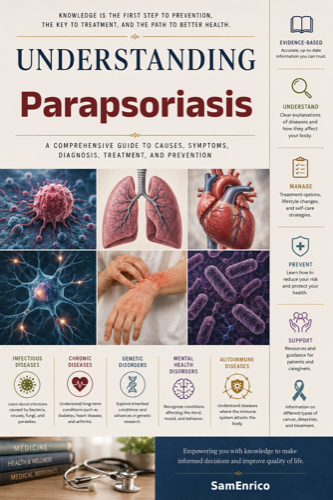
Non-FictionInformativeEducational
Understanding Parapsoriasis
This disease publication, published by SamEnrico,
This disease publication, published by SamEnrico, covers Understanding Parapsoriasis
Formats
About this book
Free sample
UNDERSTANDING PARAPSORIASISA Comprehensive Guide to Diagnosis, Treatment, and Management By Sam Enrico Revised and Consistent Edition – In-Depth Chapter Summaries (Minimum 250 Words Each)Part I: Foundations and Clinical Presentation Chapter 1: The Name That Misleads – History, Nomenclature, and Classification In-Depth Summary (Revised for Cross-References):This chapter establishes the historical and conceptual foundation for understanding parapsoriasis, beginning with its introduction by French dermatologist Louis-Anne-Jean Brocq in 1902. Brocq coined the term "parapsoriasis" – literally meaning "alongside psoriasis" – as a pragmatic placeholder for chronic, scaling skin lesions that did not fit existing diagnostic categories. The name was never intended to imply a pathogenic relationship to psoriasis, yet it has persisted for over a century, creating ongoing confusion.The chapter traces the evolution of parapsoriasis nomenclature through the twentieth century, during which the condition accumulated an impressive collection of alternative names: "chronic superficial scaly dermatitis," "digitate dermatosis," "parapsoriasis en plaques," and "xanthoerythrodermia perstans." This proliferation of terms reflected diagnostic uncertainty rather than advancing understanding, hampering both clinical research and everyday practice.A significant step toward clarity came in the 1970s and 1980s, when dermatopathologists correlated clinical presentations with histologic findings. They observed that small-plaque parapsoriasis (lesions less than 5 centimeters in diameter) typically showed mild, nonspecific inflammation on biopsy, while large-plaque parapsoriasis (lesions larger than 5 centimeters) more often demonstrated features concerning for early cutaneous T-cell lymphoma.The modern classification framework divides parapsoriasis into two main categories based on lesion diameter. (The detailed evidence for the prognostic significance of this distinction – including the specific progression risk figures – is presented in Chapter 4.) Small-plaque disease generally follows a benign course; large-plaque disease carries a substantially higher risk of progression to cutaneous T-cell lymphoma and is often viewed as a premalignant condition or an early form of mycosis fungoides.The chapter clarifies the critical distinction between parapsoriasis and true psoriasis.
Psoriasis is an immune-mediated inflammatory disease driven by the interleukin-23/interleukin-17 axis, with well-demarcated, erythematous plaques covered by thick silvery scale. Histologically, psoriasis shows regular acanthosis, elongated rete ridges, and neutrophilic collections called Munro microabscesses. Parapsoriasis lacks these features, typically showing only mild spongiosis, lymphocytic infiltration, and variable epidermal atrophy.Several controversies and unresolved…
This is the end of the free sample. Get the eBook to keep going. Buy now
Contents
- Chapter 1
- Chapter 2
- Chapter 3
- Chapter 4
- Chapter 5
- Chapter 6
- Chapter 7
- Chapter 8
- Chapter 9
- Chapter 10
- Chapter 11
- Chapter 12
Details
- Author
- Burkhart Olympia
- Publisher
- SamEnrico
- Language
- English
- Genre
- Non-Fiction, Informative, Educational
- Released
- 2026-06-02
- Pages (approx.)
- 158
- Available as
- eBook, Audiobook

Read better in the ZLOADR app
Your eBooks on your phone or tablet. Sign in with your SamEnrico account and start reading.
More by Burkhart Olympia
 Peg System for WorkoutsBurkhart Olympia$11.99
 Interview Body Language PlaybookBurkhart Olympia$11.99
 Remote Review for Marketing TeamsBurkhart Olympia$11.99
 Miscarriage and Loss TriggersBurkhart Olympia$11.99
 EdTech Capital Strategy GuideBurkhart Olympia$11.99
 The Last Stand of the Dodo: A 500-Year Extinction MysteryBurkhart Olympia$11.99
 Food WorkerBurkhart Olympia$11.99
 How to Start a Painted Steel Sheet Business (Beginners Guide)Burkhart Olympia$11.99
 Education Mentor LinkedIn GuideBurkhart Olympia$12.99
 Asia Pacific ESG Benchmark GuideBurkhart Olympia$12.99
You may also like
 Hong Kong Handover 1997Dunn Johnnie$11.99
 Zumba For Postnatal Recovery CourseNeal Christian$11.99
 Zumba for BeginnersLadner Nikia$11.99
 YouTube Comment Mining GuideHumes Pandora$12.99
 Worry Box MeditationCarlin Rudy$11.99
 Workplace Stress MeditationNguyen Lynn$11.99
 Workplace Stress and Sleep RepairHawley Ivory$11.99
 Workplace Perfectionism CureDelaney Jeffry$11.99
 Workplace Injustice Anger GuideWallen Isabelle$11.99
 Work Addiction and Burnout LinkGreenwood Ester$11.99
 Women in Yoga and WellnessBeattie Galina$11.99
 Women in Stand Up ComedyChun Evangeline$11.99