
Non-FictionInformativeEducational
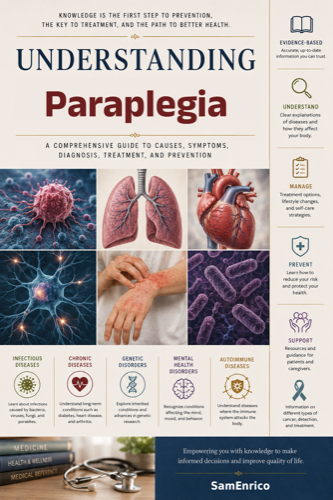
Understanding Paraplegia
This disease publication, published by SamEnrico,
This disease publication, published by SamEnrico, covers Understanding Paraplegia
Formats
About this book
Free sample
Chapter 1: Beyond the Diagnosis...--The word arrives like a weather alert you never signed up for. One moment you are driving, walking, swimming, or simply sitting in a chair that does not have wheels. The next moment, someone in sterile scrubs is using anatomical terms that sound like a foreign language: thoracic level six, incomplete lesion, anterior cord syndrome. Your legs are still attached to your body, but they feel like luggage you no longer claim. This chapter is not about cheerleading or false hope.
It is about mapping the territory so you can navigate it. You are about to learn what paraplegia actually means, what it does not mean, and why the first days of confusion are not a preview of the rest of your life.The Geography of the Spine To understand paraplegia, you must first understand the spinal cord. Think of it as a biological superhighway running from your brainstem down to your tailbone, encased within the bony vertebrae of your spinal column. This superhighway carries two types of traffic: motor signals traveling down from your brain to your muscles (telling your legs to step, your bladder to hold, your toes to curl), and sensory signals traveling up from your body to your brain (telling you that the floor is cold, your shoe is too tight, or that you have touched something sharp). When that highway is damaged at any point, the traffic stops below that point.
The higher the damage on the highway, the more exits are closed.The spinal cord is divided into four regions. The cervical region (C1 through C8) is the neck area; injuries here produce quadriplegia (also called tetraplegia), affecting arms, hands, trunk, and legs. The thoracic region (T1 through T12) corresponds to your upper and mid-back; injuries here produce paraplegia, meaning the arms and hands work normally but the trunk, legs, and internal organs below the injury level are affected. The lumbar region (L1 through L5) is your lower back; injuries here affect hip and leg function but may preserve some trunk control. The sacral region (S1 through S5) is the tailbone…
This is the end of the free sample. Get the eBook to keep going. Buy now
Contents
- Chapter 1
- Chapter 2
- Chapter 3
- Chapter 4
- Chapter 5
- Chapter 6
- Chapter 7
- Chapter 8
- Chapter 9
- Chapter 10
- Chapter 11
- Chapter 12
Details
- Author
- Ouellette Marisa
- Publisher
- SamEnrico
- Language
- English
- Genre
- Non-Fiction, Informative, Educational
- Released
- 2026-05-18
- Pages (approx.)
- 158
- Available as
- eBook, Audiobook

Read better in the ZLOADR app
Your eBooks on your phone or tablet. Sign in with your SamEnrico account and start reading.
More by Ouellette Marisa
 Cybersecurity Spending ForecastOuellette Marisa$11.99
 Affirmations For Patience WorkbookOuellette Marisa$11.99
 Remote Review for DesignersOuellette Marisa$11.99
 Leg and Foot Position Cues GuideOuellette Marisa$11.99
 Surgery Trauma TriggersOuellette Marisa$11.99
 The Vanishing Scientist: Australia's Cold War Espionage MysteryOuellette Marisa$11.99
 Finance Mentor LinkedIn GuideOuellette Marisa$12.99
 Construction and Materials ESG GuideOuellette Marisa$12.99
 Financial Systems ManagerOuellette Marisa$11.99
 How to Become a Sewer-line RepairerOuellette Marisa$11.99
You may also like
 Hong Kong Handover 1997Dunn Johnnie$11.99
 Zumba For Postnatal Recovery CourseNeal Christian$11.99
 Zumba for BeginnersLadner Nikia$11.99
 YouTube Comment Mining GuideHumes Pandora$12.99
 Worry Box MeditationCarlin Rudy$11.99
 Workplace Stress MeditationNguyen Lynn$11.99
 Workplace Stress and Sleep RepairHawley Ivory$11.99
 Workplace Perfectionism CureDelaney Jeffry$11.99
 Workplace Injustice Anger GuideWallen Isabelle$11.99
 Work Addiction and Burnout LinkGreenwood Ester$11.99
 Women in Yoga and WellnessBeattie Galina$11.99
 Women in Stand Up ComedyChun Evangeline$11.99