
Non-FictionInformativeEducational
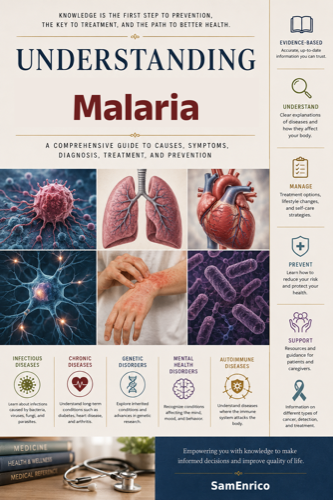
Understanding Malaria eBook
This disease publication, published by SamEnrico,
This disease publication, published by SamEnrico, covers Understanding Malaria
Formats
Free sample
Chapter 1: The Pharaoh’s Curse...--–- In the winter of 1922, Howard Carter peered through a small hole chiseled into a sealed doorway in the Valley of the Kings. Behind him, Lord Carnarvon waited impatiently. When Carter’s candle flickered in a draft of ancient air, he gasped. “Can you see anything?” Carnarvon asked. Carter’s legendary reply echoed through history: “Yes, wonderful things.” What the world remembers is the gold—the funerary mask of Tutankhamun, the alabaster jars, the chariots.
What no one noticed, for decades, was what the boy king carried inside his blood.The mummy of Tutankhamun, who died around 1323 BCE at approximately eighteen years old, underwent multiple scientific examinations throughout the twentieth century. In 2010, a team of Egyptian and German researchers published a landmark genetic study of Tutankhamun’s remains. They found evidence of multiple health problems: a cleft palate, a club foot, and the DNA of Plasmodium falciparum—the deadliest species of malaria parasite. Tutankhamun did not die from a chariot accident or murder, as some speculated. The boy king died, at least in part, from malaria.He was not alone.
When researchers began testing other Egyptian mummies, they found the same story repeated across three thousand years of pharaonic history. A study of the mummy of Ramesses V, who reigned briefly around 1145 BCE, showed unmistakable signs of smallpox. But malaria was everywhere. The parasite’s genetic signature appeared in mummies from the Old Kingdom, the Middle Kingdom, and the New Kingdom. Malaria did not merely visit ancient Egypt.
It lived there, a permanent resident in the Nile’s annual floodwaters.This discovery forces a radical rethinking of human history. We tend to imagine the past as shaped by kings, battles, inventions, and ideas. But the most powerful force in human history might be invisible to the naked eye. Malaria has killed more human beings than all the wars, famines, and natural disasters combined. It has altered the course of empires, redirected the flow of migration, and rewritten the genetic code of entire populations.
To understand humanity, you must first understand the fever.The Ancient Origins of the Parasite The story of malaria begins not in Egypt, nor in any human civilization, but deep in the forests of equatorial Africa, tens of millions of years before the first hominid walked upright. The Plasmodium genus of parasites is ancient beyond comprehension. Molecular clock studies, which use genetic mutation rates to estimate evolutionary timelines, suggest that the ancestors of modern malaria parasites first infected primates between 30 and 50 million years ago. For context, the split between Old World monkeys and apes occurred roughly 25 million years ago. The parasite was already there, waiting.The five species of Plasmodium that infect humans today each have their own evolutionary story.
Plasmodium falciparum, the deadliest, is also the most ancient in human terms. Genetic evidence indicates that P. falciparum jumped from gorillas to humans somewhere between 50,000 and 10,000 years ago, coinciding with the development of agriculture and permanent human settlements. The close relative Plasmodium vivax took a different path. Genetic analysis suggests that P.
vivax originated in Asia, likely in macaque monkeys, before adapting to humans. The other three species—P. malariae, P. ovale, and the zoonotic P. knowlesi—represent separate evolutionary branches, each with its own primate reservoir.But the parasite did not travel alone.
The Anopheles mosquito, the vector that carries Plasmodium from human to human, has an even longer evolutionary history. Fossil evidence places the Anopheles genus as far back as the Cretaceous period, 120 million years ago, when dinosaurs still walked the earth. The mosquito evolved long before the parasite it would eventually carry. The marriage between mosquito and Plasmodium is a relatively recent development in geological time—perhaps 20 to 30 million years old. But it is a marriage that has reshaped the biological world.The ancient distribution of malaria was radically different from today’s.
Before human civilization, malaria was likely a patchwork disease, restricted to tropical forests where both mosquitoes and primates were abundant. Human beings were incidental hosts, occasional victims of a parasite that primarily circulated among wild animals. Then came the agricultural revolution, around 10,000 years ago. When humans cleared forests, built villages, and created standing water in the form of irrigation canals and rice paddies, they unwittingly constructed the perfect breeding grounds for Anopheles mosquitoes. The population density of both humans and mosquitoes exploded.
Malaria, once a rare spillover infection, became a permanent human disease.The Genetic Scars of the Fever The most powerful evidence of malaria’s ancient grip on humanity is written not in history books but in our own DNA. When a disease exerts intense evolutionary pressure on a population over many generations, genetic adaptations emerge—mutations that confer some measure of protection, though often at a cost. Malaria has left deeper genetic scars on the human genome than any other infectious disease, including tuberculosis, smallpox, and plague.The most famous of these adaptations is the sickle cell trait. Sickle cell disease is caused by a single mutation in the gene that produces hemoglobin, the oxygen-carrying protein in red blood cells. People who inherit two copies of the sickle cell mutation (one from each parent) suffer from severe, often fatal anemia.
But people who inherit only one copy—known as sickle cell trait—experience a remarkable benefit: they are partially protected against severe malaria. The reason is mechanical. When Plasmodium parasites infect a red blood cell containing sickle hemoglobin, the cell deforms and ruptures prematurely, killing the parasite inside. The mutation is so effective at protecting against malaria that it has arisen independently in multiple populations across Africa, the Middle East, and India.But sickle cell trait is only the most visible scar. There are dozens of other malaria-related adaptations scattered throughout the human genome.
G6PD deficiency, the most common enzyme deficiency on earth, affects an estimated 400 million people. The mutation makes red blood cells more vulnerable to oxidative stress—but also less hospitable to Plasmodium. Thalassemias, another family of hemoglobin disorders, follow the same pattern: two copies cause disease, one copy provides protection. The Duffy antigen, a protein on the surface of red blood cells, is absent in most people of West African descent. This absence confers complete resistance to Plasmodium vivax, which uses the Duffy protein to invade cells.
Even the prevalence of HLA (human leukocyte antigen) variants—immune system genes that help the body recognize foreign invaders—has been shaped by malaria.The geographic distribution of these genetic adaptations tells a clear story. Malaria has been most intense and most ancient in sub-Saharan Africa, and indeed, the greatest diversity of malaria-protective mutations is found there. Sickle cell trait reaches frequencies of 20 to 30 percent in parts of West and Central Africa. G6PD deficiency is similarly common. Outside of Africa, in regions where malaria arrived later or was less intense, the genetic scars are fewer.
This pattern is not random. It is the fossil record of an evolutionary war that has been fought for millennia.What makes this war unique in human history is its duration and intensity. The Black Death, for all its terror, lasted only a few years in any given location. The 1918 influenza pandemic killed tens of millions…
This is the end of the free sample. Get the eBook to keep going. Buy now
About this book
Details
- Author
- Spivey Kamala
- Publisher
- SamEnrico
- Language
- English
- Genre
- Non-Fiction, Informative, Educational
- Released
- 2026-05-23
- Pages (approx.)
- 144
- Available as
- eBook, Audiobook

Read better in the ZLOADR app
Your eBooks on your phone or tablet. Sign in with your SamEnrico account and start reading.
More by Spivey Kamala
 Athlete Body Image RecoverySpivey Kamala$11.99
 Depreciation for Rental PropertySpivey Kamala$11.99
 Assertiveness For Restaurant ComplaintsSpivey Kamala$11.99
 The Social Awareness HandbookSpivey Kamala$11.99
 Managing Anxiety with Emotional IntelligenceSpivey Kamala$11.99
 The Hollow Tower: Merlin’s Forgotten CitadelSpivey Kamala$11.99
 Strategy Meeting Participant PrepSpivey Kamala$12.99
 Invoice Exception Resolution GuideSpivey Kamala$12.99
 Maintenance Mechanic SupervisorSpivey Kamala$11.99
 How to Become a Separator Tender IiSpivey Kamala$11.99
You may also like
 Hong Kong Handover 1997Dunn Johnnie$11.99
 Zumba For Postnatal Recovery CourseNeal Christian$11.99
 Zumba for BeginnersLadner Nikia$11.99
 YouTube Comment Mining GuideHumes Pandora$12.99
 Worry Box MeditationCarlin Rudy$11.99
 Workplace Stress MeditationNguyen Lynn$11.99
 Workplace Stress and Sleep RepairHawley Ivory$11.99
 Workplace Perfectionism CureDelaney Jeffry$11.99
 Workplace Injustice Anger GuideWallen Isabelle$11.99
 Work Addiction and Burnout LinkGreenwood Ester$11.99
 Women in Yoga and WellnessBeattie Galina$11.99
 Women in Stand Up ComedyChun Evangeline$11.99