
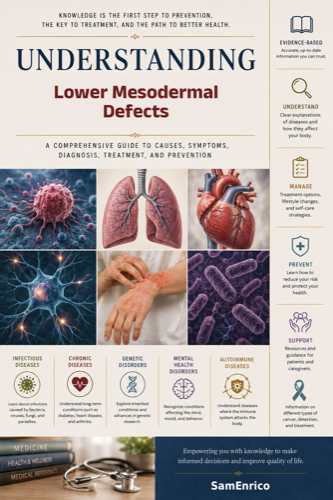
Understanding Lower Mesodermal Defects eBook
This disease publication, published by SamEnrico,
This disease publication, published by SamEnrico, covers Understanding Lower Mesodermal Defects
Formats
Free sample
Chapter 1: The Unseen Map...–- On a Tuesday morning in March, a thirty-two-year-old graphic designer named Mia Chen sat in a darkened ultrasound room, watching a wand glide over her swollen belly. The technician’s face remained professionally neutral, but Mia had spent enough years reading human expression to notice the pause—that fractional hesitation where the wand backtracked over the same spot, the way the tech’s fingers tapped the keyboard faster than necessary. “We’ll just get some more images,” the technician said. “The doctor will review everything.” Mia nodded, but her husband David later admitted that in that moment, he already knew something was wrong. He couldn’t name it.
He just felt the air change. Three hours later, a perinatologist sat across from them with a clipboard and a diagnosis that sounded less like medicine and more like poetry: “Your baby has a sequence of anomalies involving the lower part of the body that formed very early in pregnancy.” She used words like mesoderm, cloaca, and sacral agenesis. She said the kidneys might not be normal. She said the spine might be incomplete. She said, “We need to do more tests.” Mia drove home in silence, the term “lower mesodermal defects” playing on a loop in her head.
She had never heard of it. Neither had David. Neither, as they would soon discover, had most of their friends, their family, or even their regular obstetrician. This is the story of that diagnosis—not just Mia’s story, but the story of every family who has ever sat in that darkened room and heard a name for something they could not see, could not fix, and could not fully understand.The Anatomy of Ignorance Lower Mesodermal Defects (LMD) occupy a strange place in medical literature. They are simultaneously common enough to warrant systematic study and rare enough that most clinicians will encounter only one or two cases in an entire career.
The term itself is a cartographic label—a name for a territory that was only fully mapped in 1994, when Dr. Richard M. Pauli and his colleagues at the Wisconsin Stillbirth Service Program (Wis SIP) published a cohort analysis that, for the first time, recognized a recurring pattern of anomalies affecting the caudal (lower) half of the developing human body. Before Pauli, these defects were scattered across different specialty journals: urologists wrote about bladder exstrophy, pediatric surgeons wrote about imperforate anus, orthopedists wrote about sacral agenesis, and reproductive endocrinologists wrote about Müllerian agenesis. No one had connected them.
No one had asked why the same baby might have all four.The answer, when it came, was elegantly simple and devastatingly complex: all of these structures—the kidneys and ureters, the bladder and urethra, the uterus and vagina, the lower spine and sacrum, the anus and rectum—derive from a single embryonic source. They are not separate systems that happen to fail together by coincidence. They are different rooms in the same house. If the foundation cracks during a specific week of construction, every room on that floor will show damage. That foundation is the lower mesoderm.
The critical construction window is weeks four through seven of gestation. And the damage, when it occurs, produces what dysmorphologists call a sequence: a cascade of anatomical consequences that unfold from a single initial insult.Sequence Versus Syndrome: A Crucial Distinction Before going further, we need to understand a piece of medical vocabulary that will appear throughout this book. The distinction between a sequence, a syndrome, and an association is not academic pedantry. It is the difference between understanding why your child’s body looks the way it does versus simply listing the things that are wrong.A syndrome (from the Greek syn meaning “together” and dramein meaning “to run”) refers to a set of anomalies that occur together because they share a single underlying cause, usually a specific genetic mutation or chromosomal abnormality. Down syndrome, for example, is caused by trisomy 21.
Marfan syndrome is caused by a mutation in the FBN1 gene. If you have the cause, you can predict the pattern of anomalies with reasonable accuracy.An association is a weaker connection. Anomalies occur together more often than chance would predict, but no single cause has been identified. The most famous example is VACTERL association (Vertebral, Anal, Cardiac, Tracheo-Esophageal, Renal, Limb). Two babies with VACTERL may share several anomalies, but the specific combination differs.
One might have vertebral defects and an imperforate anus but normal kidneys; another might have renal agenesis and a cardiac defect but a normal spine. The term “association” is a placeholder—a confession that we see a pattern but do not yet understand its mechanism.A sequence is different. In a sequence, a single initial anomaly triggers a chain reaction of secondary effects. Think of a domino fall. The classic example is Pierre Robin sequence: a small mandible (jaw) causes the tongue to be positioned abnormally high, which prevents the palatal shelves from closing, which results in a cleft palate.
The cleft palate did not occur independently. It is the last domino, not the first.Lower Mesodermal Defects operate as a sequence. The initial insult—whether genetic, vascular, or environmental—occurs during weeks four to seven of embryonic development and disrupts the formation of the caudal mesoderm. That disruption produces primary anomalies in the structures derived from that mesoderm: the kidneys, ureters, bladder, internal and external genitalia, lower spine, and hindgut. But then those primary anomalies cause secondary effects.
Renal agenesis leads to oligohydramnios (low amniotic fluid), which leads to pulmonary hypoplasia (underdeveloped lungs) and Potter facies (flattened nose, low-set ears, micrognathia). Imperforate anus leads to colonic distension and, if unrecognized, perforation. Bladder exstrophy leads to chronic urinary tract infections and renal scarring. The sequence is both the cause and the cascade.The Pauli Paper: A Retrospective Landmark The 1994 Wis SIP paper remains the foundational text for understanding LMD. Pauli and his team reviewed 103 cases of stillbirths and neonatal deaths with anomalies affecting the caudal structures.
They identified a subset of 47 cases that could not be classified as VACTERL, caudal regression, sirenomelia, or any other named condition. These 47 cases shared a specific pattern: renal anomalies (agenesis, dysplasia, or horseshoe kidney), genital anomalies (ambiguous genitalia, vaginal atresia, cryptorchidism), lower gastrointestinal anomalies (imperforate anus, rectal atresia), and vertebral anomalies (sacral agenesis, hemivertebrae). None had the cardiac, limb, or tracheoesophageal defects that would have pointed to VACTERL. None had the maternal diabetes or lower limb fusion of caudal regression. They were, Pauli argued, a distinct entity.The paper was meticulous.
It classified defects by severity, documented associated findings (single umbilical artery, adrenal hypoplasia, pulmonary hypoplasia), and provided recurrence risk estimates (low, suggesting sporadic occurrence). It also noted something that would prove critically important for later researchers: most of the affected fetuses were stillborn or died shortly after birth. The Pauli cohort was an autopsy cohort. It told us what LMD looked like at the end of life. It could not tell us what LMD looked like in a ten-year-old, or a twenty-year-old, or a parent.This is not a criticism of Pauli’s work—it was the best possible science given the data available in 1994.
But it created a selection bias that persists in the medical literature to this day. When clinicians search for “lower…
This is the end of the free sample. Get the eBook to keep going. Buy now
About this book
Details
- Author
- Elias Adriana
- Publisher
- SamEnrico
- Language
- English
- Genre
- Non-Fiction, Informative, Educational
- Released
- 2026-05-11
- Pages (approx.)
- 153
- Available as
- eBook, Audiobook

Read better in the ZLOADR app
Your eBooks on your phone or tablet. Sign in with your SamEnrico account and start reading.
More by Elias Adriana
 Religious Shame Childhood Origins WorkbookElias Adriana$11.99
 The 4 7 8 Breath MethodElias Adriana$11.99
 The Digital Nomad Visa PlaybookElias Adriana$11.99
 DoorDash Delivery StrategyElias Adriana$11.99
 Door Open Questions GuideElias Adriana$11.99
 The Last Oracle of Delphi: When Prophecy Shaped EmpiresElias Adriana$11.99
 How to Become a Lane-marker InstallerElias Adriana$11.99
 Non Resident LLC Formation DocumentsElias Adriana$12.99
 Grocery Delivery AdoptionElias Adriana$12.99
 Four WheelingElias Adriana$11.99